
Why Seamless Tube Production Is One of India’s Most Compelling Business Ideas
India’s goal of infrastructure development is on a full throttle. There’s no application where failure isn’t a concern, and there are no products as important as oil and gas pipelines, power plant boilers, automotive axles, aerospace assemblies, chemical reactors — and no place where a weld failure isn’t an option. Seamless tube manufacturing is a viable business venture as it has good industrial demand, export potentials and real government support when compared to other business ideas.
Seamless tubes are manufactured from a solid billet, not welded, no weak point, unlike welded tubes. This structural superiority makes them essential in applications with high-pressure, high-temperature and corrosion. The demand is rising where India has the most aggressive expansion plans – energy, defence, railways, petrochemicals and nuclear power. However, domestic production is still not meeting demand which means there is a significant import deficit that enterprising manufacturers can exploit.
This article analyzes the seamless tube production business in India in detail based on the available data providing a detailed outlook on the market opportunity, government incentives, various business models, trade dynamics and lessons learnt from the most successful MSME stories in this space in India.
View Full Project Details: Seamless Tubes Manufacturing Project Report
Why Seamless Tube Production Is a High-Growth Sector Right Now
The global seamless tube and pipe market is estimated at more than USD 100 billion and is expected to grow at a moderate CAGR mainly due to the investments in energy infrastructure, urbanisation and defence modernization. This is the worldwide picture and, in some areas, India’s domestic demand outstrips it. India’s steel demand growth has been surpassing many developed economies, with finished steel demand posting a solid year-over-year growth due to infrastructural and manufacturing activity, as mentioned in IBEF Indian Steel Sector Report.
Multi-Sector Demand: The Core Strength
Seamless production of tubes is especially strong as a manufacturing investment because of its multiple industry end-user applications. There is no dominant end-industry in terms of consumption. Large diameter, high pressure seamless line pipes are needed for oil and gas exploration. The precision metallurgic requirements for boiler tubes in power generation, thermal and nuclear, are well known. Seamless tubes are applied to manufacturing of axle shafts, drive shafts and structural parts for the automotive industry. Seamless tubes in special alloys are needed for aerospace and defence applications. Corrosion resistant seamless tubes are used in chemical/pharmaceutical plants in stainless steel and duplex grades. This diversification will ensure that the demand does not slow down when any one sector slows down.
India’s Infrastructure Push: A Direct Demand Catalyst
The seamless tube consumption is directly related to the Government of India’s spending on infrastructure, such as the implementation of the National Infrastructure Pipeline, the PM Gati Shakti corridors, the city gas distribution network, and defence self-reliance initiatives. For every kilometre of gas distribution line, for every new boiler installation, for every renewal of a railway wagon. This initiative, known as Make in India — Metals and Mining, is actively encouraging the push towards domestic manufacturing and providing a demand signal as well as a preference towards buying seamless tubes made in India by government projects.
Import Substitution: The Commercial Opportunity
The current market demand for seamless tubes in India is fairly high particularly for high quality products like stainless steel, alloy steel, specialty API grade, etc. The prices these imports come in at are based on world freight, duties, and traders’ margins. An immediate and natural competitive advantage is achieved if a local company is able to compete at a lower effective cost while providing products of equivalent quality. Heavy engineering and capital goods manufacturing is growing at an accelerated pace as explained by Invest India’s study on the capital goods manufacturing boom in India that’s providing a tactical opportunity to Indian seamless tube manufacturers to outcompete imports in several grade categories.
Government Policies and Incentives for Seamless Tube Production
The policy landscape in India has been made one of the most conducive for manufacturing in the country’s history. There are some central government schemes that directly benefit the entrepreneurs who are contemplating investing in seamless tube production.
PLI Scheme for Specialty Steel
The Ministry of Steel’s Production Linked Incentive (PLI) Scheme offers support to business owners in the seamless tube segment directly for seamless tube products in alloy steel, stainless steel and other high value grades. This scheme offers monetary support for manufacturers for sales exceeding a base year sales amount. In a PIB press release announcing the launch of PLI Specialty Steel Round 3, it has been affirmed that investment commitments made under the scheme have reached ₹43,874 crore so far, creating jobs worth more than 13,000 direct jobs, and the scheme now covers 22 product sub-categories, such as seamless tube grades. The incentive rates vary by product sub-category from 4% up to 15% of incremental sales.
MSME Credit and Financial Support
If the seamless tube unit is registered on the Udyam portal, it will be eligible for obtaining loans up to ₹2 crore through MSME Credit Guarantee Fund Trust (CGTMSE), which offers collateral-free loans to eligible manufacturing units. New entrants’ financial burden further decreases because of concessional rates on priority sector loans, subsidised power tariffs in several states, and preferential consideration in government procurement. MSME registration can be done digitally and it should be done at the earliest by the new manufacturers.
Invest India Capital Goods Support
The Invest India Capital Goods sector page provides a complete solution to invest in India’s heavy engineering and capital goods manufacturing industry, which includes seamless tube manufacturing equipment and facilities. The sector has 100% FDI with automatic approval, no industrial licensing and no restrictions on technology transfer payments. Invest India’s investor facilitation services are designed specifically to assist manufacturers with approvals, to facilitate linkages with state governments for allocation of industrial land and to access central incentive schemes.
Startup India and DPIIT Recognition
Startups operating innovative seamless tube manufacturing ventures, especially those dealing with advanced alloys, precision tolerances, or import substitution specialty grades can avail the Startup India DPIIT Recognition Scheme. The benefits for recognised startups include exemption from income tax for three years, self-certification for compliance with various labour and environmental laws, and enhanced fund availability from the government-backed institutions like SIDBI and others. The recognition process is entirely digital and can be done in a few weeks for companies that are eligible.
5 Powerful Seamless Tube Production Business Ideas for Indian Entrepreneurs
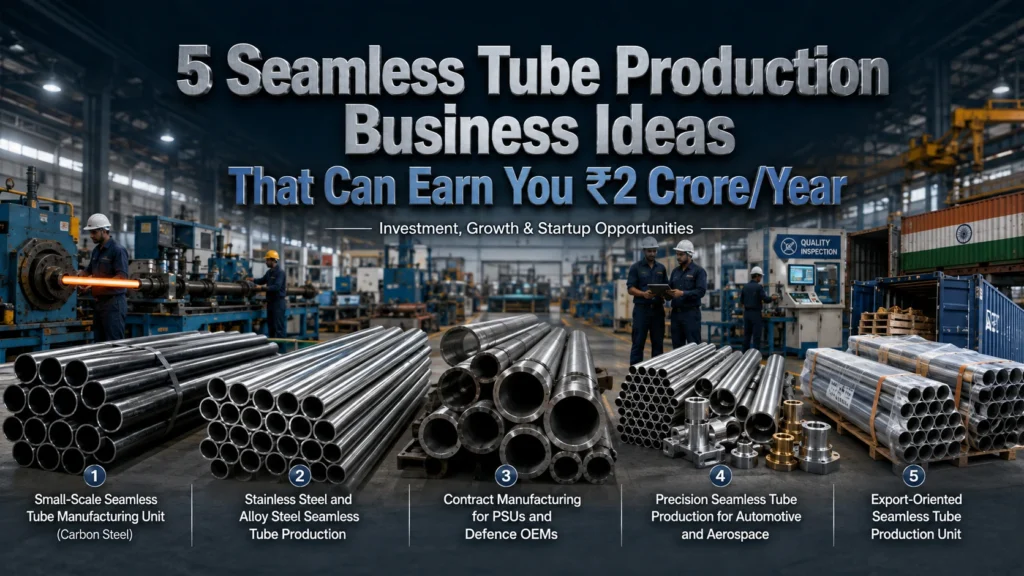
This continuous tube production opportunity cannot be limited to a specific model. Entrepreneurs can design their entry in a number of different ways, depending on capital resources, technical know-how and the market they want to go after, each with a unique risk profile and ceiling on their revenues.
1. Small-Scale Seamless Tube Manufacturing Unit (Carbon Steel)
For entrepreneurs who have a moderate amount of capital and a strong background in metallurgy or engineering, the most direct route would be to establish a small-scale focused manufacturing plant for standard-grade carbon steel seamless tubes. Solid steel billets are heated to forging temperature in the rotary hearth furnace or pusher furnace, and then are pierced on the rotary piercing mill to form a hollow shell. The shell is then lengthened on a plug or mandrel mill and reduction to a precise outer diameter and wall thickness is accomplished on a stretch reducing or sizing mill. Straightening, heat treatment, hydrostatic testing and non-destructive examination prior to dispatch are the processes of the final finishing.
A small-scale unit can serve the domestic market of oil country tubular goods for lower pressure, seamless tubes for the structure industry or mechanical tubes for the auto ancillary industry. The first to market will be steel service centres, industrial distributors and direct contact with the OEM procurement teams. By offering the unit around two important factors, such as dimensional accuracy and delivery time, the business can establish a loyal client base in the area quicker than the larger competition.
Indeed, India’s infrastructure and manufacturing demand for steel products continues to grow strong, as stated in the IBEF Steel Sector Report.But the demand for steel products in India, driven by infrastructure and manufacturing, continues to be strong, which is a direct lift to the small steel tube producers, according to the IBEF Steel Sector Report.
Explore This Book: Steel and Iron Handbook
2. Stainless Steel and Alloy Steel Seamless Tube Production
The realisation of premium grade seamless tubes (304, 316L, 321, 347, duplex and super duplex grades and high alloy steels) are much higher per kilogram than carbon steel products and are not as competitive in the domestic market. These grades are demanded by the chemical processing, pharmaceutical, food and dairy, nuclear power and oil refinery industries, all of which require seamless tubes with corrosion-resistant or high-temperature-resistant properties as a part of their engineering requirements.
A carbon steel tube manufacturer could not easily duplicate an entrepreneur’s product mix, if he or she has access to specialty steel raw material supply chains or has a strategic partnership with a melter of specialty steels. The PLI Scheme for Specialty Steel has an explicit inclusion of seamless tubes of stainless and alloy steel, which makes this sub-segment one of the most financially incentivised sectors for entry. Qualifications like PED, ASME compliance, and NORSOK qualification bring with them a greatly broadened scope of addressable markets when it comes to exporting to Europe, U.S. markets, and oil and gas applications.
Related Article: Stainless Steel Tubes & Pipes, SS Pipe and Tubes, Tube mill, Pipe Mill, Extrusion and Pilgering Process
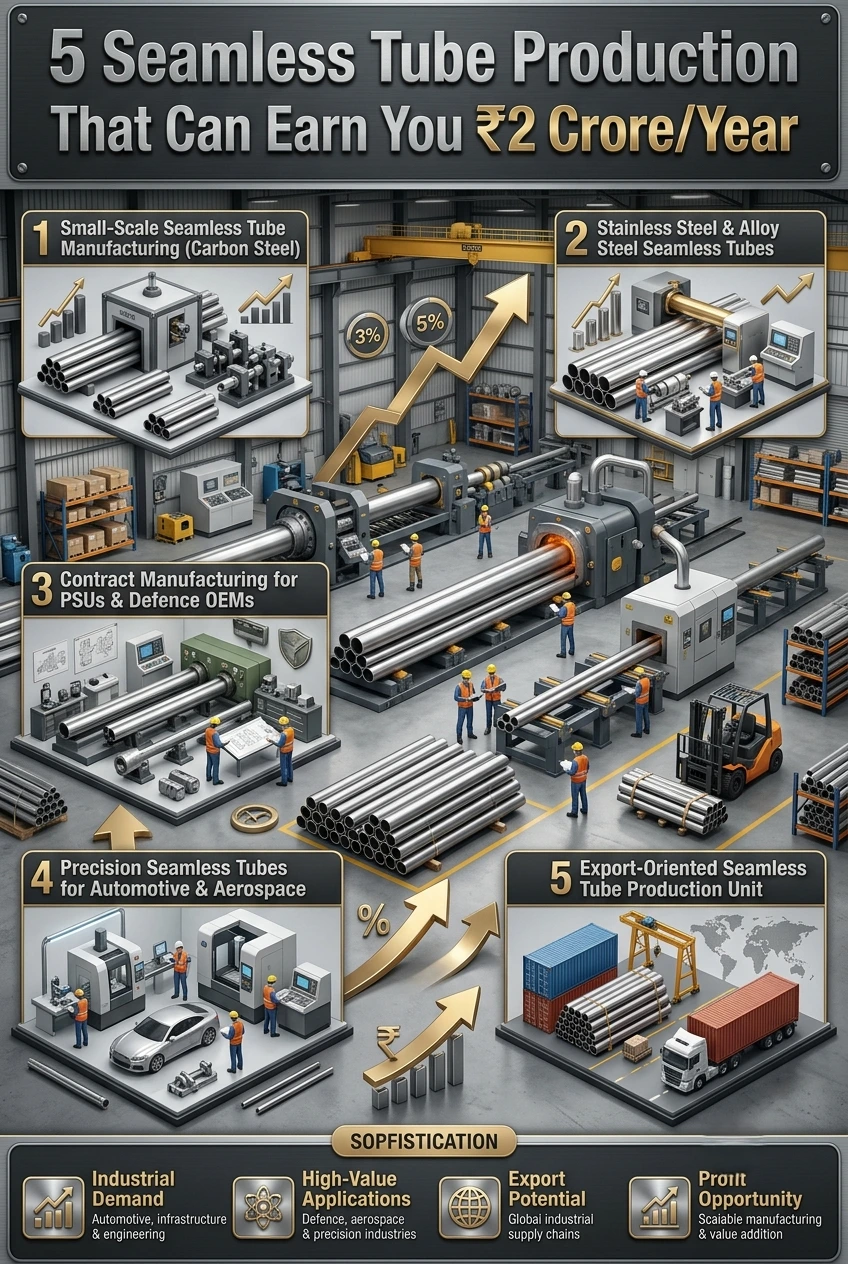
3. Contract Manufacturing for PSUs and Defence OEMs
The public sector undertakings such as ONGC, GAIL, NTPC, BHEL, NPCIL are regular buyers of seamless tubes under long term rate contracts and through registered vendor programmes. Once a vendor is registered with one PSU, it can expect regular orders, consistent payment cycles, and a reference that will give it opportunities with other institutional buyers. This model is well suited for entrepreneurs who have been involved in quality management systems previously because PSU procurement standards call for BIS certification, third-party inspection and traceability paperwork at every stage.
The Defence Acquisition Procedure has specific indigenisation requirements for the Defence procurement process that actively favor MSMEs, wherein the Defence Research & Development Organisation (DRDO) and other DRDO–linked agencies are engaged. Early registration of a unit under the MSME CGTMSE scheme and certification of BIS and ISO 9001 provides the entrepreneur with a strong credibility and banking status when he sells to the government PSU entities which decreases the selling cycle time significantly.
4. Precision Seamless Tube Production for Automotive and Aerospace
Seamless tubes to tolerances that would be difficult for commodity tube manufacturers are required for the automotive and aerospace industry. The dimensional control with specific mechanical properties of Automotive Axle Tubes, Steering Column Tubes, Hydraulic Cylinder Tubes and Shock Absorber Tubes. Additional metallurgical complexity is introduced in the case of aerospace seamless tubes, such as those manufactured from titanium alloys, high strength Al alloys and Ni-based superalloys.
Targeting the Tier 1 and Tier 2 supply chain, a precision seamless tube unit, which is clustered around Pune, Chennai, Gurugram and Sanand, can maintain a good capacity utilisation by entering into long-term supply contracts with OEMs. The Invest India Capital Goods company sector overview shows that the capital goods and engineering manufacturing sector of India enjoys a number of benefits such as 100% FDI through automatic route and the robust governmental support which further emphasizes the long term sustainability of investments in the precision engineering industry. In the case of aerospace, the certification under AS9100 and the process qualification by the DGCA are a prerequisite and once obtained, make non-certified suppliers almost impossible to compete.
5. Export-Oriented Seamless Tube Production Unit
Seamless tube units built with a cost-effective steel manufacturing base, a large talent pool of deep engineers, and a well-established freight infrastructure in India are poised to be strong contenders for international markets. An export-oriented unit requires international quality certification (API 5CT and API 5L for the oil country steel and line pipe grades, ASTM/ASME for the US markets and EN for European market buyers) and actively participate in EEPC India’s engineering export promotion programmes to find buyers, attend international trade fairs and avail market intelligence for the target geography.
RoDTEP, Interest Equalisation Scheme for MSME exporters are a few export incentives offered by the government, which substantially enhance the landed cost competitiveness. An entrepreneur who invests in developing relationships with international trading houses or steel distributors and lays the bases for the international certification infrastructure will have access to a number of buyers larger than the domestic market. Indian export manufacturers can use the World Bank Commodity Markets Outlook to find a benchmark for the demand scenario and pricing of steel across the world and decide when to enter the market.
Import–Export Opportunity Analysis for Seamless Tube Production
Trade potential in seamless tubes in India is a double-edged sword with current import substitution opportunities and an emerging export avenue. Entrepreneurs that grasp both aspects can design their enterprise to take advantage of multiple points of market access.
India’s Import Dependency: A Manufacturer’s Opening
Massive amounts of seamless tubes, especially high-quality grades like stainless steel seamless, API-grade OCTG and specialty alloy tubes are imported into India every year. Main imports come from China, Japan, Germany, South Korea and Ukraine. Chinese seamless tubes have been under anti-dumping investigations and imposed anti-dumping duties at various product categories which have made Chinese seamless tubes to create pricing and supply uncertainty to the domestic players which they wish to resolve by sourcing from India.
According to IBEF Indian Steel Sector Report, finished steel demand growth is consistently higher in certain specialty sectors than supply growth, resulting in a continued premium demand for imports which can be systematically met by domestic manufacturers with the appropriate certifications. Each Rs. 1 worth of substitutes given to the manufacturers helps them improve their market position and directly helps achieve Aatmanirbhar Bharat’s national trade balance goal.
Export Markets: Building India’s Seamless Tube Footprint
India’s smooth tube export journey is just incomplete, and that’s what the opportunity is to write the rest! The first movers that create international quality credentials will create connections and approvals that other “competitors” will require years to build. The Middle East continues to be the most attractive near-term export market. The Southeast Asian markets of Vietnam, Indonesia, and Malaysia offer an expanding addressable market for Southeast Asian refineries and petrochemical complexes.
In recent years, European buyers have been actively looking for seamless tube suppliers other than China and Russia, as a result of the disruptions in the supply chain.With the disruption in the supply chain, buyers on the European side have been active in looking for seamless tube suppliers other than China and Russia.
In the PIB press release regarding “PLI Specialty Steel Round 3”, the government’s thrust towards India becoming a specialty steel manufacturing hub of the world directly impacts export-oriented seamless tube manufacturers. Further, EEPC India’s export promotion facilities offer the manufacturers assistance for participation in the various trade fairs, introduction programmes for buyers and market entry facilitation, which lowers the cost and risk of the manufacturers in establishing an international sales presence.
Indian MSME and Industry Leaders in Seamless Tube Production
There are a number of Indian companies that have carved out good and defensible positions in the space of seamless tube production, offering a few practical models and lessons to the new players coming into this space.
Maharashtra Seamless Limited (MSL)
D.P. Jindal Group’s promoted Maharashtra Seamless Limited is the biggest seamless tube manufacturer in the country. MSL established its competitive edge around integrated manufacturing, a process that involves controlling from the beginning of the steel melting process up to the tube rolling, heat treating and finishing process, providing them with cost, quality, and delivery benefits compared to their competitors who relied on the purchase of billets. They have been investing heavily in API certification early on, which paved the way for the oil and gas market becoming their main source of income.
MSL’s lesson for brand new entrepreneurs: invest in quality certifications early; invest in high dollar industrial applications with high specifications and low price sensitivity; invest in backward integration into raw materials wherever possible. The Make in India initiative under which MSL works continues to give policy support, procurement preference and export facilitation support to manufacturers like them.
Ratnamani Metals and Tubes Limited
The Lakhani family of Ratnamani Metals and Tubes Limited started its business in Ahmedabad with a specialty of manufacturing of seamless and welded tubes for specialty applications, which did not involve direct competition with the larger carbon steel manufacturers, but operated along different lines. Their focus on investing in metallurgical complexity and certification depth for chemical, pharmaceutical and nuclear-grade tubes has developed a product line that helps them to charge premium prices and has limited domestic competition.
The case of Ratnamani proves that seamless tube entrepreneurs don’t have to be big-boycotted players; they just have to be the highest rated and most reliable supplier in their selected high dollar niche. They have been among the first to implement the quality certification program now endorsed by the PLI Specialty Steel scheme, providing a clear pathway for new companies.
Surya Roshni Limited (Steel Division)
Although Surya Roshni is more famous for its lighting solutions, it has a substantial branch of steel tube manufacturing that caters to the infrastructure and industrial sectors. They have achieved success in building distribution reach (through a network of steel service centres and dealer network spread throughout India) and this has proved the significance of channel strategy, as well as production capability. Surya Roshni’s distribution approach is a template for entrepreneurs who want to build a smaller seamless tube unit: Steel companies serving in the region with stock, technical sales support, and last-mile logistics.
For entrepreneurs, building a smaller seamless tube unit, Surya Roshni’s distribution model could be a template: Partnering with steel companies in the region who will carry stock, support with technical sales skills, and manage last mile logistics, to let the manufacturer focus on producing the quality tubes and being efficient.
Discover scalable startups tailored to your goals
How NPCS Can Help You Build a Seamless Tube Production Business
Niir Project Consultancy Services (NPCS) offers professional consulting for the preparation of Market Survey cum Detailed Techno-Economic Feasibility Reports (DPRs) on the establishment of new industries such as Seamless Tube production plants for all different types of carbon steel, stainless steel, alloy steel, precision tube etc. The complete manufacturing process from beginning to end is covered in our extensive reports, which include process flow diagrams, market research and demand analysis, raw material and machinery sourcing details, product mix and capacity planning, and the full financials of the project, complete with profitability analysis.
Our goal is to assist entrepreneurs in determining if a project is feasible, profitable, and can be scaled up as a business. Our DPRs form the analytical underpinning that banks, investors and government agencies need for project appraisal, be it a small MSME unit or a large-scale export project. We have helped hundreds of metals, engineering and industrial product manufacturing entrepreneur’s start-up in India. To give a global perspective, we incorporate the world bank commodity markets outlook and the Invest India Capital Goods sector analysis into our feasibility reports for smooth and hassle-free tube project analysis.
Seamless Tube Production: Market and Business Overview
| Parameter | Detail / Estimate |
| Global Seamless Tube Market Size | USD 100+ Billion (CAGR ~5–7%) |
| India Market Growth Rate | ~8–12% annually (infra-led) |
| Key Raw Material | Steel Billets (Carbon, Alloy, Stainless) |
| Primary Production Process | Hot Piercing + Rotary/Mandrel Mill + Sizing |
| Key End-Use Sectors | Oil & Gas, Power, Auto, Aerospace, Defence |
| Major Domestic Producers | Maharashtra Seamless, Ratnamani, ISMT |
| Key Export Markets | Middle East, SE Asia, Europe, Africa |
| Critical Certifications | API 5CT/5L, BIS, ISO 9001, ASTM/ASME, EN |
| PLI Scheme Support | Ministry of Steel — 4–15% incentive on sales |
| MSME Financing | CGTMSE — Collateral-free loans up to ₹2 Crore |
| Import Substitution Potential | High — specialty grades heavily imported |
| Startup India Eligible | Yes — for innovative/specialty mfg ventures |
Conclusion: The Seamless Tube Production Opportunity Is Real, and the Time Is Right
The seamless tube production enterprise is in the middle of a few of the country’s most robust enablers of structural growth – infrastructure investment, energy security, self-reliance in defence, and industrial modernisation. Seamless tubes will be used in every pipeline laid, every boiler erected, every defence vehicle commissioned and every petrochemical plant built for the next ten years in India — and the domestic manufacturing base that will supply all that demand is still being built.
For entrepreneurs with engineering sensibility and manufacturing ambition, this is one of the more compelling business ideas available in Indian industry today. The import dependency in premium grades, the government’s strong PLI and MSME support framework, and the export opportunity in the Middle East and Southeast Asia collectively create a market environment where a well-planned, quality-focused seamless tube manufacturing unit can achieve attractive returns and long-term resilience.
The companies that succeed in this space — Maharashtra Seamless, Ratnamani, and others — did so by making early bets on quality certification, technical differentiation, and institutional customer relationships. Those same strategies remain available to new entrants today. The PLI Specialty Steel scheme, the MSME CGTMSE credit facility, the Startup India DPIIT recognition, and the Make in India manufacturing ecosystem together form a policy support structure that makes this one of the most government-backed manufacturing entry points in India today. At NPCS, we provide the feasibility intelligence, process engineering detail, and financial modelling that turns a promising opportunity into a bankable investment plan. The window is open — a disciplined, well-prepared entrepreneur can walk through it.
Citations and References
1. PLI Scheme for Specialty Steel — Guidelines, Ministry of Steel, Government of India
2. IBEF — Indian Steel Sector Industry Presentation & Report
3. PIB — PLI Specialty Steel Round 3 Launch Press Release (PRID 2186206)
4. MSME Ministry — Credit Guarantee Fund Trust for Micro and Small Enterprises (CGTMSE)
5. EEPC India — Engineering Export Promotion Council of India
6. Invest India — Capital Goods Sector Investment Opportunities
7. Startup India — DPIIT Startup Recognition and Tax Exemption Scheme
8. Make in India — Metals and Mining Sector
9. Invest India — India’s Capital Goods Boom: Powering Manufacturing, Infrastructure & Growth
10. World Bank — Commodity Markets Outlook: Metals and Steel