
India Chemicals Sector Exports
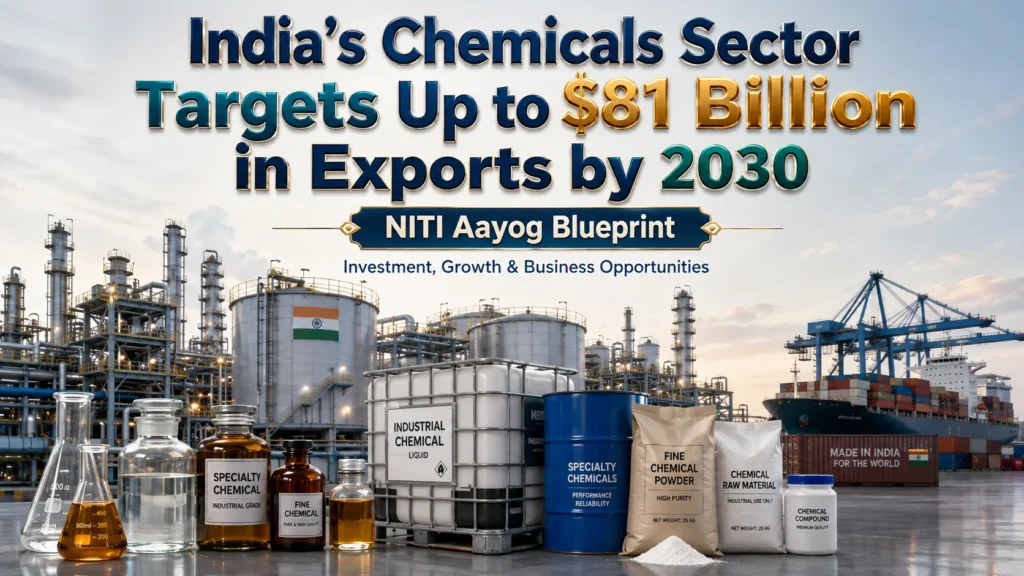
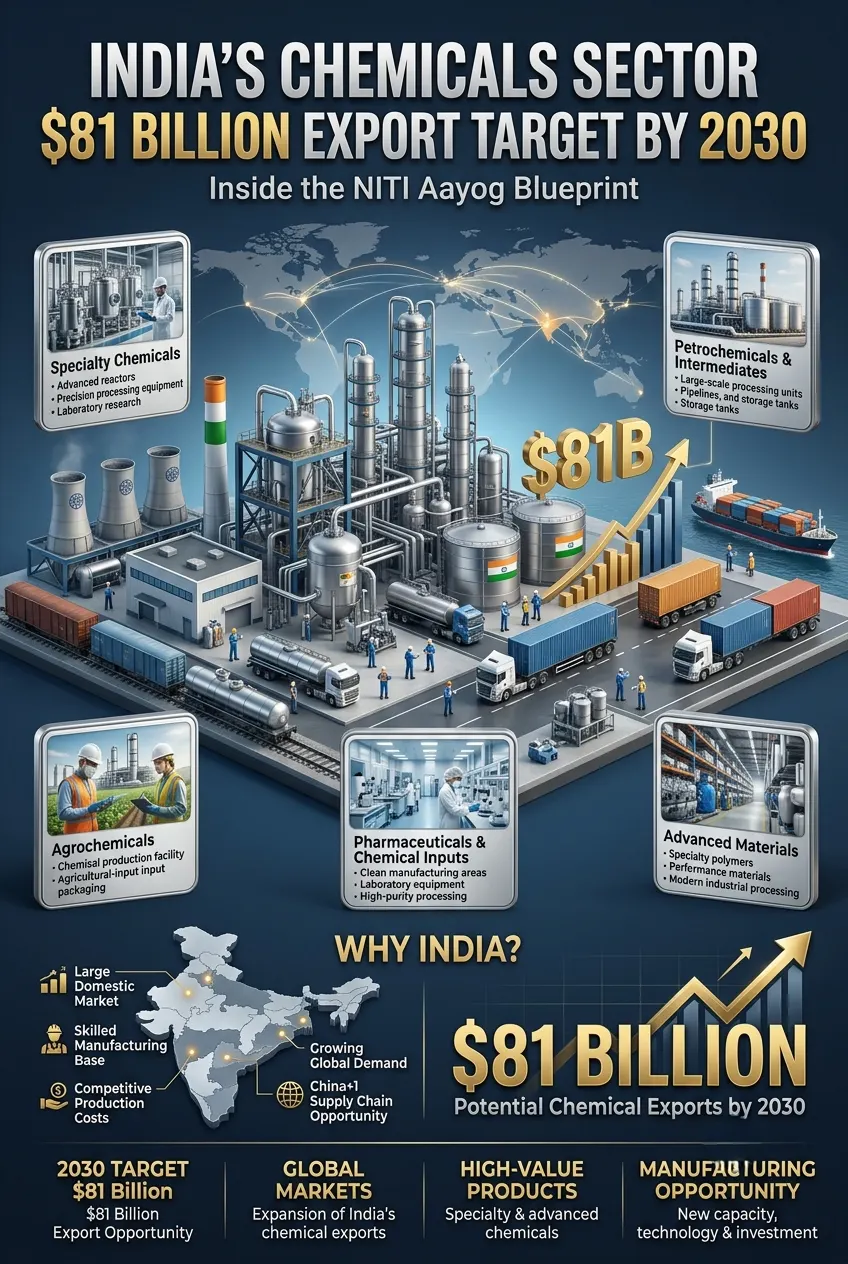
The chemicals industry in India is embarking on one of its biggest shifts in decades. The government’s top policy think tank, NITI Aayog, has recently submitted a report, which projects that the sector can drive exports to $81 billion by 2030—a nearly 2-fold increase from its current export value. Setting this target is part of a bigger picture: India becoming a net-zero chemical importer, a nation that now generates chemical products to keep pace with its rapidly growing consumption, and is also one of the major chemical exporters in the world.
This is a bold move for an industry which has consistently experienced a persistent and growing trade deficit. It indicates that New Delhi is no longer considering chemicals as a sector that can support the other more prominent sectors such as pharmaceuticals, textiles, and agriculture but one that can sustain itself on a standalone basis in the process of India’s march towards a $5 trillion economy.
Get Detailed Insights from This Book: Modern Technology of Industrial Chemicals
The Numbers Behind the Ambition
The NITI Aayog report details the export goal under various categories. Specialty chemicals are expected to shoulder the bulk of the load with anticipated exports in 2030 of $45 billion. The inorganic chemicals are in the middle somewhere between $5 billion and $10 billion, followed by the petrochemicals at about $26 billion. This adds up to a total export aspiration of $76 billion to $81 billion.
In order to meet these levels, the report estimates that India’s chemicals industry will require a compound annual growth rate of 10 to 11 percent in consumption for the next five fiscal years, and even higher growth rates in the case of production — at about 14 percent per year. It’s a tough speed for an industry in a nation where infrastructure constraints, land acquisition time, and regulatory delays have held large-scale industrial development back in the past.
The size of the domestic market opportunity behind this plan is massive. The chemicals consumption is expected to grow to $290 billion to $310 billion in Fiscal Year 2030, and India will be consuming 5-6 percent of the global amount. To meet that demand locally, rather than importing, India’s chemical production capacity must be scaled up by nearly 2x, from around $110 billion in fiscal 2023 to $220 billion-$280 billion by fiscal 2030, the report estimates.
That’s not a simple capacity growth. It suggests a long-term sequence of new plants and plants that have grown larger, specialty chemical plants, and supporting infrastructure at ports, pipelines, and logistics corridors. If realised, it could also create 700,000 to one million new jobs by the end of the decade, which would be a major boost to the employment situation in the manufacturing sector in India, the report adds.
Where the Growth Is Expected to Come From
The report identifies four segments that have been identified as the main growth drivers for speciality chemical exports: dyes and pigments, paints and coatings, agrochemicals and flavours and fragrances. These are areas where India already enjoys a manufacturing capability and where international buyers have been willing to spread their purchasing beyond the traditional sources, mainly China.
The change is already evident in trade figures. India’s exports of speciality chemicals have shown some solid ground in key markets, with the U.S. being around 17 percent of the exports, followed closely by Brazil with around 16 percent in 2024. These statistics indicate that speciality chemical producers from India have succeeded in gaining a foothold in markets which are not only large, but also tougher and more competitive.
However, it is worth highlighting that India’s overall share in the major import markets is not high, approximately 8 percent. That’s not a liability, it’s a potential: while less than 10% of major markets are currently being accessed by Indian exporters, there’s significant scope for them to grow before they begin to face a level of saturation that would make it harder to gain market share.
The other opportunities are the Petrochemicals. It is a “scale-intensive”, capital-intensive business in which the Indians already have a strong base in the sector of refining and cracker capacity, mostly public and private sector giants. The $26 billion export goal for this segment suggests a greater linkage of the refining complexes in India with their downstream petrochemical production, enabling the nation to monetise crude oil and naphtha feedstocks for an export value higher than that of exporting crude oil as intermediates or derivatives from it.
Access Complete Business Plan: Chemicals (Organic, Inorganic, Industrial) Projects
Why India Runs a Chemicals Trade Deficit in the First Place
It is important to understand the significance of this export target by examining the present scenario of India’s chemicals trade. The country has a significant and increasing trade deficit in chemicals, for years. However, imports have far exceeded exports, with the demand for plastics, inorganic chemicals and petrochemical products increasing that domestic production has not matched.
Import levels are high and the substantial proportion of these imports from China—providing a major source of chemical imports to India—as well as from other countries such as the United States, Southeast Asia, and South Korea. This dependence on imported chemicals, especially from the dominant single source, has emerged as a strategic worry for Indian policy-makers as world supply-chains have become more vulnerable than ever before in recent years.
The structural challenge is the way India’s current petrochemicals plant capacity is currently structured. Very high percentage of Indian propylene is being used in the production of lower valued Polypropylene as compared to the world average. The same is true of ethylene, which is primarily used to make commodity-grade polyethylene, rather than the more valuable products like MDI, fluorochemicals or specialty feedstock for batteries and other advanced materials. This concentration on commodities lowers the value of the output for the large chemical industry in India than for more diversified industries in other countries. Existing industries in India, which are predominantly chemical, are not as valuable as output per unit of commodity produced in other more diversified industries.
The result has been a widening trade deficit that industry watchers have flagged as a growing vulnerability. The NITI Aayog report treats closing this gap, and eventually flipping it into a surplus or at least a balanced position, as central to the entire 2030 strategy.
Strengths, Gaps, and What Needs to Change
The report is forthright on the benefits India can contribute to this endeavour, as well as the challenges facing it. On the positive side, it suggests there is a healthy and expanding domestic demand, supportive government policy and a very robust manufacturing base the industry can leverage. India is not setting benchmarks for the very first time. It is already one of the world’s biggest chemical producers, and the industry is linked to almost every other manufacturing industry from pharmaceuticals to textiles to agriculture.
At the other end of the coin the report highlights infrastructure shortfalls, regulatory challenges and a necessity for enhanced technological capacity to be the major challenges that are stunting the sector’s ability to scale up at the speed desired. These are not novel issues for the Indian manufacturing sector as a whole, but assume special significance in chemicals because safety regulation, pollution control, availability of land for establishing large industrial complexes, and adequate utility, logistics and infrastructure are important considerations in deciding whether to build new capacity on time and on competitive terms.
To fill these shortfalls, two key points are put forward in the report: targeted investment and policy intervention, as well as creating an industry innovation ecosystem. This involves pushing companies up the value chain, from commodity chemicals to higher-margin specialty chemicals and developing research and development capabilities to stay competitive on product sophistication and not cost.
Specifically, industry analysts have noted some technological changes that would address the value gap detailed in the report. Increased investment in green chemistry and bio-based feedstocks is thought to help Indian producers cut down on crude-based raw material usage and meet the requirements of the global buyers, which look for sustainably certified suppliers. Indian companies are already delving into strategies for platform molecules and process optimisation towards higher margin specialty derivatives, which dovetails with the report’s broader appeal to diversify away from commodity derivative production.
Related Article: Manufacturing and Business Ideas in the Chemical Sector: Gallic Acid, Potassium Nitrate, Chlorinated Paraffin Wax and Zinc Sulphate
A Global Moment for Supply Chain Diversification
This push is not a coincidence. Since the disruption caused by the pandemic, global chemical supply chains have been realigned, and that has been further driven by the current trade tensions between the United States and China. But whether in the automotive sector, the electronics industry or consumer goods, multinational buyers have actively sought to mitigate their concentration risk in their supply chain by finding new sources of supply that can provide reliability and competitive cost.
This change is the birthright of countries such as Vietnam and Indonesia, and India is well poised to benefit from it. However, supply chain diversification requires more than just geopolitics to succeed since the competitiveness of the manufacturing process must also be strong enough to enable the movement of business from existing and established suppliers. Studies done in India on competitiveness of the chemical manufacturing industry with the chemical clusters of China, Germany, Indonesia, Saudi Arabia, South Korea and Vietnam have revealed that India is competitive on a large number of parameters, but still lacks competitiveness on a few factors that are critical to the global buyer, such as costs, infrastructure and logistics.
The NITI Aayog report is just an attempt to fill the very space it is aiming to bridge. Its suggestions are not so much about finding new markets to export to; they are about developing the domestic production and competitiveness required to meet the demand in challenging markets such as the United States and Brazil on a large scale.
What This Means for the Broader Economy
This report’s ambitions are not just for the chemicals sector, but for the Indian economy. The chemicals industry is closely tied to pharmaceuticals, agriculture, textiles and more recently to newer industries such as electric vehicle batteries and electronics, which require quality, competitively priced domestic sources of chemical inputs. An increase in the volume of exports from the chemicals industry has multi-faceted implications.
The 700,000 to one-million jobs by 2030 would also be a significant addition to India’s overall manufacturing employment targets, which have been under pressure to generate employment opportunities for its large and growing working-age population.
In reality, it will be execution, not ambition, that will make the difference in whether India is able to meet the export goal of between $76 billion and $81 billion by 2030. The scale of the challenge is reflected in the report itself: doubling output in about five to six years; maintaining double-digit growth rates for consumption and output; and closing the infrastructure, regulatory and technological gaps that have long plagued the industry. These are very high demands for any industry, and chemicals manufacturing in particular, which have a long history of project timeframes and the time to move large petrochemical and specialty chemical facilities into operation.
However, it is clear the direction of travel. Global value chains are actively searching for alternatives to having too much reliance on any single country and India’s chemical demand is also expected to surge no matter how well the exports are. The NITI Aayog report basically says that India has yet to make the best of a opportunity and the chemicals sector could be a lot bigger than it’s been before in the next five years or so, if it receives the right investment and policy support.
Your investment deserves the right opportunity
How NPCS Supports Startups Entering the Chemicals Sector
As India works toward this 2030 chemicals roadmap, a large part of the opportunity will depend on new entrants, not just existing large players, being able to identify the right projects and execute them well. This is where specialised project consultancy firms play a role in the ecosystem. NIIR Project Consultancy Services (NPCS), a Delhi-based industrial consultancy established in 1994, is one such organisation that works specifically with entrepreneurs and startups looking to enter manufacturing sectors, including chemicals, agrochemicals, dyes and pigments, paints and coatings, and speciality chemical processing.
NPCS positions itself as a technical and market-research partner for first-time entrepreneurs and existing companies planning capacity expansion. Its core services relevant to a founder scoping a chemicals-related venture include:
- Detailed Project Reports (DPRs): Techno-economic feasibility studies that cover manufacturing processes, machinery and raw material requirements, plant layout, and multi-year financial projections, giving a founder a structured business plan rather than a blank slate.
- Pre-feasibility and market studies: Early-stage assessments to help entrepreneurs evaluate whether a specific chemical product line or process is commercially viable before committing capital.
- Identification of profitable project opportunities: Guidance on which chemical sub-sectors, such as speciality chemicals, agrochemicals, or petrochemical derivatives, currently offer the strongest demand and margin potential.
- Technical and commercial counselling: Support on plant, process, and equipment selection, along with general guidance for entrepreneurs navigating regulatory and compliance requirements specific to chemical manufacturing.
- Publications and directories: A library of industry books, databases, and directories that founders and consultants can use as reference material when building out a new project.
For a startup evaluating entry into segments the NITI Aayog report flags as high-growth, such as dyes and pigments, flavours and fragrances, or agrochemicals, this kind of structured feasibility work can shorten the distance between an initial business idea and an investment-ready project plan.
Reference Links
- NITI Aayog – Official Website
- NITI Aayog Chemical Industry Report (PDF)
- ANI News – India’s Chemicals Sector Targets Up to USD 81 bn Exports by 2030
- Sunday Guardian Live – India’s Chemicals Sector Targets Up to USD 81 bn Exports by 2030
- Asianet Newsable – India’s Chemical Industry Eyes USD 81 Billion in Exports by 2030
- PwC India – Sustainability in a Dynamic World: Strategic and Operational Imperatives
- Department of Chemicals and Petrochemicals, Government of India
- Federation of Indian Chambers of Commerce and Industry (FICCI) – Chemicals Sector
- Niir Project Consultancy Services (NPCS) – Official Website