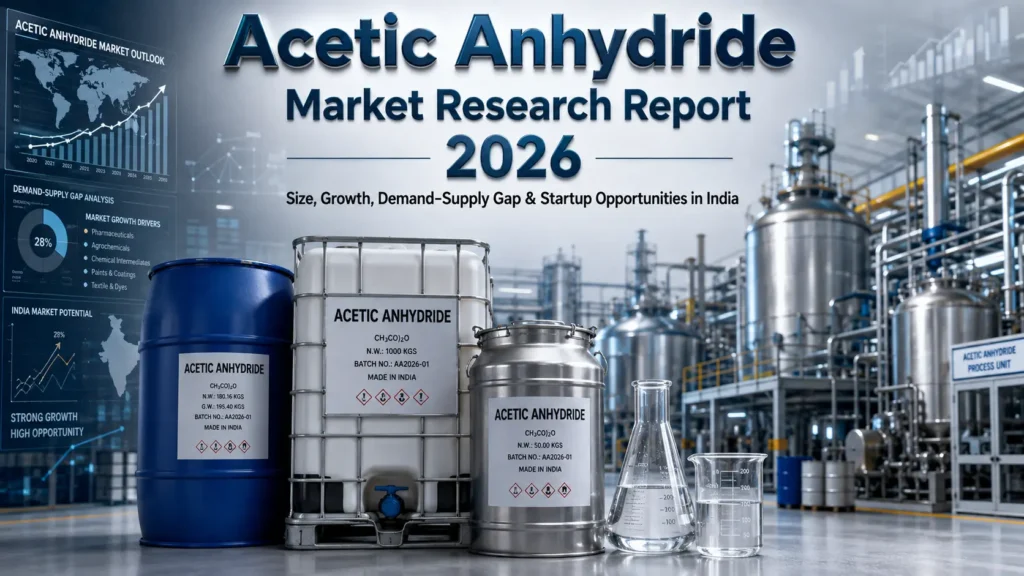

Acetic Anhydride Manufacturing in India
India’s pharma sector is estimated to expand from USD 65 billion in 2024 to USD 130 billion by 2030 and acetic anhydride plays a central role in the synthesis process of some of the most widely consumed drugs produced by the industry, such as aspirin and paracetamol. However, the higher molecular weight acetyl chemical chain to which acetic anhydride belongs is one of the most import dependent industries in India as India imports over 85% of its need for upstream acetic acid. This opportunity is embedded in that dynamic: a growing demand for the pharma products downstream coupled with a highly import-dependent feedstock supply chain.
What Is Acetic Anhydride?
Acetic anhydride or ethanoic anhydride is a clear colourless liquid carboxylic acid anhydride produced mainly by the ketene process using glacial acetic acid as the raw material. It acts as a powerful acetylating agent (reacts with an alcohol or amine to add an acetyl group), which is useful in a number of key industrial value chains:
- Pharmaceutical synthesis is the biggest application in India and in the rest of the world (some estimates suggest that 48% of the total usage is for pharmaceutical synthesis), and plays a vital role in the production of aspirin, paracetamol, acetaminophen, ibuprofen intermediates, sulfa drugs, and other vitamins and hormones.
- Photographic film and fibre use in textiles are other major applications for cellulose acetate in India, and its production is also an important area of cellulose use.In India, production of cellulose acetate is also important, as cellulose is acetylated for cigarette filter tow, photographic film, and textile fibre applications.
- The synthesis of agrochemical/pesticides, which is a critical raw material used in the production of acephate and other organophosphate pesticides, relies on the R&D efforts of a single company.A single company has to do the R&D of a critical raw material used in the manufacturing of agrochemical/pesticides such as acephate and other organophosphate pesticides.
- TAED (Tetraacetylethylenediamine) – a compound that activates bleach in laundry detergents
- Smaller but growing specialty chemical applications include dyes, flavours, fragrances and explosives.
Get Detailed Project Report (DPR): Acetic Anhydride
Global and India Acetic Anhydride Market Size and Growth
Global estimates for market value vary widely, depending on scope, from approximately USD 3.36 billion to USD 6.98 billion in 2025-26, rising to between USD 5.42 billion and USD 9.12 billion by the early-to-mid 2030s, with the CAGRs in the middle band.
The size of India’s domestic market is estimated to be around USD 87–400 million (2024), with volume estimates ranging from approximately 76,000 metric tonnes (MT) in 2023, and most estimates of the Indian portion of the market CAGRs are significantly higher than the global average — ranging from 2.1% to as high as 7.8% across different studies — reflecting the country’s skewed higher growth pharmaceutical and agrochemical demand base compared to more mature global markets.
Note on figures: Market studies of the acetic anhydride market differ in scope, some covering only the volume of the merchant market, others including the captive/integrated market. NPCS can develop an investor-grade numbers-based techno-economic feasibility study to suit your target application (pharma-grade vs. industrial-grade) and capacity.
The Upstream Acetyl Chain Import Dependency
The Indian supply position of acetic anhydride cannot be viewed in isolation as it is downstream of acetic acid and India’s acetic acid supply chain is extremely import dependent. India is the biggest consumer of acetic acid (around 1.2 million tonnes of acetic acid was consumed in 2024 ahead of China and the United States) but also imports over 85% of its acetic acid consumption, making the whole acetyl chain (including acetic anhydride, ethyl acetate and other derivatives) one of the most import dependent chemical sectors in India. The Indian acetyl chain market is estimated to be about USD 567 million, and could be significantly bigger by 2032 with the expansion of the downstream pharmaceutical and industrial market.
This gives a unique strategic situation: domestic acetic anhydride capacity is growing (and recently has grown from established producers) – but even with this additional capacity, the production process still generally relies on the import of upstream acetic acid as feedstock – not just at the conversion stage of the process, but that stage is upstream.
Explore This Book: Handbook On Chemical Industries (Alcohol Based)
Policy Tailwinds
1. Pharmaceutical self-sufficiency push: India’s government emphasis on domestic API (Active Pharmaceutical Ingredient) production, aimed at reducing reliance on imports for critical drug intermediates, directly strengthens demand for domestically-manufactured, traceable, consistent-quality acetic anhydride.
2. PLI scheme of bulk drugs and key starting materials: Supporting the business case for backward integration investments for Acetyl chain – including Acetic anhydride – in indirect terms through PLI scheme for bulk drugs and key starting materials.
3. Expanding agrochemical export industry: India exports about 50% of its agrochemicals and the demand for acetic anhydride is closely linked to this export-intensive growth industry as it is used as a key raw material in the manufacture of organophosphate pesticides such as acephate.
4. Manufacturing relocation from stricter-regulation markets: Increasing environmental restrictions on pesticide manufacturing in the US and Europe are shifting agrochemical production toward India, further increasing domestic acetic anhydride demand.
5. Resurgent interest in cellulose acetate/bio-based materials: Revival of global interest in the use of cellulose acetate in the field of biodegradable plastics and sustainable textile products has generated new market opportunities for acetic anhydride in addition to the traditional cigarette filter tow market.
India Demand-Supply Gap: Acetic Anhydride and the Broader Acetyl Chain
| Parameter | Current Position |
| India’s acetic acid position | World’s largest consumption market (~1.2 million tonnes, 2024), yet imports over 85% of this requirement |
| Broader acetyl chain market size | ~USD 567 million (encompassing acetic acid, ethyl acetate, acetic anhydride, and related derivatives) |
| India acetic anhydride market (2023) | ~76,000 metric tonnes, growing at a CAGR estimated between 2.1% and 7.8% depending on the study |
| Recent domestic capacity expansion | IOL Chemicals & Pharmaceuticals expanded acetic anhydride capacity from 25,000 to 32,000 MTPA (March 2026); Laxmi Organic Limited has proposed further expansion at its Raigad, Maharashtra facility |
| Nature of the gap | A compound, two-tier import dependency — India’s acetic anhydride production capacity is growing, but much of it still relies on imported upstream acetic acid, meaning the more structural opportunity sits in backward integration across the full acetyl chain, not acetic anhydride conversion alone |
| Downstream demand driver | India’s pharmaceutical industry, projected to grow from ~$65 billion (2024) to ~$130 billion (2030), directly and substantially grows the addressable acetic anhydride market as a critical drug synthesis intermediate |
| Opportunity for new entrants | Strongest for integrated players capable of backward integration from acetic acid production through to acetic anhydride and downstream cellulose acetate/pharma intermediate manufacturing |
Reading in the gap: This is a multi-layered opportunity, not a one-and-done opportunity. India’s own government recognised acetyl-chain research explicitly states that the country is “one of the most import dependent chemical industries in India” since 85%+ dependence on Acetic Acid, and in turn, this is a constraint on realising self-sufficiency at the level of Acetic Anhydride with an increase in conversion capacity. The best of all available opportunities is not just another acetic anhydride plant but investing in backward-integrated acetyl chain capacity to lower the dependence on importation of acetic acid feedstock and cater to the true fast growth rate of the Indian pharmaceutical and agrochemical downstream demand.
Major Indian Acetic Anhydride Manufacturers
| Company | Base/Region | Notes |
| IOL Chemicals & Pharmaceuticals Limited | Punjab (with multiple facilities) | Recently expanded acetic anhydride manufacturing capacity from 25,000 MTPA to 32,000 MTPA (March 2026), explicitly aligned with rising domestic acetylating agent consumption in pharma and agrochemical applications |
| Laxmi Organic Industries Ltd. | Raigad, Maharashtra | One of India’s leading manufacturers of ethyl acetate and acetaldehyde for pharmaceuticals and specialty chemicals; has proposed further acetic anhydride capacity expansion at its Raigad plant; strong export presence in the broader acetyl chain |
| Jubilant Ingrevia Ltd. | Multiple locations | Produces acetic acid, ethyl acetate, and acetic anhydride with a strong export presence across the acetyl chain |
| Taj Pharmaceuticals | India | Recognised Indian acetic anhydride manufacturer and exporter serving pharmaceutical customers |
| A base of regional pharmaceutical intermediate manufacturers | Gujarat, Maharashtra, Andhra Pradesh, Telangana | Numerous smaller manufacturers and API-adjacent chemical producers using or supplying acetic anhydride within India’s broader pharmaceutical manufacturing clusters |
Major International Acetic Anhydride Players
| Company | Country | Notes |
| Eastman Chemical Company | United States | Major global specialty chemicals company and leading acetic anhydride producer, recently implementing price adjustments reflecting feedstock cost dynamics |
| Celanese Corporation | United States | Major global integrated chemicals company with substantial acetic anhydride and acetyl chain production capacity |
| BASF SE | Germany | Global chemicals major with acetic anhydride production as part of its broader specialty chemicals portfolio |
| Daicel Corporation | Japan | Major Japanese chemicals company, a leading global acetic anhydride and cellulose acetate producer |
| SABIC | Saudi Arabia | Major global petrochemicals company with acetic anhydride production capability |
| Sekab | Sweden | Recognised European acetic anhydride and bio-based chemicals producer |
Market Segmentation
By Application
- Cellulose acetate flakes (cigarette filter tow, textiles, film) — historically a dominant India application
- Pharmaceuticals — largest and fastest-growing global segment, driven by API synthesis
- TAED (laundry detergent bleach activator)
- Agrochemical/pesticide intermediates
- Dyes, flavours, fragrances, and explosives
By Grade
- Reagent grade
- Food grade
- Pharmaceutical/industrial grade (above 98% and 98%-and-below purity tiers)
By End-Use Industry
- Pharmaceutical manufacturing (APIs and drug intermediates)
- Tobacco (cigarette filter tow via cellulose acetate)
- Agrochemicals and crop protection
- Textiles and film
- Laundry and cleaning products
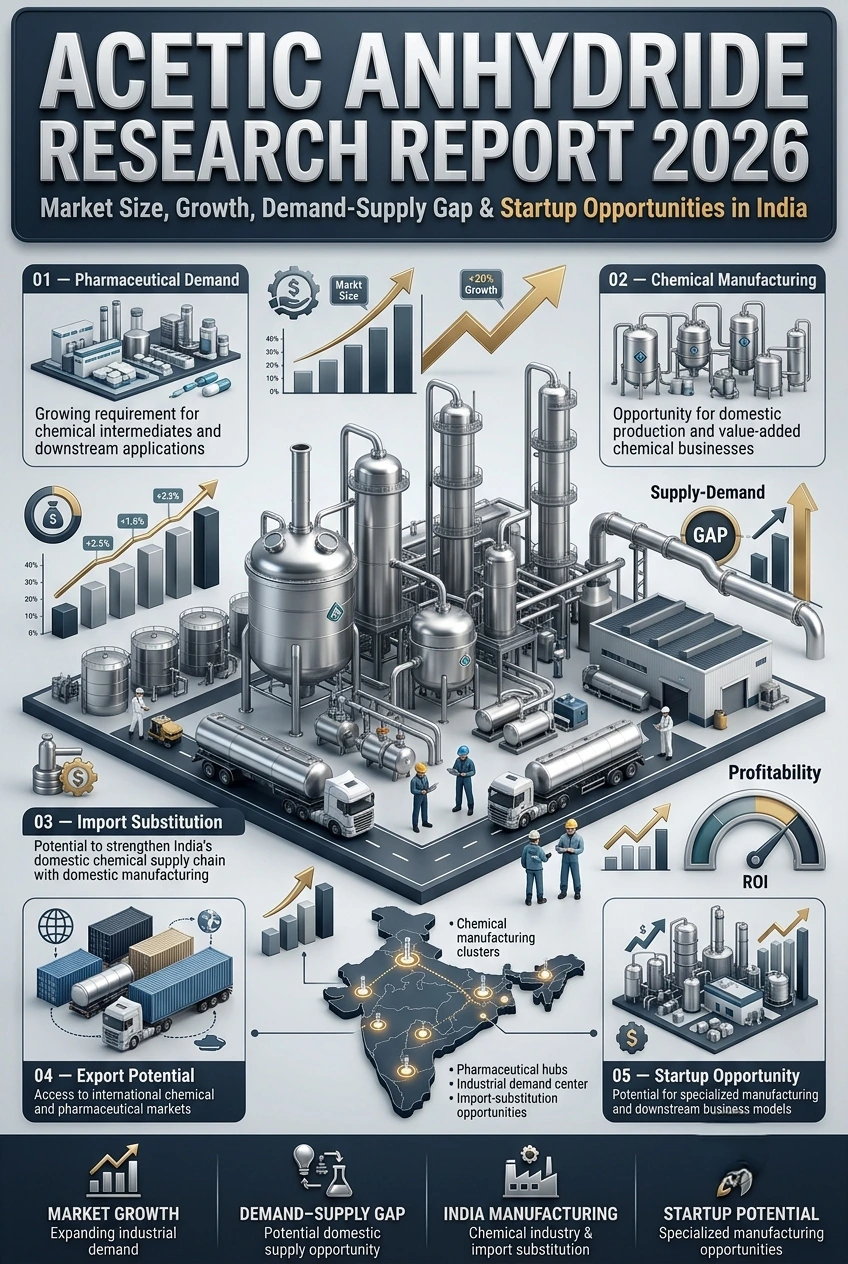
Key Growth Drivers
1. India’s rapidly expanding pharmaceutical manufacturing sector. Acetic anhydride is an important intermediate in the synthesis of Paracetamol, Aspirin and many other APIs; the Indian pharmaceutical industry is expected to grow by more than doubling from ~$65 billion to ~$130 billion by 2030, making its demand directly related with the growth of this fastest-growing industry in India.
2. Agrochemical export growth and manufacturing relocation. Demand for acetic anhydride for agrochemicals, especially for acephate production, is increasing in parallel with the increasing share of agrochemicals production in India, which is due to environmental restrictions in the US and Europe.
3. Government pharmaceutical self-sufficiency and PLI support. Domestic API and key starting material production is incentivised through policy emphasis on backward integration in the acetyl chain manufacturing, such as acetic anhydride.
4. Cellulose acetate revival for sustainable materials. It is not only the cigarette filter tow that is driving demand for cellulose acetate but also new avenues are opening up in the field of biodegradable materials for use in textiles, film, and packaging.
5. TAED and detergent industry demand. The steady demand from the expanding FMCG and household products industry in India is being driven by continued use of the laundry detergent bleach activator, acetic anhydride.
Related Article: Investing In Manufacturing Acetic Anhydride Derivatives
Challenges and Restraints
- Upstream acetic acid import dependency. With India importing over 85% of its acetic acid requirement, acetic anhydride producers without backward integration remain exposed to global acetic acid price volatility and supply chain disruption — a structural vulnerability distinct from typical demand-side risk.
- Significant price volatility. The market for acetic anhydride is particularly volatile in India, where prices have climbed as high as USD 1.06/kg in recent tracking and declined more than 17% in just one quarter, thanks to the volatile nature of the pharmaceutical procurement cycle.
- Cost pass-through complexity of feedstock. The cost of acetic acid upstream impacts production margins directly and immediately, as the cost of acetic acid is the driver for the cost of acetic anhydride, which is produced with the ketene process.
- Regulatory and safety compliance. Acetic anhydride is a corrosive chemical with a wide range of applications in the regulated pharmaceutical industry and is an ideal candidate for the implementation of rigorous quality documentation and traceability, especially in the production of pharma-grade acetic anhydride.
- Competition with large, vertically-integrated producers from around the world. India-based companies, which do not fully integrate their operations from the start with acetic acid production, face real cost and reliability competition from companies like Eastman, Celanese and Daicel, that are operating at scale with full backward integration.
Competitive Landscape
The Indian acetic anhydride industry is dominated by a few established and partially integrated companies, such as IOL Chemicals & Pharmaceuticals, Laxmi Organic Industries and Jubilant Ingrevia, which are aggressively expanding production in line with the growing demand for pharmaceuticals and agrochemicals in the country. The market is more concentrated in hands of large multinational companies, which are fully vertically integrated in acetic acid and acetic anhydride production, and provide structural cost and supply security advantage to their customers and which Indian producers at scale do not have at present as India’s national dependence in acetic acid is 85%+ on imports.
The challenge is one that India has to face in the future – how to integrate in the upstream while satisfying the growing demand downstream; this is the area where the most enduring new entrant opportunity lies.
Acetic Anhydride Manufacturing: Business Opportunity for Startups and MSMEs
1. Backward-integrated acetic acid-to-acetic anhydride manufacturing. Given India’s severe acetic acid import dependency, a venture that integrates upstream acetic acid production (or secures long-term domestic supply contracts) with acetic anhydride conversion addresses the structural vulnerability that even established Indian anhydride producers currently face.
2. Production of acetic anhydride in a pharma grade and compliant with GMP. A manufacturer’s ability to supply to the rapidly expanding API manufacturing industry rigorously documented, traceable and pharmaceutical grade acetic anhydride enables a premium and quality differentiated product positioning over commodity grade competition.
3. Agrochemical intermediate-focused production. Having a presence with stock of acetic anhydride for customers in the agrochemical sector, particularly the pesticide/organophosphate segment, provides a unique demand base from the pharma segment, especially for this sector, which is emerging as a significant agrochemical manufacturing base for the country.
4. Integration of value chain for cellulose acetate. The integration of acetic anhydride production with downstream cellulose acetate production for filter tow, textile or new emerging biodegradable film production results in more value than selling the acetic anhydride as a commodity intermediate product.
5. Regional supply for pharmaceutical manufacturing clusters. Positioning production near India’s major pharmaceutical manufacturing hubs (Gujarat, Andhra Pradesh, Telangana, Himachal Pradesh) offers logistics and lead-time advantages over centralised or import-dependent supply chains.
Assumption flag: There is a true supply risk for acetic acid if it is produced standalone without any backward integration; structural upstream dependence on acetic acid as feedstock. NPCS develops comprehensive Project Reports with value chain integration analysis, sourcing of feedstocks, and financial projections for each grade / domain (pharma vs. industrial) based on your targeted capacity & market.
How NPCS Supports Entrepreneurs Entering This Space
The first step for any entrepreneur who wants to consider an acetic anhydride manufacturing venture is to develop a Detailed Project Report (DPR) that covers the specific requirements of the plant, such as plant capacity, production process (ketene pathway), backward-integration with feedstocks, manpower requirement, project cost, and financial viability relevant to the specific grade and target market.
Identify high-growth industries before others do
About NPCS (Niir Project Consultancy Services)
Founded in 1994, NPCS is an ISO 9001:2015 certified organisation, based in New Delhi, with a rich experience of more than 30 years in techno-economic and project consultancy. In three decades of operation, NPCS has provided over 150,000 project reports and profiles to 85 countries, in all aspects of manufacturing and process industries such as intermediates, acetyl chain chemicals, specialty organic chemicals etc.
NPCS has three integrated platforms:
- niir.org — the primary repository of industry-specific Detailed Project Reports, business plans, and techno-economic feasibility studies
- entrepreneurindia.co — market research, project profiles, and manufacturing business opportunity content aimed at entrepreneurs and MSMEs
- npcsblog.com — industry insight, trend analysis, and manufacturing sector commentary
The following are primary products that NPCS provides that would apply to an acetic anhydride business:
- Detailed Project Reports (DPRs) containing details of plant capacity, details of machines, and layout.
- Techno-economic feasibility studies including acetyl chain backward-integration analysis
- Financial modelling – project cost, profitability analysis, ROI, and break-even calculations
- Raw material and market assessment for pharmaceuticals and agrochemicals in India with specific focus on manufacturing clusters in India
- Support documents for MSME loan applications, guidance on PLI scheme and bank funding requirements.
Entrepreneurs evaluating this sector can access relevant acetic anhydride manufacturing profiles directly on niir.org and entrepreneurindia.co, or request a custom feasibility study scoped to a specific grade and capacity.
Government and Institutional Reference Links
- Central Drugs Standard Control Organisation (CDSCO)
- Ministry of Micro, Small and Medium Enterprises (MSME)
- Development Commissioner, MSME (DCMSME)
- Directorate General of Foreign Trade (DGFT)
- Press Information Bureau (PIB), Government of India
- Startup India
- Invest India (National Investment Promotion and Facilitation Agency)
Entrepreneurs are advised to verify the latest PLI scheme guidelines for bulk drugs/KSMs, CDSCO pharmaceutical-grade compliance requirements, and MSME subsidy norms directly on these portals, as regulatory provisions are periodically revised.
Conclusion
Acetic anhydride sits at an interesting junction in India’s chemical manufacturing landscape: strong, structurally-growing downstream demand from pharmaceuticals and agrochemicals, layered on top of a persistently import-dependent upstream acetyl chain. While established players are actively expanding acetic anhydride conversion capacity, the more durable opportunity for a new entrant lies in addressing the structural acetic acid import dependency that constrains true self-sufficiency across the entire chain — not just the final conversion step.
For entrepreneurs and established manufacturers evaluating pharmaceutical intermediate and specialty chemical investments, acetic anhydride offers a genuine opportunity anchored to India’s fastest-growing manufacturing sectors, provided the venture is structured with real attention to feedstock security across the broader acetyl value chain.