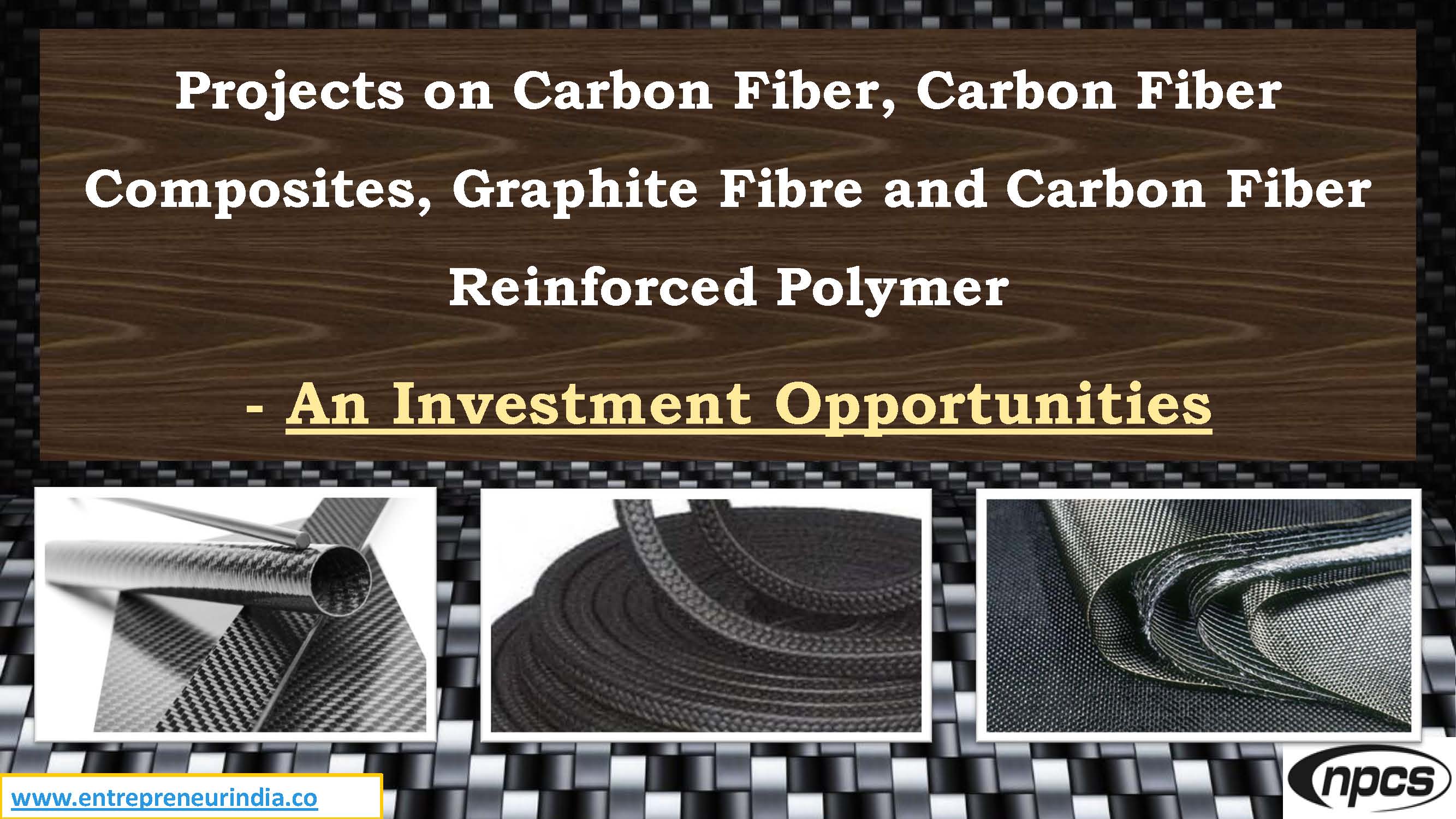
As industries move toward lightweight, high-strength materials for improved performance and efficiency, Carbon Fiber & Composites have emerged as key players in modern manufacturing. Known for their superior strength-to-weight ratio, corrosion resistance, and design flexibility, these advanced materials are revolutionizing sectors like aerospace, automotive, defense, wind energy, and sports equipment. Moreover, with India actively promoting indigenous production under Make-in-India and defense offset programs, setting up a business in Carbon Fiber & Composites offers lucrative opportunities with long-term potential.
Carbon Fiber & Composites Projects | Business Setup Guide
Carbon Fiber & Composites refer to materials made by reinforcing polymers with carbon fibers to achieve high strength, low weight, and superior durability. These composites are used wherever performance, fuel efficiency, or structural integrity is critical. From aircraft wings and satellite structures to high-end bicycles and prosthetics, carbon fiber-based products are seeing widespread application. Moreover, India’s growing interest in green mobility and high-tech infrastructure is fueling demand for both raw carbon fibers and finished composite products.
What Are Carbon Fiber Composites?
Carbon fiber is a synthetic fiber made by heating organic polymers, usually polyacrylonitrile (PAN), at high temperatures in a controlled environment. The result is a high-tensile, lightweight material that, when combined with a matrix resin (like epoxy), forms carbon fiber-reinforced composites. These composites can be:
Prepregs: Pre-impregnated carbon fiber sheets used in aerospace and defense
Laminates: Multiple layers of carbon fiber sheets bonded together
Chopped fiber composites: Used in injection molding for automotive and consumer goods
Filament-wound structures: Cylindrical components like pressure vessels and pipes
Moreover, the customization of fiber orientation and matrix combinations allows endless possibilities for application-specific properties.
Read Also :Food & Beverage Industry
Types of Products You Can Manufacture
Your Carbon Fiber & Composites business can cater to diverse industries by producing:
Raw carbon fibers (PAN-based)
Prepreg sheets for aerospace and motorsports
Carbon fiber sheets and rods
Composites for automotive panels and EV components
Industrial parts like rollers, jigs, and brackets
Sports equipment (e.g., rackets, bats, helmets)
Medical components like prosthetic limbs
Defense-grade parts such as UAV frames or ballistic panels
Moreover, by selecting niche segments like e-mobility or renewable energy, you can build a highly specialized and profitable business.
Raw Materials and Sourcing
To manufacture Carbon Fiber & Composites, you need:
Precursor fibers: PAN, pitch, or rayon-based (PAN is the most common)
Resins: Epoxy, polyester, vinyl ester, or phenolic resins
Additives: Curing agents, accelerators, flame retardants, UV stabilizers
Release agents and hardeners for mold separation
Protective films and core materials like foam or honeycomb (for sandwich structures)
Moreover, importing PAN fiber or establishing a tie-up with domestic PAN fiber producers is crucial for ensuring consistency and quality.
Manufacturing Process
The process for Carbon Fiber & Composites depends on the product but generally includes:
Precursor fiber preparation – PAN fibers are oxidized and carbonized at high temperatures
Layup or molding – Fibers are layered in desired orientation, either manually or with automated layup systems
Resin infusion or prepreg application – The matrix resin is applied to bind the fibers
Curing – Resin is cured under heat and pressure using autoclaves or hot presses
Finishing and trimming – The cured product is cut, sanded, and polished
Quality testing – Nondestructive tests ensure strength, porosity, and weight criteria are met
Moreover, vacuum-assisted resin transfer molding (VARTM) and filament winding are used for precision and efficiency in industrial components.
Required Machinery and Equipment
Setting up a Carbon Fiber & Composites manufacturing unit involves:
Carbonization and oxidation ovens (for PAN to carbon conversion)
Autoclaves or hot press systems
Resin mixing and dispensing machines
Filament winding machines (for pipes, tanks)
Prepreg machines
CNC cutters or waterjet cutting systems
Quality testing tools (UTM, C-scan, density testers)
Moreover, proper clean room setups, fume extraction, and safety systems are essential for compliance and worker safety.
Investment and Profit Potential
The capital requirement varies by product and production capacity:
| Type of Unit | Investment (INR) | Monthly Profit Potential |
|---|---|---|
| Small parts and accessories unit | ?50 lakhs – ?1 crore | ?2 – ?4 lakhs |
| Prepreg or composite sheet plant | ?2 – ?5 crores | ?5 – ?8 lakhs |
| PAN-to-carbon fiber plant (large) | ?15 – ?25 crores | ?15+ lakhs |
Moreover, high-value niche markets like drone frames, prosthetics, or aerospace parts offer margins exceeding 30% on premium orders.
Target Industries and Demand Sectors
Demand for Carbon Fiber & Composites is growing across:
Aerospace and aviation – Aircraft panels, seats, UAVs
Automotive – EV frames, body panels, bumpers
Defense and homeland security – Lightweight armor, vehicle structures
Sports and recreation – Bikes, golf clubs, protective gear
Medical – Surgical instruments, orthotic supports
Industrial – Robotics, pressure vessels, machine parts
Moreover, government tenders, defense offsets, and R&D collaborations drive steady, long-term demand.
Export Potential
India is emerging as a competitive exporter of composite materials and parts. Key export destinations include:
USA
Germany
France
UAE
Australia
Japan
Products such as carbon fiber tubes, sheets, and custom automotive components are in growing demand. Moreover, compliance with ASTM, ISO, and AS9100 standards makes your products eligible for global markets.
Regulatory Compliance & Certifications
To run a Carbon Fiber & Composites unit smoothly, ensure the following:
Factory License and MSME/Udyam Registration
GST registration
Pollution Control Board clearance
Fire & Safety NOC
ISO 9001/14001 for process and environment management
AS9100/TS16949 if supplying to aerospace or automotive sectors
Export-Import Code (IEC) for international trade
Moreover, having certified testing labs or partnerships ensures quality assurance and customer trust.
Government Support and Schemes
You can benefit from various central and state-level schemes:
PLI Scheme for Advanced Chemistry Cell & Auto Components
DRDO collaboration grants for defense manufacturing
Start-up India benefits including funding access and tax exemptions
Export incentives under RoDTEP
Cluster support for industrial hubs like Pune, Bengaluru, and Hyderabad
Moreover, organizations like TIFAC and DST support innovation in carbon composite technology through R&D grants.
See Also :IV Fluid Manufacturing
Conclusion
Starting a Carbon Fiber & Composites business places you at the forefront of modern, lightweight manufacturing that powers aerospace, automotive, defense, and renewable sectors. With growing global and domestic demand, supportive policies, and technological advancements, this high-potential business promises excellent scalability and long-term returns. Moreover, entrepreneurs who focus on quality, innovation, and market alignment can establish themselves as leaders in this premium, future-ready industry.