
Contents
- 1. What is Onion Powder Manufacturing?
- 2. Why Onion Powder Manufacturing Business is Profitable
- 3. Onion Powder Manufacturing Plant Cost in India
- 4. Onion Powder Manufacturing Business Plan
- 5. Understanding the Onion Powder Manufacturing Process
- 6. Onion Powder Manufacturing Machine & Equipment
- 7. Investment and Profit Margin
- 8. Marketing and Distribution Channels
- 9. Regulatory Compliance and Licensing
- 10. Challenges in Onion Powder Manufacturing
- 11. Frequently Asked Questions
- 12. Conclusion
- 13. Looking to Start an Onion Powder Manufacturing Business?
What is Onion Powder Manufacturing?
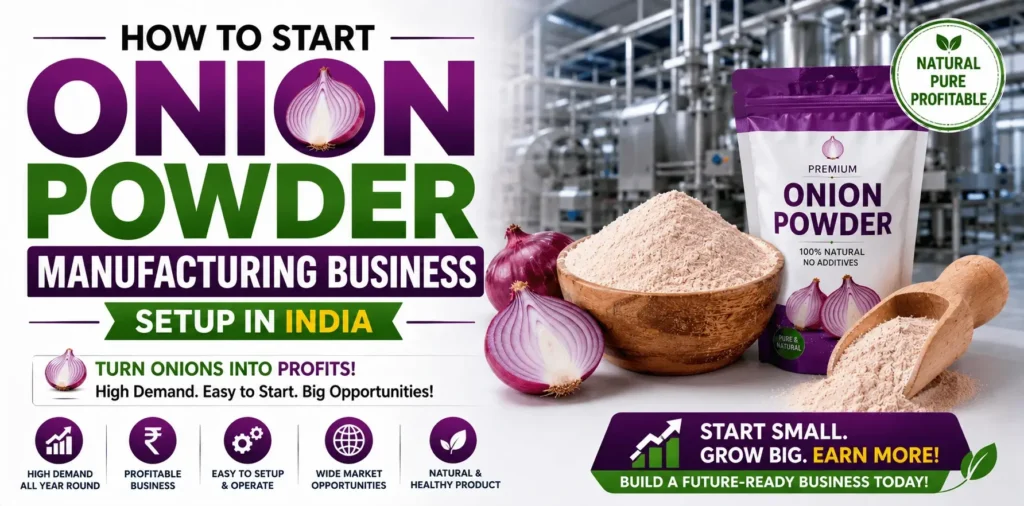
Onion powder manufacturing is a food processing business that converts fresh onions into dehydrated powder through cleaning, slicing, drying, grinding, and packaging processes for seasoning and food industry applications. Onion powder is a widely used seasoning, it adds strong flavor and aroma to dishes and is essential in many food processing industries. With growing demand from fast food chains, restaurants, and households, the onion powder manufacturing business has emerged as a lucrative opportunity for entrepreneurs. This venture is particularly attractive due to the availability of raw materials, simple processing methods, and increasing consumption in domestic and international markets.
Why Onion Powder Manufacturing Business is Profitable
The onion powder manufacturing business is gaining popularity due to:
- Rising demand from food processing industries
- Growing fast-food market
- Export opportunities
- Long shelf life compared to fresh onions
- High value addition
- Easy storage and transportation
Profit margins in onion powder manufacturing can range between 30%–40% depending on raw material sourcing, drying efficiency, and market positioning.
Onion Powder Manufacturing Plant Cost in India
Small-Scale Onion Powder Unit
- ₹10 lakh – ₹20 lakh investment
Medium-Scale Manufacturing Plant
- ₹30 lakh – ₹60 lakh investment
Major Cost Areas
- Drying machinery
- Pulverizer
- Packaging machines
- Raw onions
- Factory setup
- Labor
- Electricity
Onion Powder Manufacturing Business Plan
Include:
- raw material sourcing
- machinery setup
- drying technology
- packaging
- distribution
- export opportunities
- ROI
- breakeven
Understanding the Onion Powder Manufacturing Process
The process of onion powder manufacturing involves several carefully controlled steps to retain the flavor and nutritional quality of onions. It includes procurement, sorting, washing, slicing, drying, grinding, and packaging. Each phase plays a crucial role in ensuring the final product meets market standards.
See Also: How to Manufacture Fruit Juice
1. Raw Material Procurement
The first step in onion powder manufacturing is sourcing high-quality fresh onions. Medium-sized, white or red onions with low moisture content are ideal. Local markets, contract farming, or direct purchase from farmers can be good sources of supply. Seasonal availability and storage conditions significantly affect production planning. It’s important to ensure a consistent supply chain to maintain year-round operations.
2. Cleaning and Sorting
After procurement, the onions are thoroughly cleaned to remove soil, dust, pesticides, and other foreign particles. Mechanical washers or water jets are commonly used for this purpose. Once cleaned, the onions are sorted manually or with grading machines based on size and quality. Spoiled or infected onions are discarded to avoid contamination during processing.
3. Peeling and Slicing
The next step in onion powder manufacturing is peeling. Manual or automatic peeling machines can be used, depending on the production scale. After peeling, onions are sliced into uniform thin layers, usually between 2 mm to 5 mm. Uniform slicing is essential for even drying and better quality powder. Some units may also use blanching methods to enhance color retention and microbial safety.
4. Drying/dehydration Process
Drying is the most critical part of onion powder manufacturing. The objective is to reduce moisture content to below 5%, which helps in long shelf life. Various drying techniques are used, including:
Sun Drying (for small-scale units): Economical but slow and weather-dependent.
Mechanical Tray Dryers: Commonly used in medium-scale production. Drying temperature ranges between 55°C to 65°C.
Fluidized Bed Dryers or Vacuum Dryers: Used in advanced facilities for higher efficiency and better quality control.
Proper drying ensures that the final product is free from microbial growth and retains strong flavor and aroma.
5. Grinding and Milling
Once dried, the onion slices are transferred to grinders or pulverizers. This converts the dehydrated flakes into fine powder. The grinding process should be done in an environment that prevents moisture absorption. Mesh size can vary depending on the end-use; finer powders are preferred for seasoning and food mixes, while coarser granules may be used in soups or snacks.
6. Sieving and Quality Testing
The ground onion powder is passed through sieves to ensure uniformity in particle size. Quality testing for microbial load, moisture content, and flavor is essential before packaging. Tests are conducted in laboratories to meet FSSAI, ISO, or HACCP standards, especially if the product is for export.
7. Packaging and Storage
Packaging is vital in onion powder manufacturing to ensure product safety and extended shelf life. The powder should be packed in moisture-proof, air-tight, food-grade bags or pouches. Common packaging materials include laminated pouches, aluminum foil packs, and HDPE containers. Labels must include product name, weight, ingredients, batch number, manufacturing and expiry dates, and certifications. Store in a cool, dry place away from sunlight to prevent caking and spoilage.
See Also: Start Sugarcane Juice Preservation & Bottling Plant
Onion Powder Manufacturing Machine & Equipment
A typical onion powder manufacturing unit includes the following machinery:
Onion washer
Peeling machine
Slicing machine
Tray or conveyor dryer
Pulverizer/grinder
Sieving machine
Packaging machine
Weighing scale
Sealing machine
Optional equipment includes elevators, storage bins, and quality testing instruments. Small-scale units may start with manual methods, while larger facilities require automated or semi-automated setups for efficiency.
Investment and Profit Margin
The investment required for onion powder manufacturing varies based on production capacity. For a small-scale unit, the setup may cost ?10 lakhs to ?20 lakhs, including equipment, infrastructure, and initial working capital. Medium and large-scale plants can require upwards of ?50 lakhs. Government subsidies under MSME or food processing schemes can reduce initial investment burdens.
Profit margins in this business are quite attractive. The cost of raw onions is relatively low, and value addition through dehydration and packaging can increase the selling price significantly. A well-run unit can achieve 30%–40% gross profit, depending on the quality, brand positioning, and distribution network.
Marketing and Distribution Channels
Effective marketing strategies are key to success in the onion powder manufacturing business. Here are some common channels:
B2B sales: Supply to food processing companies, spice manufacturers, and restaurants.
Retail outlets: Packaging smaller units for direct sale in grocery stores and supermarkets.
Online marketplaces: Selling through Amazon, Flipkart, BigBasket, etc. under a private label.
Exports: Huge potential in countries like the USA, UAE, UK, and Canada where Indian spices are in high demand.
You can also attend food expos, trade fairs, and connect with wholesale distributors to expand your market.
Regulatory Compliance and Licensing
To operate a legal onion powder manufacturing unit in India, the following licenses and approvals are required:
FSSAI Registration: Mandatory for any food business.
GST Registration: For tax compliance and invoicing.
Factory License: Depending on production scale and location.
Pollution Control Certificate: Especially if wastewater or emissions are involved.
Trade License from local authorities.
ISO or HACCP Certification (optional): For better quality assurance and export credibility.
Keeping accurate records and following hygiene and safety protocols is essential for smooth operations and customer trust.
Challenges in Onion Powder Manufacturing
While this business offers good returns, there are some challenges you may face:
Price Fluctuations in Raw Onions: Seasonal variation can affect margins.
Moisture Control: In humid climates, maintaining powder quality can be difficult.
Shelf Life: Poor packaging or storage may lead to caking or flavor loss.
Market Competition: Established brands may dominate retail space.
Logistics: Transporting bulk quantities safely and economically can be challenging.
Overcoming these challenges requires proper planning, efficient systems, and continuous quality improvement.
Frequently Asked Questions
Q1. What is the onion powder manufacturing process?
The onion powder manufacturing process includes cleaning, slicing, drying, grinding, sieving, and packaging onions into dehydrated powder form.
Q2. What is the profit margin in onion powder manufacturing?
Profit margins can range between 30%–40% depending on production efficiency, raw material pricing, and branding.
Q3. How much investment is required for onion powder manufacturing plant?
Small-scale onion powder manufacturing plants may require investments starting from ₹10 lakh to ₹20 lakh. Medium-scale units may require higher investments depending on automation levels.
Q4. What machinery is required for onion powder manufacturing?
Major machinery includes onion washers, slicers, tray dryers, pulverizers, sieving machines, and packaging equipment.
See Also: Grain Alcohol Distillery
Conclusion
Onion Powder Manufacturing Business is a profitable agro-processing business with strong demand in both domestic and international markets. It offers excellent scalability, value addition, and job creation potential. With the right investment in equipment, quality control, and marketing, entrepreneurs can build a sustainable and rewarding venture. The growing inclination toward convenience foods and ready-made spice mixes ensures long-term viability for this industry.
Looking to Start an Onion Powder Manufacturing Business?
If you are planning to establish an onion powder manufacturing plant, professional consultancy can help with:
- Detailed Project Reports (DPR)
- Plant setup guidance
- Drying technology consultation
- Machinery selection
- Food processing compliance
- Packaging solutions
- Export guidance
- Financial feasibility analysis
Contact our expert team today to explore profitable onion powder manufacturing business opportunities.