
Before starting a new business, industrial project, manufacturing unit, or startup, entrepreneurs must evaluate whether the idea is practical, profitable, and sustainable. This is where feasibility studies and feasibility analysis become important tools in business planning.
Many people confuse feasibility study and feasibility analysis, but both serve different purposes in project evaluation and investment decision-making. Understanding the difference can help startups, SMEs, and industrial investors reduce risks, improve financial planning, and increase business success rates.
In this guide, we explain feasibility study vs feasibility analysis, their importance, applications, benefits, and how businesses use them for smarter strategic decisions.
Contents
- 0.1. Key Takeaway
- 0.2. Understanding Feasibility Study
- 0.3. Understanding Feasibility Analysis
- 0.4. Applications of Feasibility Study vs Feasibility Analysis
- 0.5. Why Feasibility Evaluation is Essential
- 0.6. How to Conduct a Feasibility Study
- 0.7. How to Conduct a Targeted Feasibility Analysis
- 0.8. Real-World Case Study: Merging Feasibility Methods
- 0.9. Difference Between Feasibility Study and Business Plan
- 0.10. Need Expert Feasibility Study Support?
- 1. Frequently Asked Question
Key Takeaway
A feasibility study evaluates the complete viability of a business or project, while feasibility analysis focuses on examining specific factors such as finance, operations, or technical capability in greater detail.
Understanding Feasibility Study
The feasibility study is actually one type of comprehensive assessment that is required to find out whether proposed project feasibility and viability would exist. This holistic evaluation for financial, technical, operational, and legal aspects is meant to arrive at a better all-round understanding of how well the project can work. It would help the stakeholders decide on whether to make a move.
For example, if an organization would want to consider starting up a manufacturing plant, the feasibility study would look into the availability of raw materials, labor force, market demand, cost, and legal compliance for the activity. This broad evaluation makes sure that there are no overlooked factors in terms of resource commitment.
These include the following essential components of a feasibility study:
- Market Study: Determining demand, competition, and customer needs.
- Technical Review: Finding out whether the required technology and infrastructure can be made available.
- Financial Analysis: Determining costs, revenue, and overall funding.
- Operational Planning: Fit of the project. Legal: Addressing the regulations and possible legal issues.
While feasibility studies provide a broad evaluation of an entire project, feasibility analysis focuses more deeply on specific components that may affect project success, profitability, or operational performance.
Understanding Feasibility Analysis
Yet, feasibility analysis deals with detailed considerations of individual elements of the project. In fact, it is a very focused procedure often used to address some particular issues or examine single components. Whereas a feasibility study might broadly outline most aspects of an entire program, feasibility analysis typically delves more specifically for more granular insights.
For example, prospective research might be in the feasibility analysis by throwing closer attention at whether the technology required for a new application software is feasible under budget and time estimated in the case of an organization that is unsure of the technology challenges that lie ahead. Or, a financial feasibility analysis can focus solely on ROI regarding a concept under consideration.
Also, Read Our Feasibility Study Reports
Differences Between Feasibility Study and Feasibility Analysis
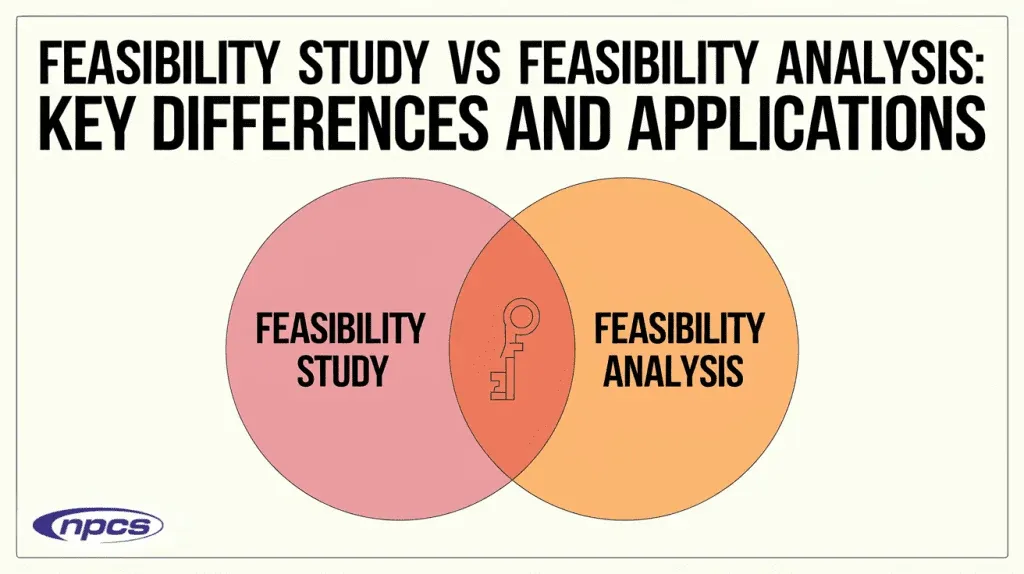
The difference between a feasibility study and a feasibility analysis is scope and objective. Feasibility studies cover all aspects of a project comprehensively, providing a macro-level understanding of the viability. It is, however, accounted for in the feasibility analysis where studies presented a narrow focus on specific areas leading to micro-level insights that can be compiled into the general feasibility evaluations.
For example, while a feasibility study for a real estate development would explore factors such as how much demand there is in the market, how legal constraints would be applicable, and the cost of construction itself, a feasibility analysis would drill down into such things as impact or financial modeling on the environment. Individually, they provide a view into detail balanced with a big picture.
Applications of Feasibility Study vs Feasibility Analysis
Both feasibility studies and feasibility analyses are essential tools used across industries to support better decision-making, reduce risks, and evaluate investment opportunities before major resources are committed.
- Business Expansion: A company that has recently ventured into a new market can perform feasibility studies on the possible demand, regulatory requirements, as well as the competition. It may also turn to feasibility analysis when focusing on the cultural preferences or distribution challenges of the market.
- Product Launch: Feasibility studies help learn the trends of the market and its financial needs for startups. A further analysis into the feasibility could delve into production costs or the rate of the scalability of production.
- Infrastructure Projects: Construction projects are often very broad feasibility studies for the overall viability and engineering firms conducting tenders for a construction project usually are in the habit of making both capacity and technical analysis for validation of design.
- Sustainability Initiatives: Organizations focusing on green projects usually carry out feasibility assessments to look at the environmental and regulatory compliance and then accompany such feasibility studies with in-depth operational feasibility studies for an implementation strategy.
With these tools, organizations will be able to foresee difficulties and hidden opportunities and optimize strategies.
Why Feasibility Evaluation is Essential
A feasibility study is essential to reduce risks and increase the level of success in any business venture. Without these steps, companies can otherwise run into projects that consume resources and end in ultimate failure. A very good feasibility study will afford an overall picture, while the feasibility analysis will provide an expert examination of every area of concern.
How to Conduct a Feasibility Study
- Step 1: Define Business Objectives
- Step 2: Conduct Market Research
- Step 3: Analyze Technical Requirements
- Step 4: Estimate Financial Costs
- Step 5: Evaluate Operational Feasibility
- Step 6: Assess Legal Compliance
- Step 7: Prepare Feasibility Report
How to Conduct a Targeted Feasibility Analysis
When addressing a certain area of project analysis, these steps should be followed:
Identify the main issue
Determine what the specific question or challenge is that is to be investigated more thoroughly. For instance, if a start-up became concerned about production costs, a financial feasibility analysis might be considered.
Collect all necessary information
Gather data relevant to the issue. This could include interviewing stakeholders, studying the industry benchmarks, or consulting with specialists.
Use the right analytical tools
Use specialized software or tools to analyze the data. For example, financial modeling tools can be used to evaluate ROI, while environmental assessments may call for impact analysis software.
Provide affirmative insights
Realize a focused report that speaks to that area of concern. Those insights would be actionable, integrating fully into the overall project.
Real-World Case Study: Merging Feasibility Methods
A company that is about to launch an electric vehicle (EV) manufacturing plant puts up a feasibility study that includes everything about its probable market trends, financial projections, technical requirements, and environmental effects.
During this process, one key challenge arises: the procurement of sustainable battery materials. The company decides to conduct a focused feasibility analysis: alternatives such as recycling or sourcing locally are analyzed. Findings from this analysis help sharpen the larger study to produce a more viable strategy.
Also Read: What are the Components of a Project Feasibility Report?
Difference Between Feasibility Study and Business Plan
Although feasibility studies and business plans are closely related, they serve different purposes in business planning and project development. A feasibility study is prepared before launching a project to determine whether the business idea is practical, profitable, and sustainable. In contrast, a business plan is created after feasibility approval and acts as a roadmap for managing and growing the business successfully.
A feasibility study focuses on evaluating technical, financial, operational, legal, and market-related factors to reduce investment risks and support decision-making. On the other hand, a business plan explains how the business will operate, generate revenue, achieve growth targets, and manage day-to-day activities.
| Feasibility Study | Business Plan |
|---|---|
| Evaluates project viability and practicality | Provides business execution strategy |
| Conducted before investment decisions | Prepared after project feasibility approval |
| Focuses on risks, costs, and opportunities | Focuses on operations, marketing, and growth |
| Helps determine whether to start the project | Helps manage and expand the business |
| Used for project evaluation and investment analysis | Used for business management and funding |
For example, an entrepreneur planning a food processing plant may first conduct a feasibility study to evaluate market demand, machinery costs, raw material availability, and profitability. Once the project is found viable, a business plan is prepared to outline production strategy, staffing, marketing, operations, and financial projections for business execution.
Frequently Asked Questions
Q1. What is project feasibility?
A feasibility study is a detailed assessment used to determine whether a business idea, industrial project, startup, or investment opportunity is technically, financially, operationally, and commercially viable before implementation.
Q2. What are the main types of feasibility studies?
The main types are:
- technical feasibility
- financial feasibility
- operational feasibility
- market feasibility
- legal feasibility
Q3. How are feasibility study and analysis different?
A feasibility study provides a broad evaluation of an entire project, while feasibility analysis focuses on examining specific aspects such as technical capability, financial performance, or operational feasibility in greater detail.
Q4. Why is feasibility study important for startups?
Feasibility studies help startups reduce risks, estimate costs, identify market demand, and improve business planning.
Q5. How do industries use feasibility studies?
Industries use feasibility studies for plant setup, investment planning, machinery selection, market evaluation, and profitability analysis.
Final Thoughts
Feasibility studies and feasibility analysis are essential tools for evaluating business ideas, industrial projects, and investment opportunities before major decisions are made. They help businesses reduce risks, improve planning, and identify profitable opportunities more effectively. Whether for startups, SMEs, or large industrial ventures, proper feasibility evaluation plays a critical role in long-term business success and sustainable growth.
Need Expert Feasibility Study Support?
If you are planning a startup, manufacturing plant, industrial project, hospital, food processing unit, or infrastructure venture, professional feasibility study services can help with:
- Detailed Project Reports (DPR)
- Market feasibility reports
- Manufacturing project analysis
- Financial viability studies
- Technical feasibility evaluation
- Industrial project planning
- Business viability assessment
- Investment opportunity reports
- Risk assessment
Contact our expert team today for customized business consulting solutions and project consultancy solutions.