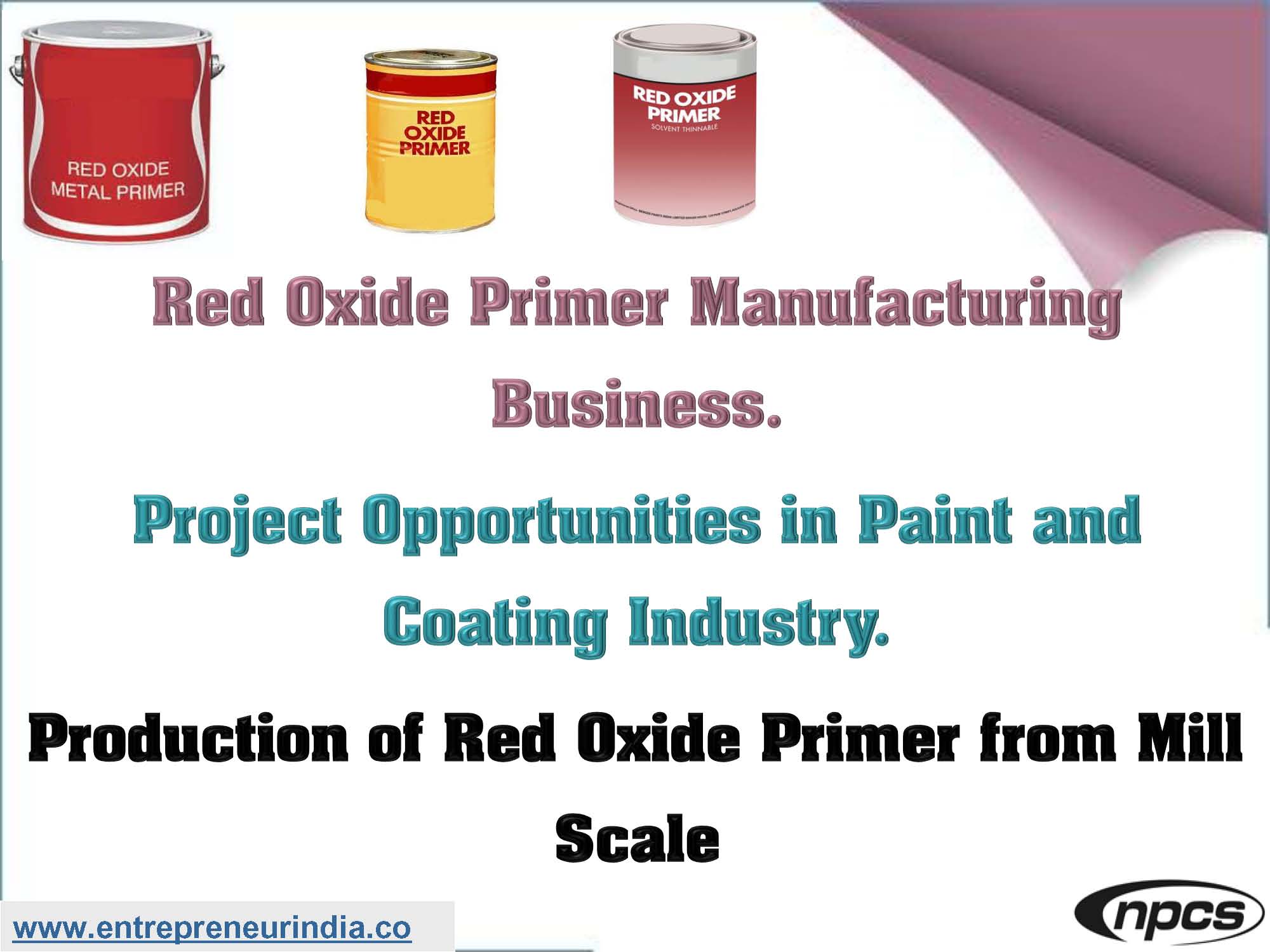
The Red Oxide Primer manufacturing business is a profitable venture in the paint and surface protection industry. Known for its rust-inhibiting properties, red oxide primer is widely used in construction, automotive, agricultural tools, structural steel, and industrial machinery. Its strong adhesion, affordability, and durability make it a staple in both residential and industrial applications. With a steady demand from infrastructure and manufacturing sectors, this business offers promising growth and returns.
Growing Demand for Anti-Corrosive Coatings
As industrialization and urban development continue to rise, so does the need for corrosion protection. Red Oxide Primer acts as the first line of defense against rust and surface deterioration. It ensures long-lasting finishes on metal surfaces and improves the adhesion of topcoats. Its demand spans across steel plants, engineering firms, construction sites, and home renovations, making it a staple product in the protective coatings market.
Applications of Red Oxide Primer
Red oxide primer is applied across a broad range of metal surfaces where rust prevention is crucial:
Steel Structures: Bridges, trusses, towers, beams, and columns
Machinery and Equipment: Industrial parts, machines, and frames
Automotive Parts: Car chassis, trailers, and undercarriages
Agricultural Implements: Tools, pipes, tanks, and fencing
Home Renovation: Grills, railings, gates, and fabricated metal works
Its compatibility with enamel and synthetic topcoats further increases its utility in various finishing systems.
Key Raw Materials Required
Manufacturing Red Oxide Primer involves the blending of several chemical and mineral components:
Red Iron Oxide (Fe?O?) – Provides rust resistance and pigmentation
Resins – Alkyd resin or synthetic resin for binding and adhesion
Solvents – Mineral turpentine oil (MTO), xylene, or toluene
Driers – Cobalt, manganese, or lead-based driers for faster drying
Additives – Anti-skinning agents and thickeners
Fillers – China clay, talc, or barytes for body and coverage
Dispersing Agents – For smooth mixing of pigments and resins
Sourcing high-grade and consistent materials ensures better product performance and customer satisfaction.
Manufacturing Process of Red Oxide Primer
The process to produce red oxide primer involves systematic mixing, dispersion, and quality control:
Pigment Dispersion
Red iron oxide pigment is mixed with solvents and dispersing agents in a high-speed mixer or bead mill.Resin Addition
Alkyd resin or binder is added to the dispersion under controlled stirring to form the base of the primer.Incorporation of Additives
Driers, anti-skinning agents, and stabilizers are blended in to improve shelf-life and drying performance.Filler Integration
Fillers such as talc or barytes are added to achieve the desired thickness and opacity.Filtration and Quality Testing
The batch is filtered to remove any coarse particles and tested for viscosity, drying time, coverage, and adhesion.Packaging
The finished primer is filled into tins, drums, or buckets based on the target market – retail or industrial.
The entire process should follow quality standards like IS 2074:1992 (for red oxide primer) to maintain consistency and compliance.
Machinery and Infrastructure Required
Setting up a Red Oxide Primer manufacturing unit requires the following machinery and tools:
High-speed Disperser or Bead Mill
Mixing Kettles with Agitators
Weighing Scales and Dosing Units
Filtration Units and Strainers
Packaging Machines (Semi or Automatic)
Fume Extraction and Ventilation Systems
Quality Control Lab Instruments
A small to medium-scale plant with a production capacity of 1,000–5,000 liters per day can be set up with an investment of ?15–?50 lakhs, excluding land.
Quality Control and Testing Parameters
Consistent product quality ensures trust and repeat orders. Key tests for red oxide primer include:
Viscosity Check – Measured with a B4 Ford Cup
Drying Time Test – Surface dry and hard dry parameters
Adhesion Test – Cross-hatch or pull-off test on metal panels
Coverage Measurement – Square meter per liter coverage
Salt Spray Test – To assess corrosion resistance
Color Consistency and Stability
Adopting a documented quality assurance system enhances brand image and simplifies certification processes.
Licensing and Regulatory Requirements
To legally operate a red oxide primer manufacturing business, obtain the following licenses:
Udyam/MSME Registration
GST Registration
Factory License
Pollution Control NOC
Fire Safety Compliance
Trademark Registration (Optional)
BIS Certification (IS 2074) for government or bulk tenders
Proper documentation builds credibility and opens opportunities in institutional and export markets.
Packaging and Branding Strategy
For effective market penetration, pay attention to packaging design and durability:
Retail Packs: 500 ml, 1 L, 4 L, and 10 L cans
Bulk Packs: 20 L, 50 L drums for industrial clients
Labeling: Must include product type, batch number, usage instructions, safety info, and manufacturing details
Branding: Position the product as corrosion-resistant, fast-drying, and economical for painters and contractors
A strong brand identity supported by product performance increases dealer confidence and customer loyalty.
Marketing and Distribution Channels
Red oxide primer sells through both B2B and B2C channels:
Paint Retailers and Hardware Stores
Construction Contractors and Real Estate Developers
Industrial Maintenance Service Providers
Online Portals and B2B Platforms (IndiaMART, TradeIndia)
Direct Sales to Engineering and Fabrication Units
Offering free samples, discount schemes, and loyalty programs to dealers enhances product visibility and shelf space.
Profitability and ROI
The red oxide primer market offers:
Low raw material and operational cost
High repeat demand from core industries
Margins of 15%–25% depending on volume
Breakeven within 1.5–2 years in well-managed plants
Scalability is possible through product diversification into metal primers, zinc-rich primers, and water-based anti-corrosive coatings.
Environmental and Safety Measures
Manufacturing involves solvents and chemical handling, so ensure:
Proper ventilation and PPE for workers
MSDS and labeling for hazardous materials
Effluent treatment for water-based discharge
Fire safety measures and flameproof electricals
Adhering to environmental norms boosts eligibility for industrial incentives and certifications.
Conclusion
The Red Oxide Primer manufacturing business presents a solid opportunity for entrepreneurs interested in the paints and coatings industry. With consistent demand across sectors, low production costs, and excellent scalability, this business promises sustainable profits. By maintaining quality standards, obtaining necessary licenses, and adopting smart branding, manufacturers can build a trusted and profitable brand in this evergreen market.
Niir Project Consultancy Services
An ISO 9001:2015 Company
106-E, Kamla Nagar, Opp. Spark Mall,
New Delhi-110007, India.
Email: npcs.ei@gmail.com , info@entrepreneurindia.co
Tel: +91-11-23843955, 23845654, 23845886, 8800733955
Mobile: +91-9811043595
Website: www.entrepreneurindia.co , www.niir.org