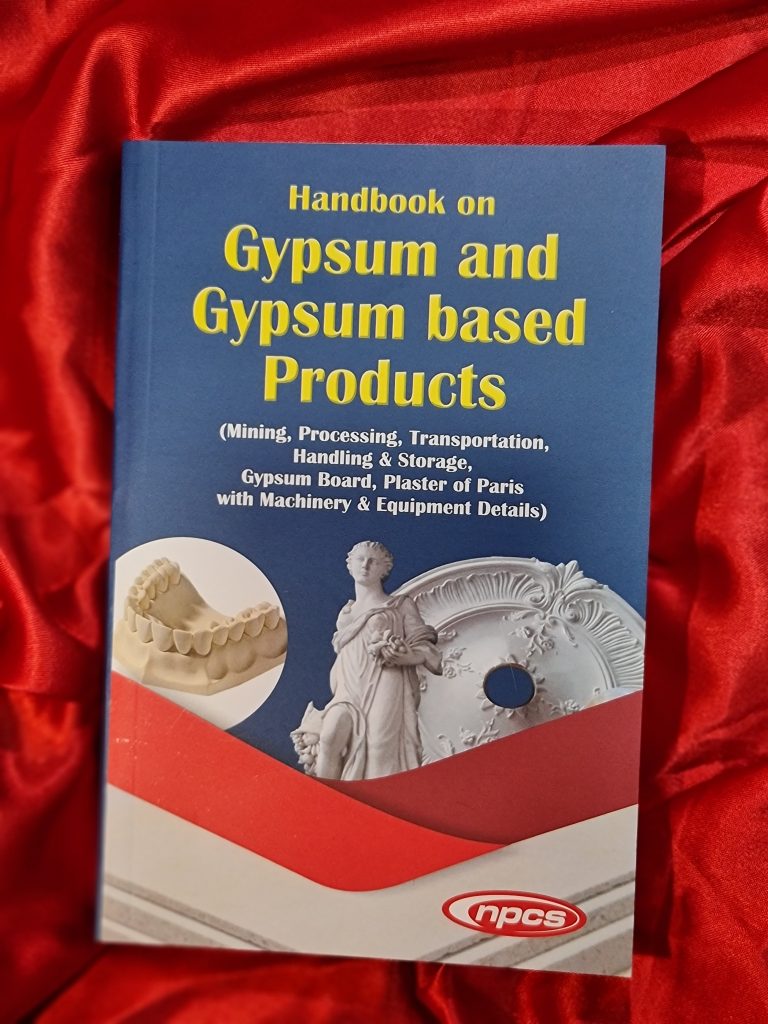

If you’re looking for a highly scalable and industrially relevant opportunity, then it’s time to start your own gypsum business. Gypsum is a mineral used widely in construction, agriculture, cement, and even medical industries. With the real estate and infrastructure sectors booming in emerging markets like India, the demand for gypsum-based products such as plaster of Paris, wall panels, and gypsum boards is on the rise. Low entry barriers, abundant raw materials, and increasing demand make it a profitable segment for entrepreneurs aiming to enter the building materials market.
Contents
- 1. Why Gypsum is a High-Potential Business
- 1.1. Various Gypsum-Based Business Models
- 1.2. Manufacturing Process and Machinery
- 1.3. Raw Material and Utilities
- 1.4. Licensing and Legal Compliance
- 1.5. Market Strategy and Customer Segments
- 1.6. Cost Breakdown and Profit Potential
- 1.7. Challenges and Risk Mitigation
- 1.8. Conclusion
- 1.9. About Niir Project Consultancy Services (NPCS)
Why Gypsum is a High-Potential Business
Gypsum is a naturally occurring mineral composed of calcium sulfate dihydrate, and it serves multiple industrial purposes. In the construction sector, it’s used for producing gypsum boards, plaster, and drywall systems. In agriculture, gypsum is used as a soil conditioner, and in the medical sector, it plays a role in creating surgical molds and dental impressions. When you start your own gypsum business, you’re entering a market with constant, year-round demand from various industries.
The increasing adoption of prefabricated construction systems, lightweight building panels, and sustainable construction materials has further driven the use of gypsum-based products. Additionally, since gypsum can be recycled and reused, it fits well into eco-friendly and green construction goals. These factors make the gypsum business not only profitable but also future-proof and aligned with environmental sustainability trends.
Various Gypsum-Based Business Models
There are several ways to start your own gypsum business, depending on your budget, target market, and technical capabilities:
Gypsum Mining and Supply: Extracting raw gypsum and supplying it to industries such as cement and construction.
Plaster of Paris Manufacturing: Heating gypsum to produce POP for use in decoration, casting, and construction.
Gypsum Board/Sheet Production: Used for false ceilings, interior walls, and partitions.
Gypsum Powder for Agriculture: Selling finely ground gypsum to farmers as a soil enhancer and conditioner.
Gypsum Moulds and Artifacts: Creating decorative pieces, ceiling medallions, and sculptural products.
Each model offers a different investment and returns profile. For first-time entrepreneurs, manufacturing POP or gypsum boards on a small to medium scale is often a good entry point.
Manufacturing Process and Machinery
If you plan to start your own gypsum business with a manufacturing unit, you need to understand the production process. For Plaster of Paris (POP), the process involves:
Crushing the raw gypsum to a fine powder.
Heating the powder in a rotary kiln or calciner to remove moisture and convert it into POP.
Cooling and grinding the calcined product to uniform fineness.
Packaging the final product into bags or containers.
For gypsum board production, the process includes:
Mixing gypsum with water and additives.
Pouring the slurry onto a moving belt lined with paper.
Setting, cutting, and drying the boards.
Stacking, finishing, and packaging for delivery.
Essential machinery includes crushers, calcining kilns, mixers, belt conveyors, board formers, dryers, and packaging equipment. A basic POP manufacturing setup may cost ?12–15 lakhs, while a gypsum board plant can range upwards of ?40–50 lakhs depending on automation level and capacity.
Raw Material and Utilities
To start your own gypsum business, the primary raw material is gypsum ore, which is widely available in India, especially in states like Rajasthan, Gujarat, and Tamil Nadu. If you’re not mining yourself, you can procure gypsum from authorized mines or industrial by-products such as phosphogypsum from fertilizer plants.
Additional materials include:
Paper liners (for board production)
Additives like starch, foaming agents, and binders
Packaging bags for POP
Electricity, water, and fuel for calcination and drying
Ensure a reliable supply chain and check local availability to minimize transportation and logistics costs. Quality of gypsum directly impacts the strength and whiteness of your end product, so source high-purity gypsum wherever possible.
Licensing and Legal Compliance
Before you start your own gypsum business, ensure all necessary licenses and permits are in place. These include:
Udyam (MSME) registration
GST registration
Factory license (as per state regulations)
Pollution Control Board NOC
BIS certification for POP (IS 2547) or gypsum boards (IS 2095)
Mining lease (if involved in extraction)
Proper compliance is key to building a sustainable and legal business. If you plan to export your products, certifications like ISO 9001, CE marking, or eco-labels can enhance credibility.
Market Strategy and Customer Segments
Your success in the gypsum sector depends heavily on your go-to-market strategy. After you start your own gypsum business, you’ll need to reach specific buyer segments such as:
Construction contractors and real estate developers
POP dealers and interior decorators
Fertilizer suppliers and agri-input retailers
Architects and design studios (for gypsum boards)
Medical/dental supply companies (for surgical-grade gypsum)
Use a combination of traditional B2B sales, channel partnerships, and modern platforms like IndiaMART, TradeIndia, or even Amazon Business for wider reach. Providing demos, attractive trade discounts, and bulk supply assurance can help in creating long-term relationships.
Branding your gypsum products with features like “extra white,” “fast setting,” or “dust-free application” can also create differentiation in a price-sensitive market.
Cost Breakdown and Profit Potential
You can start your own gypsum business on a small scale with an investment of ?15–20 lakhs for a POP unit or ?40–60 lakhs for a gypsum board plant. Here’s a sample cost structure for a small POP manufacturing setup:
Machinery and setup: ?8–10 lakhs
Raw materials: ?3–4 lakhs (initial stock)
Labor and utilities: ?1.5–2 lakhs/month
Marketing and branding: ?1 lakh
Licensing, rent, and contingencies: ?2–3 lakhs
POP and gypsum boards offer margins of 20–35% depending on scale and branding. A well-run unit can achieve monthly revenues of ?4–6 lakhs in its early phase, with significant growth potential as contracts and distributors increase.
Challenges and Risk Mitigation
Like any industry, gypsum businesses face challenges such as:
Raw material price volatility
Competition from low-cost players
Transport constraints due to bulkiness
Moisture control during storage and packaging
These can be mitigated by:
Establishing local raw material sources
Automating key processes for consistency
Maintaining dry storage conditions
Focusing on niche applications like decorative gypsum or eco-friendly boards
When you start your own gypsum business, risk planning and quality control are crucial to long-term sustainability.
Conclusion
To start your own gypsum business is to tap into a market that serves both everyday needs and infrastructure ambitions. Whether it’s producing Plaster of Paris for decorative use or manufacturing drywall systems for fast-paced construction, gypsum-based products have lasting relevance and commercial value. With the right planning, legal setup, marketing, and product quality, entrepreneurs can build a highly profitable and reputable brand in this space. As the demand for lightweight, eco-friendly, and cost-effective building materials rises, gypsum will continue to play a central role in modern construction—and your business can grow along with it.
About Niir Project Consultancy Services (NPCS)
NPCS provides reliable consultancy services worldwide and has been excelling its expertise in a wide range of services. NPCS also publishes a monthly magazine Entrepreneur India since 1995. Which is widely read by Entrepreneurs, Businessman etc. The services includes: investment opportunities, technology transfers, pre-feasibility study, business plan, new project identification, project feasibility, identification of profitable industrial project opportunities, thorough analysis of the project, plan all resources & details on capital and operational costs, economic feasibility study of the project, profile analysis, preparation of project profiles / pre-investment studies, market surveys / studies, preparation of techno-economic feasibility reports, funding analysis, market potential study, identification and section of plant /process / equipment, general guidance, technical and commercial counseling for setting up new business.
Media Contact:
Ajay Gupta
+91 8800733955
https://www.niir.org/