
Break Even Analysis for Manufacturing Business
The Number That Decides Everything — Before You Sell a Single Unit
Only 72% of the first-generation manufacturing entrepreneurs in India have never worked out the break-even point before they go into production. This number is not only a number; it is a figure from a SIDBI MSME Pulse report. It is a confession. It is like driving on the Yamuna Expressway with your headlights off — fast, confident and headed for a crash.
What is so deadly about this number when left unchecked; you can be operating at 80% capacity with a salary of ₹8 lakh per month and still be in the red. This is a common occurrence in industrial belts ranging from Morbi to Meerut every day. The machine is running. Workers are paid. Orders are flowing. However, the unit is running a leak!
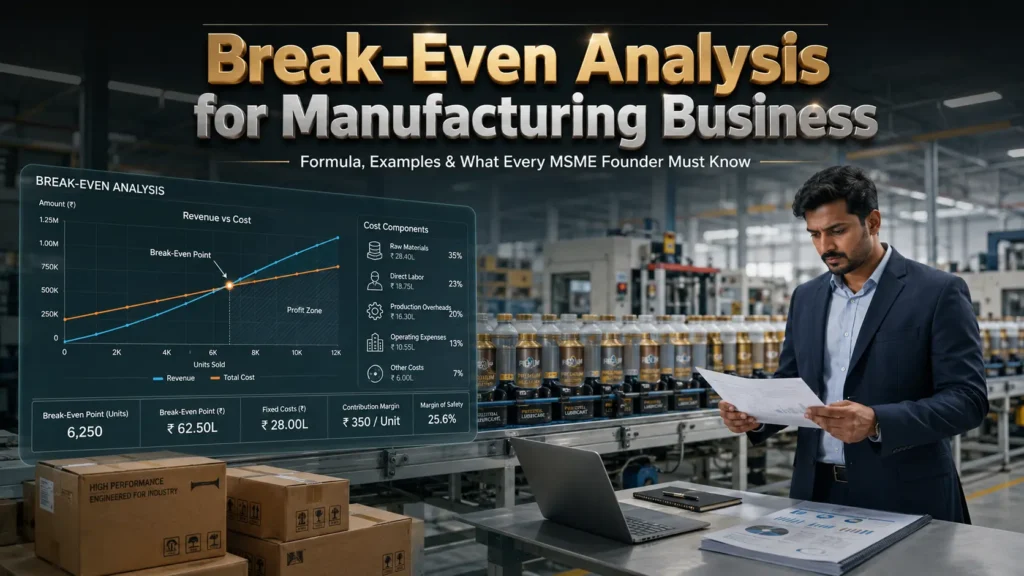
Break-even analysis will tell you precisely how many units you need to produce (or how much revenue you need to clock in) before your business starts to break even and begin to turn a profit. It is NOT a Finance Department Tool! It serves as a survival tool. It is a must-know for every MSME owner, entrepreneur with a startup investment of ₹20 lakh or ₹2 crore.
In this article, you will get the formula, real-world examples in India, and the step-by-step process to compute your break-even – for any product or production scale!
Why Most MSME Units Price Blind — and Pay for It
According to the government, India has more than 63 million MSMEs, accounting for a whopping 30% of the country’s GDP and 45% of its exports.
According to the Annual Report of the Ministry of MSME, there are more than 63 million MSMEs in India which contribute to almost 30% of GDP and 45% of exports in the country. Among these are about 14 million manufacturing units. However, there is an enduring problem in this sector – most of the owner’s price on the gut rather than on a cost basis system.
The problem is structural. In clusters such as Ludhiana (hosiery), Rajkot (engineering goods), Firozabad (glassware) and Sivakasi (fireworks and matches), the pricing for first generation entrepreneurs is passed on from the older ones. They use their lower prices to compete and don’t know if those competitor prices are profitable at all. The outcome: narrow profit margins that always disappear when costs of input increase.
Data from the Confederation of Indian Industry (CII) and the National Sample Survey Office (NSSO) reveals that more than 50 per cent of manufacturing units in India that close are not due to lack of demand but due to mismanagement of cash flows – a lot of which is directly related to under-pricing and unmanaged fixed-cost overhead.
The three industrial towns of tier-2 and tier-3, namely, Hapur in Uttar Pradesh (rubber goods), Morbi in Gujarat (ceramics) and Batala in Punjab (agricultural equipment) are most vulnerable to this issue. In each of these clusters, new firms regularly enter without considering break-even analysis — for prices that just cover variable costs and exclude fixed costs.
The immediate result: They ran straight into a wall at 6–18 months of service. Not because the market was against them. As the numbers were never calculated.
Related Article: 100 Industrial Parks Worth ₹33,660 Cr: Top Business Ideas for MSME Founders
Table 1: Break-Even Analysis Snapshot — Indian Manufacturing Sectors
| Industry / Product | Fixed Costs/Month (₹) | Variable Cost/Unit (₹) | Selling Price/Unit (₹) | Break-Even Units/Month |
| Garment Unit (Tiruppur, TN) | 3,20,000 | 180 | 320 | 2,286 |
| Plastic Moulding (Rajkot, GJ) | 4,80,000 | 42 | 95 | 906 |
| Namkeen / Snack Food (Indore, MP) | 2,10,000 | 28 | 55 | 7,778 |
| Steel Fabrication (Ludhiana, PB) | 6,50,000 | 220 | 440 | 2,955 |
| Agarbatti / Incense (Bengaluru, KA) | 1,20,000 | 12 | 28 | 7,500 |
| Paper Cup Manufacturing (Pune, MH) | 3,80,000 | 0.35 | 0.75 | 9,50,000 cups |
Source: Illustrative estimates based on MSME cluster data from SIDBI, CII, and industry association benchmarks. Actual figures vary by state and scale.
The Formula — Simple, Powerful, Non-Negotiable
There is one basic equation to break-even analysis. All other are modifications of it.
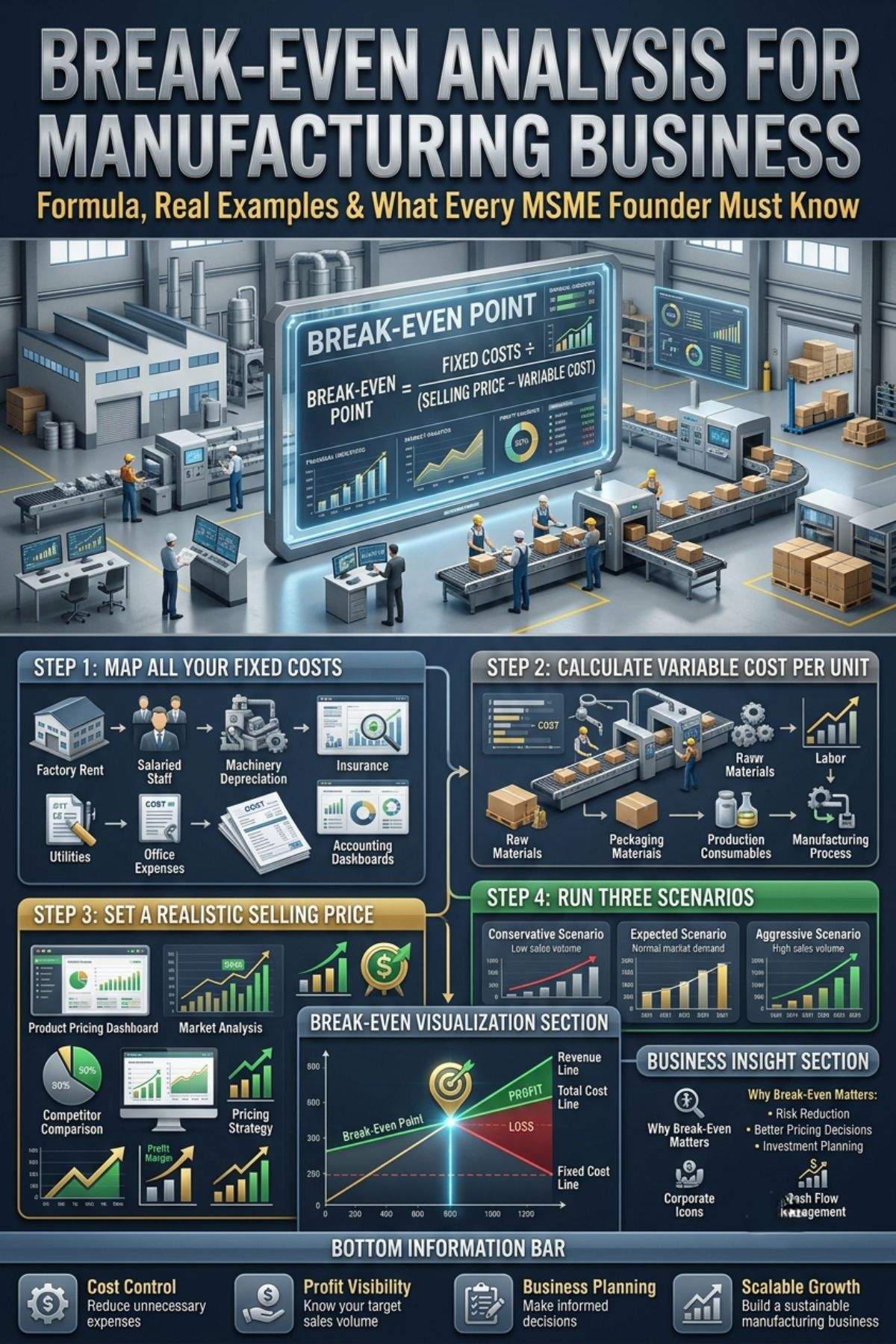
Break-Even Point (Units) = Fixed Costs ÷ (Selling Price per Unit − Variable Cost per Unit)
The Contribution Margin in this formula is the denominator or Selling Price per Unit minus Variable Cost per Unit. It indicates the amount of each unit sold that covers your fixed costs and ultimately, your profits.
A revenue-based version is also available:
Break-Even Point (Revenue) = Fixed Costs ÷ Contribution Margin Ratio
As selling price increases, the contribution margin ratio has the same trend as the contribution margin.As the selling price goes up, the contribution margin ratio follows the same pattern as the contribution margin.
Worked Example: Plastic Moulding Unit, Rajkot
A first-generation businessman establishes a plastic injection moulding shop in Rajkot. The data from Gujarat Industrial Development Corporation (GIDC) suggests that the rent of a standard GIDC shed of 1500 sq ft in Metoda Industrial Estate is in the range of ₹35,000 to ₹45,000 per month. He has fixed monthly expenses of the following amounts:
- Factory shed rent (GIDC Metoda): ₹40,000
- Loan EMI on machinery (₹18 lakh @ 10.5% over 5 years): ₹38,500
- DGVCL (Electricity fixed charges): ₹22,000
- Salaries — supervisor + admin: ₹55,000
- Depreciation, insurance, misc: ₹24,500
Total Fixed Costs: ₹1,80,000 per month
He incurs the following variable costs per kg of moulded output: raw material (HDPE) ₹92, direct labour ₹18, power per unit run ₹12 and packaging ₹8. He sells the product to a distributor at a price of ₹185 per kg.
Contribution Margin = ₹185 − ₹130 = ₹55 per kg
Break-Even = ₹1,80,000 ÷ ₹55 = 3,273 kg per month
The monthly sales in this unit have to be 3,273 kg to be profitable. At 5,000 kg — a realistic 70% capacity run — it earns ₹94,985 in monthly profit. At 60% (4,300 kg), profit is ₹56,650. The numbers shouldn’t tell the originator what to shoot!
Why Government Schemes Must Factor into Your Break-Even
PMEGP (Prime Minister’s Employment Generation Programme) scheme provides capital subsidy up to 35% project cost (25% for urban) up to ₹25 lakh for manufacturing units. On the other hand, on a setup of ₹33 lakh, this subsidy adds up to a deduction in your loan principal, thus reducing your monthly EMI which, in turn, brings your break-even point down, thereby cutting down your fixed cost.
Likewise, MUDRA Kishore or Tarun loans at concessional rates ease the EMI burden, which increases the fixed cost burden. When calculating break-even analysis, always calculate with and without the subsidy to determine your “downside risk.
Get Detailed Project Report (DPR): Project Reports & Profiles
How to Calculate Break-Even for Your Manufacturing Unit — Step by Step
This is the playbook they will use in the operation. Adopt it regardless of whether you’re creating auto parts in Pune or bamboo furniture in Assam.
Step 1 — Map All Your Fixed Costs
Fixed costs are the costs that you incur whether you make a product or not. Include every rupee:
- Rental or Lease expense on factory (EMI)
- The interest rate charged by banks, MUDRA, NBFC on machinery loan.
- The Salaries of permanent staff (owner’s draw if applicable)
- Insurance premiums (factory, machinery)
- Machinery depreciation (generally about 10-15 per cent per annum)
- Fixed/demand charges for electricity (State DISCOM fixed tariff component)
- Professional fees (CA, lawyer, compliance retainers)
- Interest on the loan that does not form part of the instalments (EMI) of the loan.
A frequently made error: novices forget to put their own salary into their fixed costs. If operating, the imputed salary is a real cost. Your break-even calculation is off on the first try if you don’t include it.
Step 2 — Calculate Variable Cost Per Unit
The variable costs change in direct proportion to the level of production. For an average manufacturing facility, they are:
- Manufactured in the same amount as raw materials consumed (per unit produced)
- Packing material per unit
- Direct labour (piece-rate workers, contract labour)
- Power and Fuel per Unit Run (Variable cost of electricity bill)
- Freight & Logistics (inbound raw material + outbound delivery)
- Note: If the dealer margin is not netted out of the selling price, it is included here.
Use your own supplier invoices for materials. Raw materials price details from the data available on the IndiaMART and the price lists on the state level industrial directories provide good raw materials price indicators in clusters. Labour cost is very different: For semi-skilled labourers in Maharashtra, minimum cost is ₹433 to ₹453 per day, while in Rajasthan it is from ₹375 to ₹420 per day. When calculating labour costs, please consult the current Schedule of Employment notification from your state.
Step 3 — Set a Realistic Selling Price
It is at the price that most of the damage occurs. Before setting your selling price, survey at least 5 buyers (be it distributors, direct buyers, or exporters). Avoid measuring competitor prices, without examining their costs. Many cluster-level sellers sell below their break-even, especially in the first year, covering the losses with family capital and/or informal loans. This isn’t an approach you can take.
The selling price should include: variable cost, contribution towards fixed cost and desired profit margin. Most of the MSME manufacturing units can aim for a margin of 12-18% at 70% capacity.
Step 4 — Run Three Scenarios
Do not use a single output to determine break-even. Run the numbers at 50%, 70%, and 90% capacity. This gives you:
- 50% capacity: Is this the limit for the unit? For how many months of the year?
- Typical operating steady-state for most units in Year 1-2 (70%)
- 90% capacity: The level of profitability — know now
This multi-scenario approach is what lenders and investors in SIDBI or CGTMSE appraisals are seeking. When approaching a bank for a term loan, a three-scenario break-even analysis really makes you look like the real deal.
Get Detailed Insights from This Book: Just For Starters: How To Become A Successful Businessman?
Minimum Investment, Space, and Team Required
- Minimum investment (small MSME manufacturing unit): ₹15 lakh – ₹50 lakh (Depending on product and scale).
- Space: 800–2,000 sq ft for micro units; 2,000–5,000 sq ft for small units\
- Core team to be started: 1 supervisor, 4-8 workers in shop floor and 1 accounts/cum/admin person.
- Time Line: It takes 3-5 months for this process to be completed from registration to first production (Udyam, GST, PCB NOC, Factory License, Bank Account, Machinery procurement, Trial Run)
- Licences required: Udyam Registration (Free, msme.gov.in), GST Registration, Factory Act License (If having 10+ workers with power), Pollution NOC from State PCB, BIS Certificate (If applicable – food, electrical goods, toys etc.)
Table 2: Investment Breakdown for a Mid-Scale MSME Manufacturing Unit (Illustrative)
| Cost Head | Amount (₹) | Category | Notes |
| Land & Factory Shed (leased, 1,500 sq ft) | 3,00,000 | Fixed (Annual) | Tier-2 industrial area |
| Machinery & Equipment | 18,50,000 | Capital Expenditure | Injection moulding machine + moulds |
| Electrical Installation & Utilities | 2,40,000 | Capital Expenditure | 3-phase power connection |
| Raw Material — 1st Month (HDPE/PP) | 4,20,000 | Working Capital | From Gujarat/Maharashtra suppliers |
| Labour — 8 workers (Monthly) | 1,76,000 | Variable (Monthly) | ₹22,000 avg incl. PF/ESI |
| Licenses, Registrations & GST filing | 45,000 | One-Time Fixed | Udyam, GST, PCB NOC, Factory Act |
| Contingency & Misc (10%) | 2,93,000 | Buffer | Recommended minimum |
| TOTAL ESTIMATED INVESTMENT | 33,24,000 | — | Scale varies by state & unit size |
Source: Field benchmarks based on GIDC (Gujarat), MIDC (Maharashtra), and SIDBI project appraisal norms. Figures are indicative; vary by state and product category.
Financial Snapshot — What the Numbers Actually Look Like
For a medium-sized plastic moulding plant (as shown and representative for other similar industries):
- Capital expenditure: ₹28 lakh – ₹38 lakh
- Monthly fixed costs: ₹1,60,000 – ₹2,20,000
- Monthly revenue at 60% capacity: ₹5,50,000 – ₹6,80,000
- Monthly revenue at 100% capacity: ₹9,00,000 – ₹11,50,000
- Gross margin: 28-35% (excluding direct material and labour)
- Net margin at 70% capacity: 12 to 18% (excluding fixed overheads)
- Payback period: 36–52 months at 70% capacity; 24–32 months at 90% capacity
These are the numbers based on the typical MSME funding structure (25–30% owner equity, 70–75% bank loan). Further, if you avail the loan under PMEGP or CLCSS and receive capital subsidy that will reduce the loan principal directly which will in turn reduce your EMI and fixed cost base.
The SIDBI MSME Pulse report and the RBI MSME Report offer benchmarked financial ratios for the top manufacturing clusters in India, for detailed sector-specific financial projections.
Table 3: Government Schemes for MSME Manufacturing Units — Eligibility and Benefit
| Scheme | Nodal Body | Benefit | Eligibility |
| PMEGP (Prime Minister’s Employment Generation Programme) | KVIC / State DICs | Subsidy up to 35% of project cost (up to ₹25 lakh for mfg) | New manufacturing units; individual/SHG/NGO |
| MUDRA Loan (Shishu/Kishore/Tarun) | Scheduled Banks / MFIs | Collateral-free credit ₹50,000 to ₹10 lakh | Non-farm micro enterprises |
| CGTMSE (Credit Guarantee Fund Trust) | SIDBI + Ministry of MSME | Guarantee cover up to 85% on loans up to ₹2 crore | Registered MSMEs without collateral |
| PLI Scheme (sector-specific) | Ministry of Commerce / MoI&CE | 4–6% incentive on incremental sales for 5 years | Selected mfg sectors; min investment threshold |
| Udyam Registration Portal | Ministry of MSME | Free registration; priority lending, scheme access | Any micro/small/medium enterprise |
| CLCSS (Credit Linked Capital Subsidy) | SIDBI | 15% capital subsidy on tech upgradation up to ₹15 lakh | Existing small-scale units upgrading tech |
Source: Ministry of MSME (msme.gov.in), KVIC, SIDBI, RBI Master Circulars. Benefits and eligibility subject to current scheme guidelines.
Build a profitable business with the right idea
Getting Professional Help on Project Financials
NPCS at niir.org is a leading publisher of detailed industrial project reports for industries ranging from food processing to chemicals, engineering goods to packaging and more. Founders can rely on NPCS for custom-designed techno-economic feasibility studies, project layout designs for their manufacturing unit and detailed project reports. NPCS has been publishing detailed project reports for more than 30 years in various industries. Their reports contain machinery specifications, raw material sourcing breakdowns, financial projections & break-even analysis template, suitable for the Indian market. The reports are also featured in the searchable database of manufacturing business guides and investment analyses on entrepreneurindia.co. NPCS reports are a practical first step to prepare for bank ready project documentation for a first-generation founder who will not be able to get a CA or project appraiser to work for him.
One Step That Changes the Financial Picture of Your Unit
Now you have the formula. We have the worked example. Here is the worked example. The breakdown of your fixed and variable costs, the three scenarios and even the government schemes that work in your favour.
One thing is missing: your real cost data, not estimated, actual cost data, and calculate your break-even before you take the plunge on the next machine you buy, the next warehouse you lease, or the next price discussion with a distributor.
In the next 48 hours, create a list of all of your unit’s fixed costs in Month 1. Next, write your variable cost per unit. Subtract. Divide your fixed costs by that number. The outcome will let you know the place survival ceases and profit starts.
Now if you are setting a current production number less than this break-even point you know that a decision is required. Otherwise, there will be a crisis out there to force a decision. The Udyam registration portal and the SIDBI loans facilitation help desk are also available at no cost to enter into a business. Use them to good stead.
Entrepreneur Spotlight
Ramesh Patel | Plastic Moulding Unit | Rajkot, Gujarat
For 31 Lakh of which 8 Lakh were PMEGP subsidy Ramesh established plastic injection moulding unit in GIDC Metoda. His first year of operation was at 55% and for 5 months he was incurring losses – not on account of low demand, but because his selling price was not enough to cover the fixed overhead. Once he knew the exact breakeven (3,100 kgs/ month) he renegotiated with one supplier a 8/kg price increase and found other ways to reduce one Fixed Cost (by restructuring EMI). Within two quarters he started to cross his breakeven consistently and now is able to get in 4800 kgs/ month, Net Profit of 14%. His mantra “Do the breakeven calculation before you speak to a single buyer. After is too late”.
FAQs
Q1. What is the investment requirement to set up a manufacturing unit to do break-even analysis?
Break-even itself is free, costing nothing more than a spreadsheet and cost details. Investment will vary depending on the sector and size. A reasonable range for a micro or small manufacturing setup in India can be Rs 15 lakh to Rs 50 lakh. What is important is you calculate break-even before your capital deployment – not after. A Rs 20 lakh investment with a known break-even will do far better than a Rs 50 lakh setup running on guesswork.
Q2. What are the licenses needed to start manufacturing production?
At the very minimum, Udyam Registration, GST Registration, and a Pollution NOC from your State Pollution Control Board are required. If your unit uses power and engages 10 or more workers, then a Factory Act License from the State Labour Department must also be acquired. Specific product approval such as BIS for standardised items, and FSSAI for food products are mandatory before the first sale.
Q3. Where can I find raw materials to supply to my manufacturing unit in India?
Your first stop is to source them from the nearest industrial cluster. Maharashtra and Gujarat are leading suppliers of chemical, plastic, and engineering raw materials in India. Textiles are predominant in Tamil Nadu and Rajasthan. For steel, grain and agro-inputs, one would turn to Punjab and Haryana. GeM portal (gem.gov.in) is useful for bulk purchase discovery, and IndiaMART for discovering smaller suppliers and comparative price analysis. Industry associations (e.g. GCCI in Gujarat, Ficci-MSME forums) publish input cost indices.
Q4. Is break-even analysis useful for a rural or agri-processing unit?
It is arguably most crucial for such units. Agri-processing industries have a highly seasonal revenue but fixed costs like rent, labour, and loan EMIs that run throughout the year. If you have a rice mill in Chhattisgarh or a dal unit in Madhya Pradesh, you might have only three to four productive months in a year. Your annual break-even needs to be calculated against the full year’s cost, against peak-season revenue, and not just average monthly sales, since many rural units fall short by pricing on the basis of prevailing spot prices in their lean season.
Q5. Which government schemes specifically help lower the break-even point?
There are three primary schemes that directly affect the break-even calculation. 1) PMEGP (kviconline.gov.in) can help reduce the interest burden on your initial capital loan by providing assistance to start, and thus lowering your monthly EMI cost. 2) CLCSS (administered through SIDBI) helps in technology upgrade at a 15% subsidy up to Rs 15 lakhs to lower your capital machinery cost and consequent depreciation. 3) CGTMSE (cgtmse.in) will guarantee collateral-free credit facilities, allowing access to finance without mortgaging personal property, indirectly providing you liquidity for emergency needs to cover fixed costs.
Q6. Where can I get a detailed project report with break-even analysis for a new manufacturing unit?
Niir Project Consultancy Services (niir.org) produces detailed project reports across 800+ manufacturing sectors. Their reports include comprehensive details on machinery, raw material sourcing, costs, and break-even point calculation. Entrepreneur India is another source for guides on business setup. If you require bank-ready project appraisal reports, consult with a SIDBI-empanelled consultant or the District Industries Centre (DIC) located in your district.
Key Data Sources & References
1. Ministry of MSME, Government of India — Annual Report and scheme details
2. SIDBI MSME Pulse — MSME credit and financial health data
https://www.sidbi.in/en/msme-pulse
3. Confederation of Indian Industry (CII) — MSME industry reports and cluster data
4. Gujarat Industrial Development Corporation (GIDC) — Industrial estate and shed tariff data
5. Udyam Registration Portal, Ministry of MSME — Free MSME registration
https://udyamregistration.gov.in