
Electrical Transformer Manufacturing Business
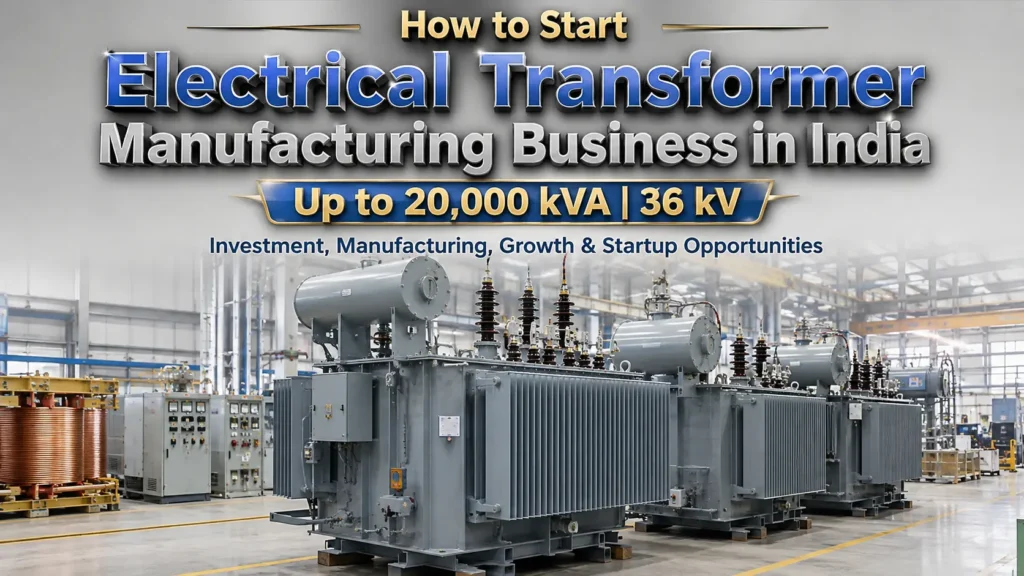
Simple as this is, India requires more power each and every year and this is where one of the most stable manufacturing business ideas of today is booming in the industrial sector; the manufacturing of electrical transformers. Transformers rated up to 20,000 kVA at 36 kV are needed by all distribution utilities, industrial plants, and renewable energy developers, and demand continues to grow, even in the wake of other sectors experiencing a slowdown.
This is a unique combination of consistent orders, policy support, and long product life cycles for entrepreneurs looking into business ideas that have the active support of the government. This article provides insight into why time is crucial, the schemes that truly benefit new manufacturer, and the specific business ideas that fit a first-time promoter.
Why This Sector Is Growing Fast
The demand for power in India continues to grow. Peak electricity demand is already at 240 GW and will soon exceed 400 GW within this decade. This means that state utilities and private developers must purchase thousands of new transformers annually, simply to provide new connections, as well as to replace old transformers that are no longer efficient.
This demand is being propelled in greater and greater numbers by three forces. First, the government’s distribution reform programme is upgrading old feeders and substations in various states, thereby generating new orders for transformers on an ongoing basis. Second, the number of inverter-duty and solar step-up transformer demand is huge for renewable energy projects, and this market was barely present 10 years ago. Third, the blooming growth in pharma, data centre, steel and cement industries is creating direct demand for dedicated power and distribution transformer.
In the meantime, the fact of dependence on imports is an issue to consider. In the past, Chinese manufacturers have been known to secure a number of big tenders from utilities at cheaper rates, which has prompted the authorities to actively promote domestic capacity development. This means that new players that are interested in quality, test facilities, and on time delivery are able to secure contracts more easily than many other capital goods businesses. What’s rare about manufacturing business ideas is that the demand for transformer manufacturing is predictable and backed by the government instead of consumer sentiment.
The demographic aspect can be a point of interest also. A number of well-known transformer producers were founded in a single generation and a few are now facing succession or capacity issues. This leaves space for new, efficient operators to be able to secure tender bids for units that can’t service them on time. That is, it’s not a market in need of consolidation, it’s an expanding pie that can be carved up by new entrants who deliver and are properly certified.
Get Detailed Project Report (DPR): Electrical Transformer & Power Equipment Guide
Government Policies Supporting New Businesses
A capital-intensive manufacturing plan can make or break on the basis of good or bad policy support. Fortunately, transformer manufacturing is a field that falls into the crosshairs of multiple government programmes, and most first-generation business owners can connect two or three of them together at least.
PLI Scheme for Electrical Equipment
The Production Linked Incentive scheme for white goods and capital goods manufacturing directly helps the manufacturers of the components of transformers. The primary aim of the PLI scheme is the big manufacturer, but MSMEs can still benefit by being approved component or material suppliers to PLI linked companies. This is an indirect route suitable for a new winding or assembly unit, especially for a new one supplying to another larger original equipment manufacturer (OEM) under an approved PLI project.
PMEGP for First-Generation Entrepreneurs
New manufacturing units have been provided with margin money subsidy under the Prime Minister’s Employment Generation Programme (PMEGP) of Khadi and Village Industries Commission, Ministry of MSME. The 15 to 25 percent subsidy for General category applicants and 25 to 35 percent for women and special category applicants (SC, ST, OBC, etc.) will depend on the location of the unit. The costs for the manufacture of the units are up to fifty lakh rupees, at present, under this scheme, therefore it is a genuine option for a small distribution transformer plant. It is always advisable for the entrepreneurs to check the updated subsidy slabs on the official site before applying.
Credit Guarantee Cover Without Collateral
The Credit Guarantee Fund Trust for Micro and Small Enterprises wave offs the one most important obstacle in the way of most new entrepreneurs – collateral. In this scheme, these are loans of working capital or term loans that are disbursed without any property being pledged and this is of much importance in a business where the capital equipment is a significant portion of the total investment, especially in the case of machinery.
State-Level Incentives
In addition to central schemes, states like Gujarat, Maharashtra, Uttar Pradesh and Rajasthan have their own industrial policies for electrical equipment manufacturers. Usually, this involves capital subsidies, power tariff concessions and stamp duty exemption for land acquisition of new manufacturing units. In a few instances, state incentives, in addition to central schemes, can reduce the effective project cost by as much as fifteen to thirty percent for a qualified project.
Make in India and Import Substitution
Transformers have been identified as a component of high value addition required in India under the Make in India initiative by the Department for Promotion of Industry and Internal Trade. In the same way, the Revamped Distribution Sector Scheme is also compelling the state discoms to upgrade the infrastructure and this will directly mean new transformer procurement during the coming couple of years.
Multiple Business Ideas for Startups
Transformer making is not a monolithic industry. Rather, it is broken up into a number of distinct product lines and service niches, each with a different level of investment and buying profile. Here are some business ideas that you can consider before you finalize your project report.
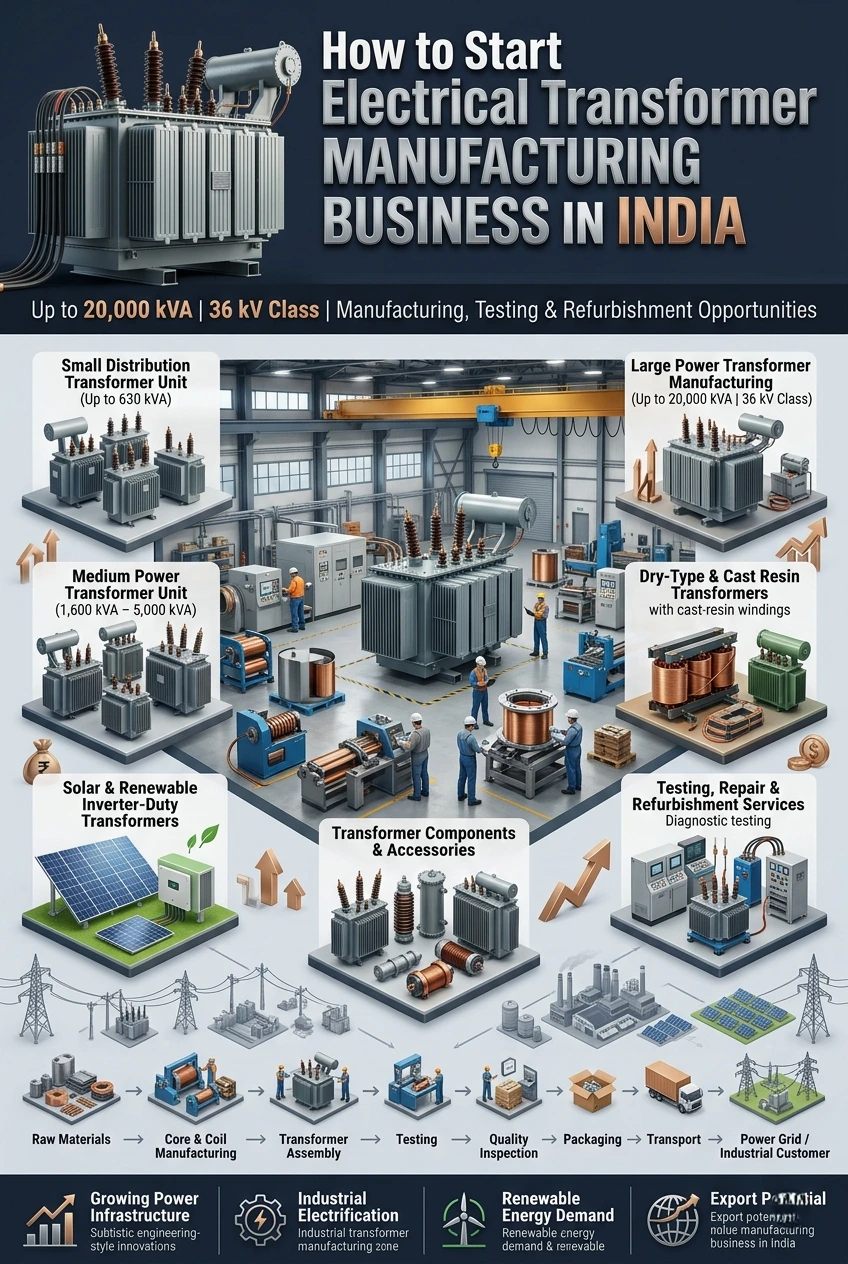
Small Distribution Transformer Unit (up to 630 kVA)
It’s the easiest place for a first-time manufacturer. These are procured regularly by the state electricity distribution companies through open tenders and rate contracts as their anchor buyers. Capital investment is relatively low as compared with power transformers and a promoter can begin with the simple winding, core cutting and tanking facilities. But it is important to maintain a suitable in-house testing laboratory to win repeat orders as the discoms are rejecting the batches which don’t meet the routine testing. Early adopters of test equipment tend to have significantly more orders in the pipeline than those who try to save money there.
View Full Project Details: Distribution Transformer Manufacturing Guide
Medium Power Transformer Unit (1,600 kVA to 5,000 kVA)
This segment caters to industrial clients directly such as captive power plants, industrial estates and medium-sized manufacturing units. The margins are better than the small distribution segment, largely due to the fact that private industrial buyers place more emphasis on reliability and after-sales services than on the lowest bid price. This means that a manufacturer who is capable of designing the products is able to develop relationships with their clients as opposed to bidding for a single quarterly project.
Related Article: How to Start a Power Transformer & Distribution Transformer Manufacturing Business: A Complete Guide
Large Power Transformer Manufacturing (up to 20,000 kVA, 36 kV Class)
The most expensive and most profitable part of this article’s topic is this. Customers are state transmission utilities, POWERGRID approved vendor chains and large industrial organizations with their own substation. The approval cycle is lengthier due to the utility’s requirement of type testing and vendor pre-qualification before placing large orders. But even after passing that hurdle, contracts in the higher-capacity segments tend to be bigger and longer, and far more profitable.
Dry-Type and Cast Resin Transformer Manufacturing
Dry type or cast resin transformers are becoming more popular than oil-filled transformers in indoor installations like shopping malls, hospitals, metro rail stations, and data centre due to their primary advantage of improving fire-safety. This segment is a premium and has comparatively lesser competition from the unorganised players as it requires tighter engineering tolerances. With the accelerating urbanization of India and the construction of a lot of data centres, this niche indeed provides a unique business opportunity for a technically inclined promoter.
Solar and Renewable Inverter-Duty Transformers
Inverter duty and step up transformers of specific renewable energy duty requirements are required for solar parks and wind power projects. This segment was virtually non-existent a decade ago, but has rapidly expanded with the push towards renewable energy in India. Manufacturers who come in here should cultivate good relations with solar EPC companies early since majority of orders are led by project developers, not open tenders.
Get Detailed Insights from This Book: Solar PV Power and Solar Products Handbook
Transformer Component and Accessory Manufacturing
Not all entrepreneurs have to produce full transformers from the beginning. Finally, bushings, tap changers, radiators, conservator tanks and other components are a lower-capex way to get in on the value chain. A component manufacturer can provide larger OEMs directly and they can use the PLI to help them grow without having to do all the technical and testing work of putting together complete transformers.
Transformer Testing, Repair, and Refurbishment Services
The existing transformer fleet in India is aging and utilities implement life-extension programs instead of replacing all the transformers. A testing, repair and refurbishment business requires much less capital than is needed for new manufacturing, but has a steady recurring revenue stream from annual maintenance agreements with utilities or large industrial plants. This is an undervalued investment entry point for a technically knowledgeable person with modest initial investment funds.
In addition to these seven ideas, an experienced promoter can offer two or three of these ideas in one location. For instance, a founder may begin by part-shipping and testing the service, and after two-or three-years’ work-up the board and also the cash flow, then he can step up into full assembly of the distribution transformer. This is a staged approach which helps minimize early risk significantly as well and is the type of approach that banks and governmental schemes consider when looking to provide a loan for the next phase of growth, as a proven history of smaller successful projects is much easier to secure funding for the next phase of growth.
Import–Export Opportunity Analysis
This is a two-way street and a savvy entrepreneur should know both sides of the trade before finalizing plans for a business. However, on the import side India continues to rely on overseas suppliers for some high value components and raw materials such as cold-rolled grain-oriented steel for transformer cores. This reliance results in price and currency volatility and volatility of the cost of input.
Opportunities on the export side are taking off more quickly than many new entrepreneurs realise. South Asia nations, some in Africa and the Middle East, are working on grid expansion while for some quality perception and geopolitical trust is a reason to invest in Indian equipment instead of Chinese. Overall estimates indicate that India’s electrical equipment exports may show a significant growth over the next decade and transformers may make a substantial contribution to this.
But an international competition demands Bureau of Indian Standards certification at least and for the majority of overseas buyers, IEC compliant testing records are required. So a founder with an export focus should plan for the costs of testing and certification throughout the project planning phase, not as an after-thought.
Indian MSME Success Stories
When assessing a capital-intensive industry such as this, it’s better to have a real-world example to go by. In addition, three Indian companies, which have taken different routes to success in the transformer business, are highlighted.Besides, three Indian companies are highlighted, which have taken different roads to success in the transformer business.
Voltamp Transformers, Vadodara
The Patel family started Voltamp Transformers in the 1960s, when Lalitkumar H. Patel an electrical engineer, trained in United Kingdom, also trained in the design of transformers by established players before he started his venture. The company established its position gradually, gradually scaling up from small transformers to power transformers and then dry-type transformers, and eventually went public on the Indian exchanges. The lesson the founders can offer here is that they focused on being financially disciplined and on having product quality, which enabled the company to beat industry downturns without burning a hole in their pockets.
Indo Tech Transformers, Tamil Nadu
Initially, Indo Tech provided distribution transformers to the Tamilnadu state electricity board and gradually grew its customer base and product line. An early focus on testing and quality infrastructure proved crucial here, as the firm secured lucrative contracts from central utilities when most of the regional utilities were still at the state level. The take-away for new entrepreneurs is clear: get certified and test early, sell to larger customers later.
Transformers and Rectifiers India Limited (TARIL), Gujarat
TARIL began in 1981 as a small repair business under founder Jitendra U. Mamtora, an electrical engineer who later became a long-serving Chairman of the transformer division at the Indian Electrical and Electronics Manufacturers Association. The company gradually climbed the voltage ladder, moving from repair work into full manufacturing of 33 kV and then higher-voltage transformers over successive decades. Today it exports to dozens of countries. The founder’s decision to keep climbing the technical ladder step by step, rather than jumping straight to the highest voltage class, remains a useful model for any new entrant in this article’s business category.
How a Feasibility Study Changes Your Odds
Every experienced consultant will tell a new founder the same thing: a transformer manufacturing project succeeds or fails on the strength of its planning, long before the first machine arrives at the plant. We at Niir Project Consultancy Services (NPCS) provide professional consulting for the preparation of Market Survey cum Detailed Techno-Economic Feasibility Reports for setting up new industries or businesses. Our reports include detailed manufacturing processes, market research and demand analysis, process flow diagrams, product mix and capacity planning, machinery and raw material details, and complete project financials with profitability analysis. Our objective is straightforward: help entrepreneurs evaluate feasibility, profitability, and long-term scalability before they commit real capital to a project.
Choose the right startup backed by real market demand
Transformer Category and Market Segment Overview
The table below summarises the main transformer categories relevant to this business, along with typical buyers for each segment. Use it as a starting reference point while you decide which product line matches your available capital and technical strength.
| Transformer Category | Typical Rating Range | Voltage Class | Primary Buyers |
| Small Distribution Transformer | 10 kVA – 630 kVA | Up to 11 kV / 33 kV | State discoms, rural electrification projects |
| Medium Distribution Transformer | 630 kVA – 1,600 kVA | 11 kV – 33 kV | Industrial parks, commercial complexes |
| Small Power Transformer | 1,600 kVA – 5,000 kVA | 33 kV | Captive power plants, industrial estates |
| Large Power Transformer | 5,000 kVA – 20,000 kVA | Up to 36 kV | State transmission utilities, POWERGRID vendors |
| Dry-Type / Cast Resin Transformer | 100 kVA – 5,000 kVA | Up to 11 kV / 33 kV | Metro rail, hospitals, data centres, malls |
| Solar / Renewable Inverter-Duty | 500 kVA – 5,000 kVA | 11 kV – 33 kV | Solar parks, wind energy developers |
Conclusion
The electrical transformer business right up to 20,000 KVA at 36 kV represents a unique place amongst the contemporary manufacturing businesses in India that actually are in demand. Its increasing demand because, as thereis a real requirement for India’s electricity infrastructure, it’s further promoted by Govt initiatives like PLI incentives, PMEGP subsidies, collateral-free loan schemes and direct state level promotions. That said, in this sector – the project setup can be challenging and success depends on project planning, front loaded testing investment and the right sector match for your capex and expertise to even enter the space. Founders that nail these basics in turn stand the opportunity of becoming a future generation Vol tamp or Indo Tech or TARIL.
Selected References
Ministry of MSME, Government of India — msme.gov.in
Department for Promotion of Industry and Internal Trade — Make in India portal
Confederation of Indian Industry — cii.in
Federation of Indian Chambers of Commerce and Industry — ficci.in
Indian Electrical and Electronics Manufacturers Association — ieema.org