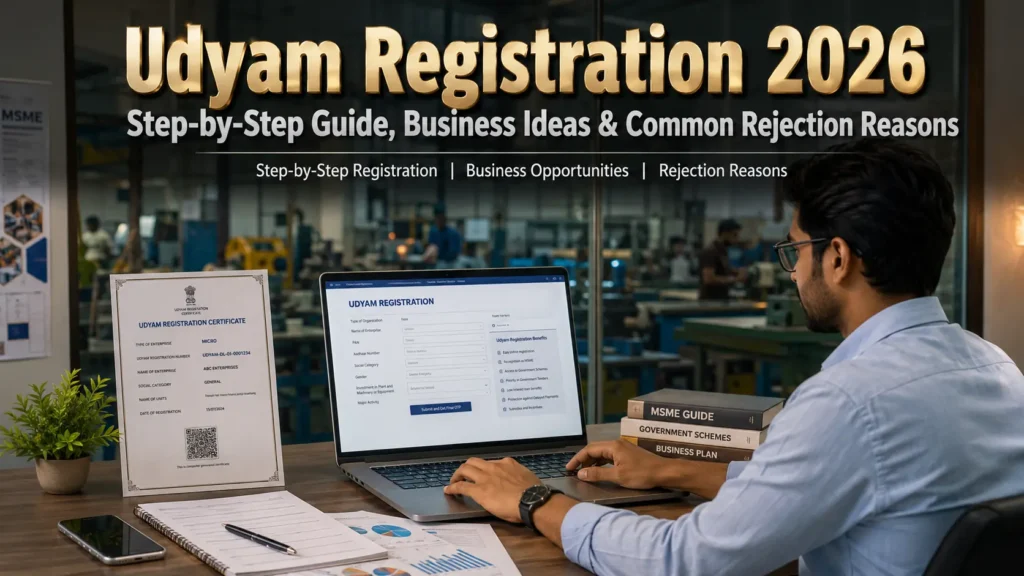

Guide for Udyam Registration 2026 in India, Government Incentive, and Business ideas it unlocks
Thousands of good business opportunities in India languish at the paper stage every year. It is not because of the weakness of the product or the absence of the market, but because the founder didn’t get to Udyam registration or the application was rejected on a technicality. It is a real waste as Udyam registration takes less than 30 minutes for most of the applicants, is free of cost and is the only document required to avail priority-sector loans, government tenders, tax benefits and a host of other subsidies.
This guide explains the steps to be taken, why applications are rejected and how concrete business ideas that make sense from a business perspective and are supported by current government policies, incentives and market demand can be registered immediately.
Why Udyam Registration Deserves Your Attention Right Now
Small and medium enterprises are the backbone of the manufacturing and services base in India. However, a considerable proportion of them still remain unregistered, thus losing the benefits of collateral-free loan facilities, access to GeM tenders and protection from delayed payments. The Ministry of MSME has been trying its best to narrow this gap, most recently through an increase of investment and turnover limits for MSME classification. This one action catapulted a number of growing businesses back into the MSME category and all the associated advantages.
If you’re a first-generation entrepreneur or a business owner who wants to formalise your business, the time is right. Priority lending norms, credit guarantee cover and interest rate support are all linked to Udyam status. In the meantime, buyers have become more inclined to go for the registered MSME vendors as the statutory obligation of paying the tax within 45 days of the bill becomes a liability for the large companies to pay the MSME dues sooner or lose the tax deduction. That’s just one of the best incentives to enroll early—and it has gone unpublicized.
Understanding MSME Classification Before You Apply
Before you approach the registration form, have an awareness of your category. The classification of the business is based on two factors: investment in plant and machines or equipment and annual turnover. They both need to be met and if either exceeds a limit then your enterprise is upgraded to the next category. Investment is calculated as the original cost and not depreciated cost and export turnover is not included in the turnover calculation, in reality an incentive for export-oriented units.
| MSME Category | Investment Limit (Plant & Machinery/Equipment) | Annual Turnover Limit | Typical Business Examples |
| Micro Enterprise | Up to ₹2.5 crore | Up to ₹10 crore | Home-based food units, small job-work workshops, boutique manufacturing |
| Small Enterprise | Up to ₹25 crore | Up to ₹100 crore | Auto-component units, packaged food plants, plastic processing units |
| Medium Enterprise | Up to ₹125 crore | Up to ₹500 crore | Mid-sized chemical plants, engineering goods exporters, textile mills |
Table 1: Revised MSME classification thresholds as per MSMED Act
Government Policies and Incentives Supporting Udyam-Registered Businesses
The Udyam registration is not just a single scheme; it’s a package of schemes. Upon registration, an enterprise can avail of credit from banks with priority sector credit norms and collateral free loans as well as avail of government procurement opportunities from GeM. The base registration is followed by several schemes.
Credit Guarantee Cover Through CGTMSE
The Credit Guarantee Fund Trust for Micro and Small Enterprises provides collateral free credit guarantee cover for eligible unit up to ₹10 crore. This is a good thing for founders with a viable project, but without property to offer as security, as banks lend based on the guarantee instead of on personal collateral.
Production Linked Incentive and Sector Schemes
The PLI scheme for electronics, pharmaceuticals, textiles, food processing, specialty steel, and other sectors is still in operation. Eligibility is different across sectors but it is mostly targeted at higher production volumes and the opportunity for the MSMEs is actually in filling in the PLI-anchor supply chains as ancillary and component suppliers.
Prompt Payment Protection Under Section 43B(h)
This is one incentive that the founder overestimates. If the buyer fails to pay the registered Micro or Small enterprise after 45 days, he/she is not entitled to claim the expense as a tax deduction. In reality, this has led to a much more careful approach by large corporates in clearing MSME invoices as the tax liability of a delayed invoice is real money that is on their books.
State-Level Subsidies and Single-Window Clearances
Apart from the central benefits, most of the State Industrial policies impose their own subsidy, exemption from stamp duty and power charge on the unit which has a valid Udyam certificate. You should definitely check your industry department portal in your respective state and also the Invest India national portal as the eligibility criteria and percentage of subsidy and the application period vary from state to state.
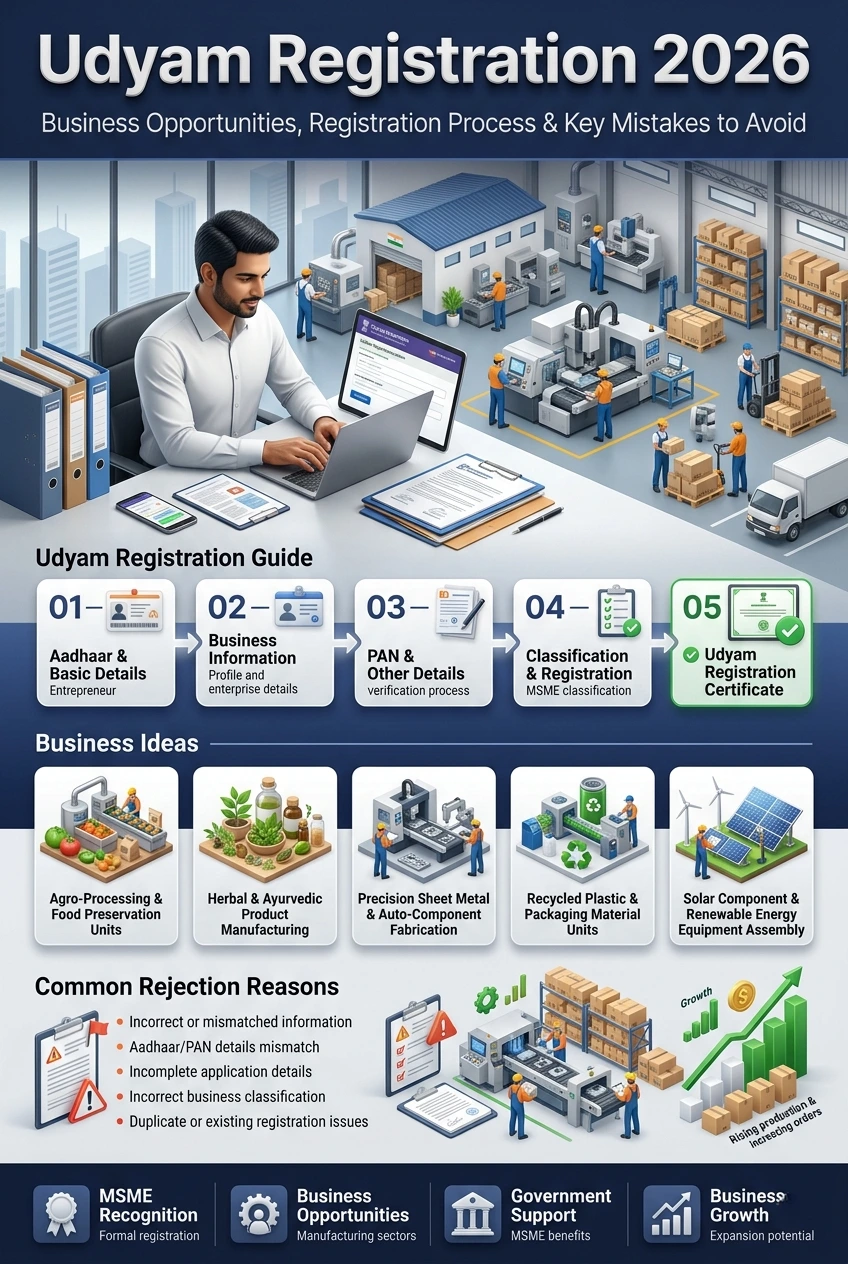
Udyam Registration: Step-by-Step Process
The process runs entirely online through the official Udyam Registration portal, and there is no government fee at any stage. Anyone asking you to pay for registration is not the official channel.
Step 1: Keep Your Documents Ready
Aadhaar number of proprietors, managing partner or authorised signatory, PAN of the business and GST information (if applicable) are required. There’s no need to upload any physical documents – most of the data is pulled straight from linked government databases.
Step 2: Visit the Udyam Portal and Choose Your Applicant Type
For the new entrepreneurs not registered on the portal or those who are new to the previous EM-II system or UAM system, the option will be available on the portal. People who already have a Udyog Aadhaar are advised to avail of the option for its migration, rather than fresh filing.
Step 3: Verify Aadhaar and Enter PAN
Fill the Aadhaar and the complete name as mentioned on the Aadhaar card and verify with OTP. This is one of the most frequent mistakes and even a spelling error could be a problem, so check before you turn it in!
Step 4: Fill Business and Investment Details
Include the business name, the type of organisation, the location, details of the bank account, the activity code for the primary business activity (from the NIC 2008), and investment and turnover figures. The NIC code must be carefully selected as often; a mismatched activity code leads to rejection of the downstream scheme even if the Udyam certificate is issued.
Step 5: Submit and Download the Certificate
After submission of the form, a Udyam Registration Number is generated and the certificate itself is generated and immediately after that, certificate is generated with lifetime validity. No renewal is required and the classification is updated annually automatically as a result of your GST and Income Tax filing, so ensure that you keep your filings up to date and accurate.
Common Udyam Registration Rejection Reasons
Most rejections are due to a few common mistakes that can be avoided instead of real ineligibility. It’s a no brainer that if you know them in advance, you save an application cycle.
- There were some minor differences in Aadhaar name mismatch, such as spacing and initials.
- Inconsistency in PAN-GST: Business PAN information is not matching with the information available on the GST portal.
- Wrong or vague NIC activity code: selecting an incorrect or generic code for the activity that you actually undertake in your business.
- Duplicate registration: re-registration for entities that already have a Udyam number with a very similar name or address.
- Incomplete/ inconsistent investment & turnover data: data which does not match data provided in ITR & GST returns.
- Any bank account information that is inconsistent with the business name that is on file.
When your application does not get through, the solution is almost always to correct the mismatched field and resubmit; it is never the solution to initiate a whole new registration process, and that will only cause duplicate-entity issues later on.
Business Ideas Worth Registering Under Udyam Today
Registration is only important if there is a business behind it. Below are some manufacturing and processing business ideas that can fit in the Micro or Small business size and are the best match with the prevailing demand and policy support.
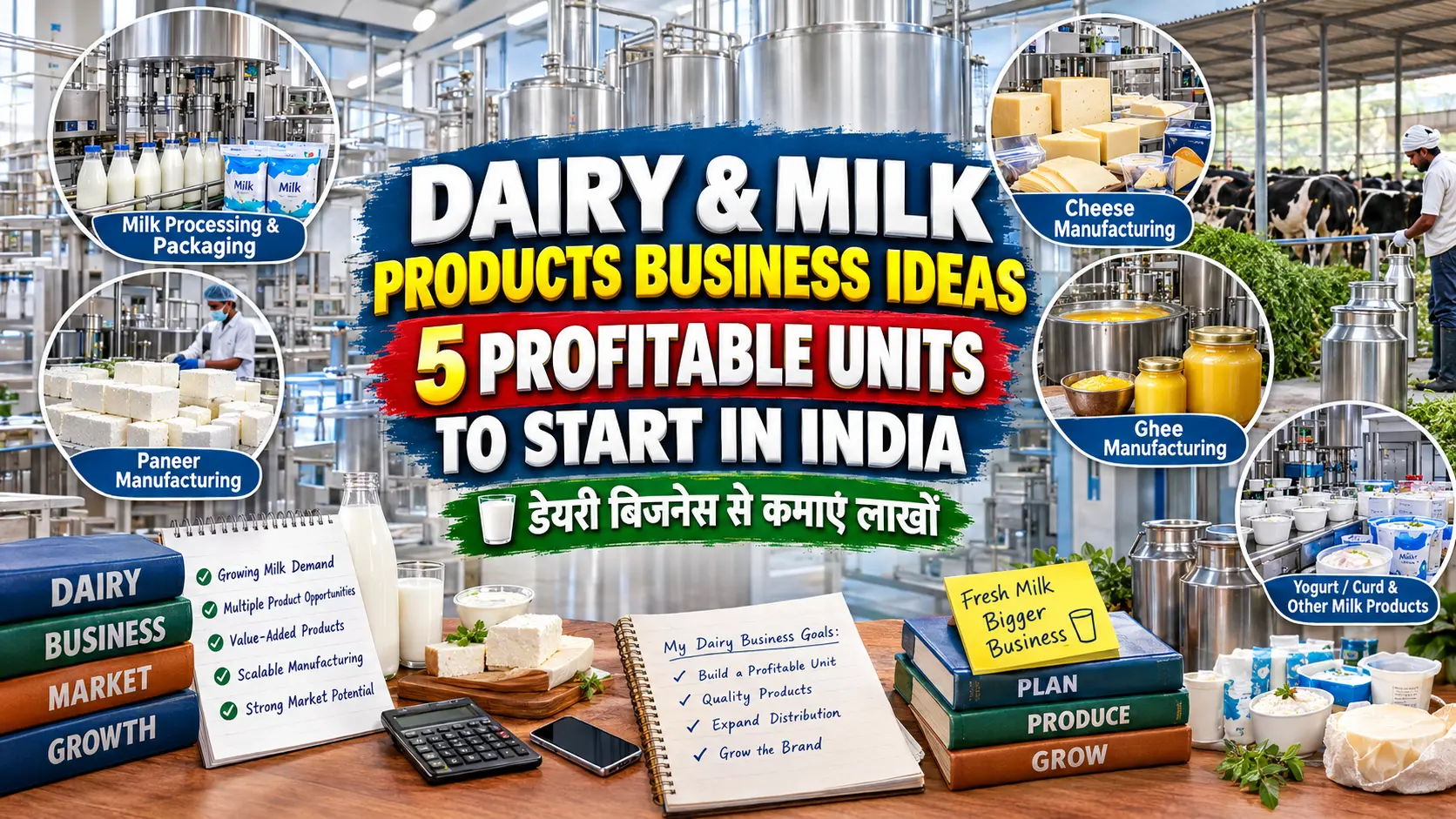
Agro-Processing and Food Preservation Units
The food processing industry in India is still not fully exploited as compared to the production of fresh produce from the farms resulting in the huge gap between the production of raw produce and packaged shelf stable food. A small-scale unit processing fruit pulp, dehydrated vegetables or millet-based snacks requires modest capital, has benefitted from the Government’s promotion of consumption of millet, value addition at the farm gate and sells into organised retail market and export. The Udyam route fits in well with the CGTMSE-backed working capital loans available, since most of these are within the Micro investor cap.
Get Detailed Project Report (DPR): Food Processing and Agro-Based Projects
Herbal and Ayurvedic Product Manufacturing
The market for Ayurvedic personal care, wellness and nutraceutical products continues to grow and in export markets, which have become more natural formulation centric, the demand is growing even faster. A registered Udyam unit engaged in the manufacture of herbal cosmetics or herbal dietary supplements may avail of promotional schemes under the AYUSH Scheme along with assistance as available to MSMEs, and the capital cost of a Start-up unit is not very high, especially when contract manufacturing space is utilized instead of constructing the unit.
Get Detailed Insights from This Book: Herbal Cosmetics & Ayurvedic Medicines (EOU)
Precision Sheet Metal and Auto-Component Fabrication
Automotive and electronics Original Equipment Manufacturers (OEMs) are always outsourcing component manufacturing to smaller ancillary component makers, and that’s exactly the kind of vendors that benefit from PLI supported supply-chains, even if they don’t meet the specific criteria to qualify for PLI incentives. A Small-category unit, engaged in precision sheet metal work, stamping or CNC machining can establish a sustainable order book by providing two or three anchor manufacturers, and this gets expanded by GeM registration in Government and PSU procurement.
Explore This Book: Sheets Production with Ferrous Metal Casting & Processing
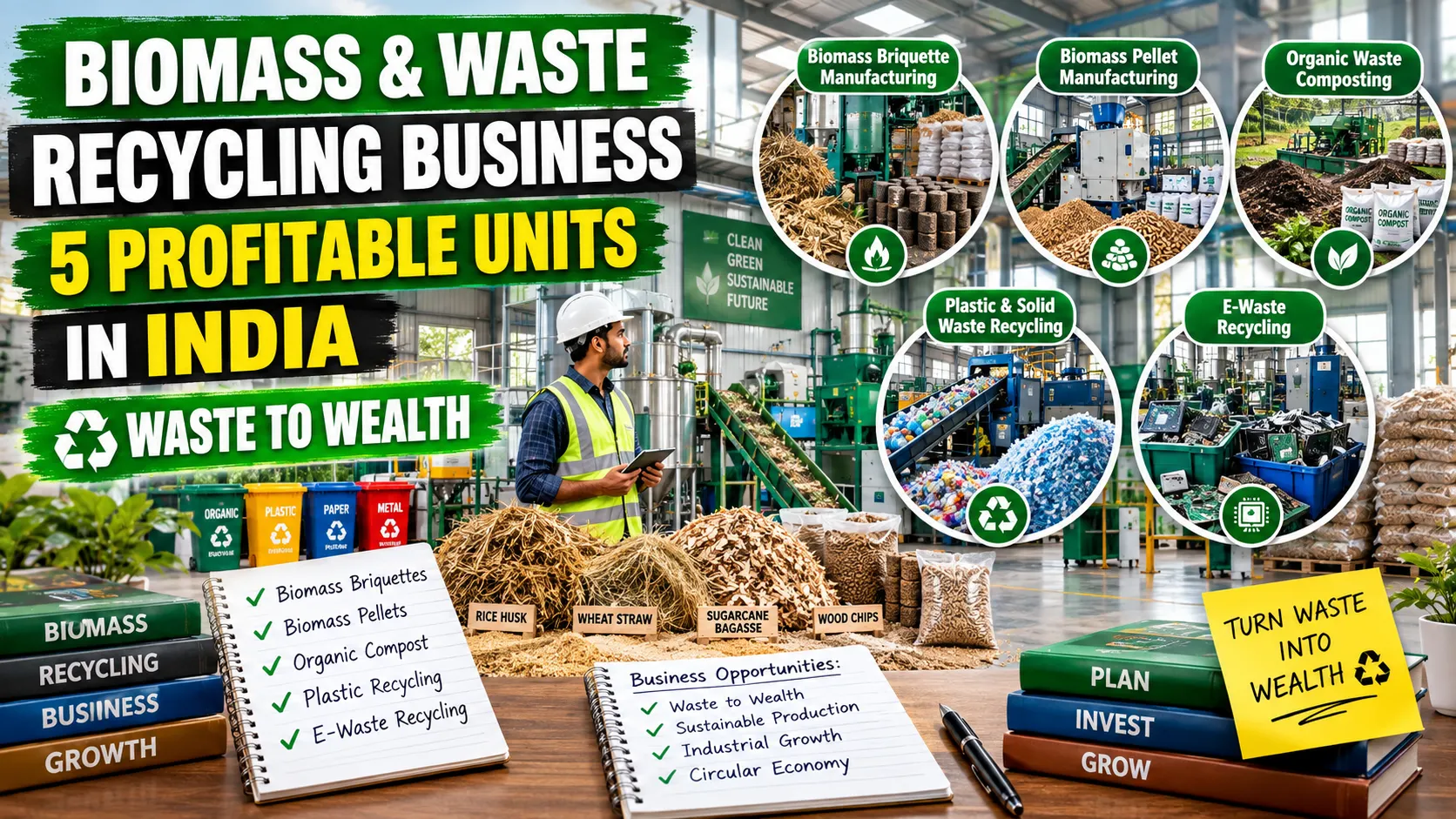
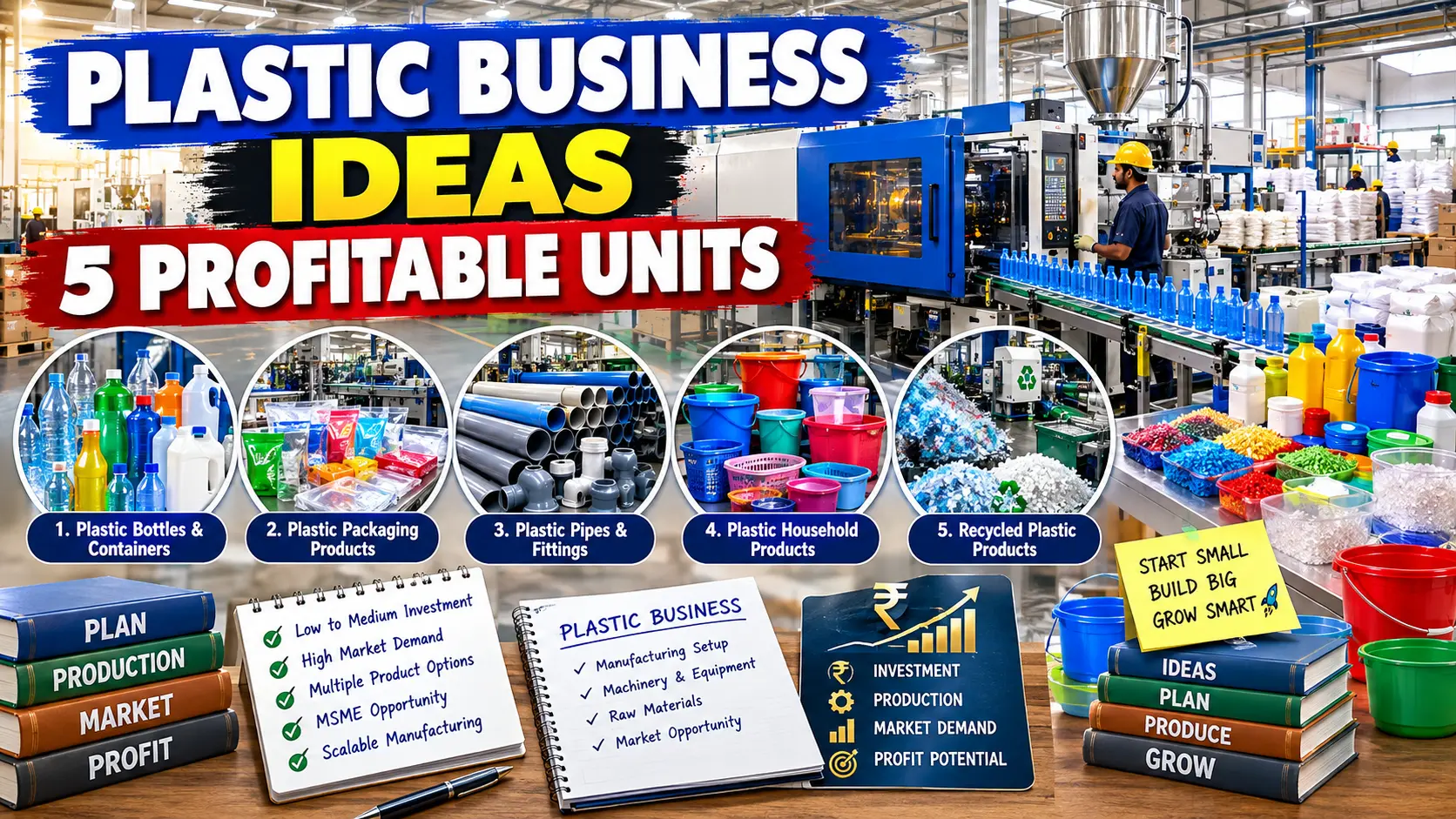
Recycled Plastic and Packaging Material Units
The EPR regulations have encouraged proactive measures from brand companies to find recycled content packaging, generating new demand for those who convert post-consumer plastic to recycled granules, sheets or packages. Capital requirements fall in the Micro or Small category and a state pollution control board clearance for environmental compliance, when executed properly, is a key differentiator for corporate buyers looking for sustainability goals.
Related Article: Plastic Waste Recycling Plant in India: Setup Cost & CIPET-Backed Business Model
Solar Component and Renewable Energy Equipment Assembly
This rooftop solar installation is on the rise through residential and commercial subsidy programs, which in turn creates demand downstream for assembly of components, mounting structures, junction boxes and components of the balance of system. A registered MSME who is making these components here eliminates the frustration of installers waiting months for parts to arrive from abroad, and is eligible for green-manufacturing incentive state grants in various states.
View Full Project Details: Renewable Energy & Green Power Projects
Import-Export Opportunity Analysis for New Udyam-Registered Startups
This exclusion of export turnover in the MSME turnover calculation is not just a finicky accounting detail but a real growth driver. A unit can increase its export revenues without any risk of re-classification into a higher MSME category and also without losing the eligibility of the scheme on the domestic front. This creates an opportunity to export goods, especially products like processed food, engineering products, leather products, handicrafts and pharmaceuticals intermediate goods, for a startup registered under Udyam, which is looking to scale up quickly without losing its benefits.
The duty structure on the import side also still has several inputs to manufacturing, including specialty chemicals and precision components, that contain duty structure advantages to local value addition over imports. One new company that imports raw material or sub-assemblies but finishes the article of manufacture in the country typically can get a better margin and can remain on the government’s import-substitution program. Product-wise data is available and can be reviewed by export promotion councils and Directorate General of Foreign trade before finalizing a trade lane.
Indian MSME Success Stories Worth Studying
Haldiram’s — From a Small Sweet Shop to a National Food Brand
Haldiram’s started its operations in Bikaner by Ganga Bishan Agarwal as a small namkeen and sweets shop and has since emerged as one of the top packaged snack food companies in India. The key takeaway of the founding family’s approach of uniform recipes for mass production, but maintain regional tastes and Flavors is that scale doesn’t have to compromise authenticity of product. The message for a food-processing entrepreneur registering on Udyam now is that it is important to develop a process that is repeatable and is consistent in quality right from the beginning, as eventually the process needs to be replicated outside a single city or region.
Amul — Cooperative Manufacturing at Scale
The Gujarat Cooperative Milk Marketing Federation, built on Verghese Kurien’s cooperative model, turned a fragmented dairy farming base into a single, dominant manufacturing and distribution brand. The decision logic here was structural rather than product-driven, aggregate scattered small producers under one quality and branding umbrella instead of competing individually. New entrepreneurs in agro-processing can borrow this thinking at a smaller scale, by building consistent sourcing relationships with local farmer groups rather than treating raw material procurement as a spot-market transaction.
Dr. Reddy’s Laboratories — From Bulk Drugs to Global Pharma
K. Anji Reddy started Dr. Reddy’s as a bulk drug manufacturing unit before moving up the value chain into formulations and eventually export-driven generics. The lesson for a small pharmaceutical intermediate or nutraceutical manufacturer is sequencing, establish reliable, compliant manufacturing first, then reinvest margins into moving up toward higher-value, export-facing products rather than trying to do everything at once.
How NPCS Helps You Move From Registration to a Bankable Project
Udyam registration answers the compliance question, but it does not tell you whether a specific business idea is financially sound. That is where a Detailed Project Report earns its place. We at Niir Project Consultancy Services (NPCS) provide professional consulting for the preparation of Market Survey cum Detailed Techno-Economic Feasibility Reports (DPRs) for setting up new industries or businesses.
Our reports include detailed manufacturing processes, market research and demand analysis, process flow diagrams, product mix and capacity planning, machinery and raw material details, and complete project financials with profitability analysis. Our objective is to help entrepreneurs evaluate feasibility, profitability, and long-term scalability before investing, so that Udyam registration is backed by a project that a bank, or the entrepreneur’s own capital, can actually support.
Smart entrepreneurs start here—find your perfect venture
Government and Institutional References
Ministry of Micro, Small and Medium Enterprises: msme.gov.in
Udyam Registration Portal: udyamregistration.gov.in
Department for Promotion of Industry and Internal Trade: dpiit.gov.in
Government e-Marketplace: gem.gov.in
Credit Guarantee Fund Trust for Micro and Small Enterprises: cgtmse.in
Federation of Indian Chambers of Commerce and Industry: ficci.in
Directorate General of Foreign Trade: dgft.gov.in
Conclusion
Udyam registration is not a bureaucratic formality to postpone until a business feels big enough. It is the foundation that makes an idea bankable, protects cash flow through the 45-day payment rule, and opens tender, subsidy and export doors that stay closed to unregistered units. Whether the plan is an agro-processing unit, a herbal manufacturing line, or a precision component workshop, the sequence is the same, get the classification right, register cleanly on the first attempt, and back the idea with a proper feasibility study before committing capital. That combination is what separates a business idea from a business.