
Biopesticide Manufacturing Business in India
Indian agriculture is faced with a dichotomy between the increasing pressure of pest and increasing resistance to conventional chemicals and at the same time the demand of the consumers, regulators and exporters for residue-free produce is also increasing. Biopesticides are exactly at that intersection and despite being on a strong tailwind of government support and export market driven adoption, India’s biopesticide sector is small in comparison to its farmland base and overall pesticide consumption. That’s the opportunity this report crosses.
What Are Biopesticides?
Biopesticides are substances that are used to manage pests and are derived from natural materials (plants, bacteria, fungi, viruses, and certain minerals) instead of synthetic chemical compounds. They can be generally divided into three types:
- Microbial pesticides – made from bacteria (e.g., Bacillus thuringiensis), fungi (e.g., Beauveria bassiana, Metarhizium anisopliae), viruses (baculoviruses), or antagonistic microorganisms that are used to control fungal and bacterial diseases of crops.
- Biochemical pesticides are naturally occurring pesticides, including plant extracts (neem/azadirachtin, pyrethrum, eucalyptus oil), as well as pheromones that control pests without being toxic.
- Plant-incorporated protectants (PIPs): pesticidal substances produced from the genes introduced into the plants (a less regulated category in India)
In India, biopesticides are registered through the Central Insecticides Board & Registration Committee (CIB&RC) through BioRRAP (Biopesticides Registration and Regulatory Approval Process) portal, with 970 bio-registrants and approximately 28 different types of biopesticides registered in the country in microbial and botanical category.
Read the Complete Book Here: Biopesticides Handbook
Global and India Biopesticide Market Size and Growth
There are some variations in the estimates, but they are not significant, and the trend is clear: this is one of the fastest-growing areas of crop protection, with estimates varying primarily in scope (whether biofertilizers and bio stimulants are counted as a single category or separated, and whether they are crop protection products or different categories of products) and base-year methodology.
Global market: Estimates for the 2024/25 base year range from approximately USD 4.4–9.5 billion, and are projected to grow anywhere from USD 9.8 billion to more than USD 27 billion by the early/mid-2030s, with most of the projections within the 8–15% CAGR range.
India market: Estimates for 2025 vary from approximately USD 242 million to 287 million, the vast majority of forecasts falling in the range of USD 380 million to USD 700+ million by 2030-2034, with a typical CAGR between 9.5% to 10.5%. As per estimates, the commercial formulation volume in India is around 35–38 thousand metric tonnes per year for 2025–26.
Note on figures: Figures are approximate, and may vary greatly depending on the scope and methodology being used and are therefore directional. NPCS can develop a custom techno-economic feasibility study to your specific requirement for precise scope for your biopesticide category (microbial, botanical, or biochemical) and numbers for investors.
Where India Stands Today
Currently, the share of biopesticides in the Indian pesticide market is approximately 10-12% of total pesticide usage, which is expected to grow significantly as the acreage of organic farms increase (organic farms have grown at around 18% CAGR over the past few years) and as export markets implement increasingly stringent limits on pesticide residues. Despite all this, awareness is the real problem; according to ICAR studies, only 10–15% of Indian farmers are aware of biopesticides and how they can benefit their crops, indicating an under-saturated rather than over saturated market.
The production is currently largely concentrated with over 50 big companies, primarily in Maharashtra, Gujarat, Tamil Nadu, Andhra Pradesh, Bengaluru is now becoming a hub for biopesticide research and development (R&D) as well as innovations in agriculture technology, including the University of Agricultural Sciences.
Policy Tailwinds
1. Parampara at Krishi Vikas Yojana (PKVY): A scheme of Ministry of Agriculture & Farmers Welfare for the promotion of organic farming clusters which directly boosts the demand for biopesticides as an alternative to synthetic chemical inputs.
2. National Mission for Sustainable Agriculture (NMSA): Promotes the adoption of integrated pest management (IPM), including biopesticides.
3. Reduced time to market for new microbial strains: CIB&RC facilitated faster registration timelines which helped smaller producers and startups to come in with proven formulations.
4. State level organic inputs subsidies: There are a few states such as Punjab, Haryana, Maharashtra, Sikkim and Karnataka where certain inputs of biological crop protection are provided with subsidies and extension support. Sikkim has made itself as first state in India which adopted organic approach in totality.
5. Export residue-compliance requirements: Horticultural exporters (grapes, pomegranates, onions, basmati rice) face increasingly strict Maximum Residue Limit (MRL) norms in destination markets, making biopesticide adoption a practical export-enablement tool rather than a niche preference.
View Full Project Details: Biopesticides Manufacturing Project Report
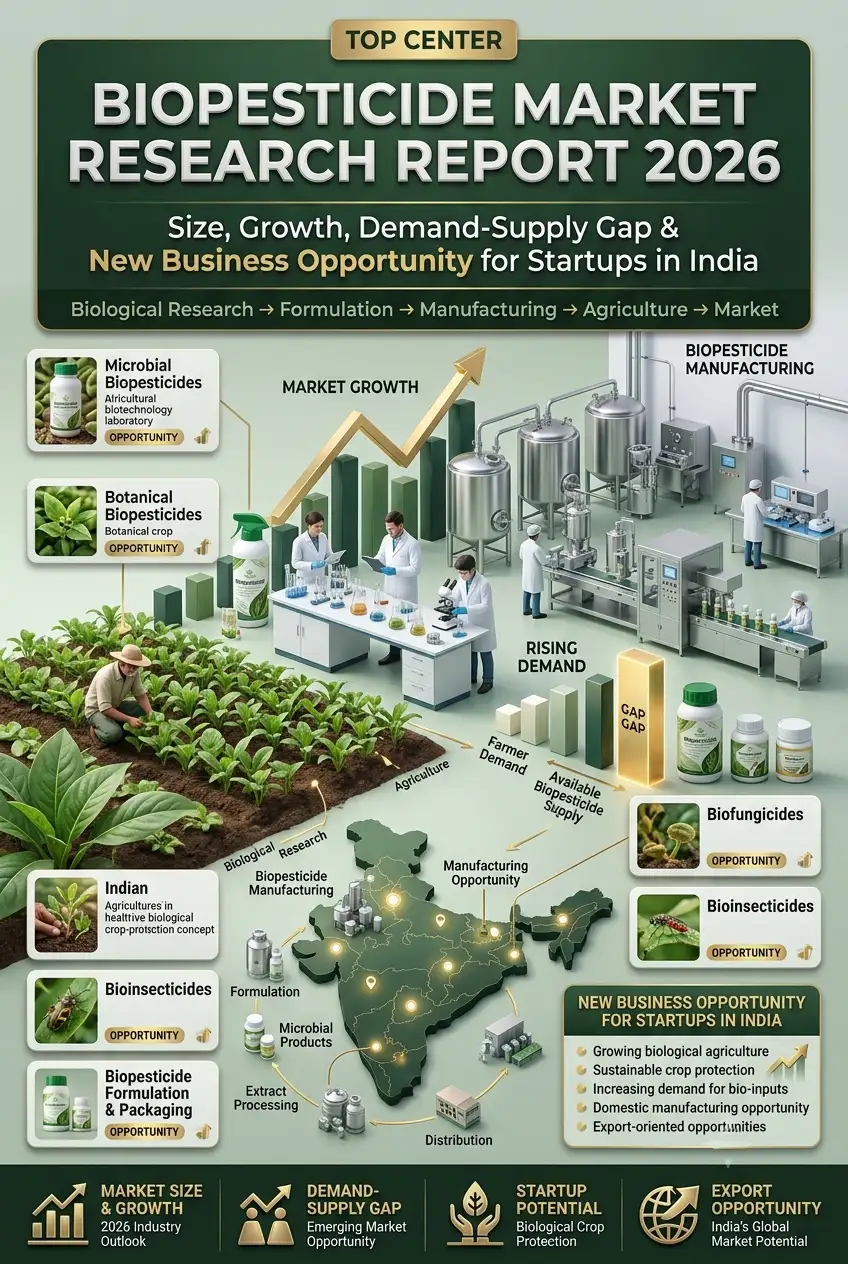
India Demand-Supply Gap: Biopesticides
| Parameter | Current Position |
| Share of total pesticide use | Biopesticides account for only ~10–12% of India’s total pesticide consumption today |
| Farmer awareness | Only an estimated 10–15% of Indian farmers are meaningfully aware of biopesticides, per ICAR-linked studies |
| Domestic manufacturing base | 50+ major producers concentrated in Maharashtra, Gujarat, Tamil Nadu, and Andhra Pradesh — a fragmented, largely regional industry structure |
| Registered product base | 970 bio-registrants with ~28 distinct biopesticide types under BioRRAP, a relatively narrow product range compared to the diversity of Indian cropping systems |
| Nature of the gap | Primarily an adoption and distribution gap rather than a raw material or capacity gap — India has the biological raw material base (agro-residue, native microbial strains) but limited farmer reach, cold-chain/shelf-life-appropriate distribution, and formulation diversity |
| Opportunity for new entrants | Significant white space in underserved crop segments, regional distribution, and shelf-stable formulation technology — not a mature market being fought over by entrenched incumbents |
Reading the gap: India is facing the Biopesticide gap as a penetration gap, since the market is small in comparison to the area being cropped and the Indian conventional pesticide market. The synergy of both (low current penetration + strong regulatory and export tailwinds) is exactly the type of category that new manufacturing capability and improved last-mile delivery forms the opportunity.
Major Indian Biopesticide Manufacturers
| Company | Base/Region | Focus Area | Notes |
| Coromandel International Ltd. | Hyderabad, Telangana | Microbial and botanical biopesticides, biofungicides | Major Indian fertiliser and agri-solutions company; launched “ECO Neem Plus,” a neem-extract biofungicide |
| SOM Phytopharma India Ltd. | Pune, Maharashtra | Botanical extracts, pheromone-based products | Established Indian biopesticide and biological crop-protection specialist, frequently profiled among global market players |
| IPL Biologicals Ltd. | Panchkula, Haryana | Microbial biopesticides and biofertilizers | Recognised domestic manufacturer with a diversified biologicals portfolio |
| T. Stanes and Company Ltd. | Coimbatore, Tamil Nadu | Botanical and microbial biopesticides | Long-established South India-based agri-input and biopesticide manufacturer |
| Kilpest India Ltd. | Indore, Madhya Pradesh | Botanical/neem-based biopesticides | Publicly listed Indian biopesticide manufacturer |
| Camson Bio Technologies Ltd. | Bengaluru, Karnataka | Proprietary microorganism database, biofertilizers and biopesticides | Technology-driven Indian biotech company with a microbial screening platform |
| Kan Biosys Pvt. Ltd. | Pune, Maharashtra | Microbial biopesticides and biofertilizers | Recognised Indian biological crop-protection manufacturer |
| International Panaacea Ltd. | Gurugram, Haryana | Botanical and microbial biopesticides | Established domestic biopesticide manufacturer with export presence |
| Sustainable Agro Solutions / GrowTech Agri Science | Various | Bio-based crop protection and plant nutrition | Representative of India’s growing tier of specialised, mid-sized biological input manufacturers |
Major International Biopesticide Players (Capacity/Scale Snapshot)
| Company | Country | Notes |
| Bayer AG / Bayer CropScience | Germany | Global crop science leader; biopesticide brands include Serenade and BioAct; recently added Velsinum (garlic-derived nematicide) |
| BASF SE | Germany | Global chemicals major with a growing biologicals portfolio (Serifel, Velifer); one of the largest overall crop protection companies by revenue |
| Syngenta AG | Switzerland | Major global agribusiness with a biopesticide range including Contans; also developing RNA-interference-based biologicals |
| Corteva Agriscience | United States | Major global agricultural inputs company with an expanding biologicals portfolio |
| Certis Biologicals (Certis USA) | United States | Specialises exclusively in biological crop protection; brands include BotaniGard, Double Nickel, and MeloCon |
| Marrone Bio Innovations (acquired by Bioceres) | United States | Pioneer in microbial biopesticide discovery; brands include Regalia and Venerate |
| Koppert Biological Systems | Netherlands | Global leader in beneficial insects and microbial biocontrol for integrated pest management |
| Novonesis (formerly Novozymes, merged with Chr. Hansen) | Denmark | Global biotech leader in microbial and enzymatic agricultural solutions |
| UPL Limited | India | India’s largest agrochemical multinational, with a growing biologicals and sustainable agriculture portfolio alongside its conventional pesticide business |
| FMC Corporation | United States | Global crop protection company with microbial-based biofungicide and bionematicide products |
Market Segmentation
By Type
- Bioinsecticides (largest global segment, led by Bacillus thuringiensis-based products)
- Biofungicides
- Bioherbicides (currently leading segment share in India)
- Bionematicides
By Source
- Microbial (bacteria, fungi, viruses) — dominant source category by volume in India
- Biochemical/botanical (neem, pyrethrum, plant extracts)
- Plant-incorporated protectants
By Mode of Application
- Foliar spray (dominant application mode)
- Seed treatment (fastest-growing application mode)
- Soil treatment
- Post-harvest and root-dip applications
By Crop Type
- Fruits and vegetables (largest and most residue-sensitive segment, especially for export)
- Cereals and pulses
- Cotton and cash crops
- Plantation and horticultural crop
Smart entrepreneurs start here—find your perfect venture
Key Growth Drivers
1. Export residue-compliance pressure. Adoption of biopesticides is a direct enabler for accessing export markets as the EU, US and Gulf markets are getting increasingly strict with the MRL norms for horticultural exporters, especially grape, pomegranate and basmati rice.
2. Support for organic farming by the government. Some schemes, such as PKVY and the organic clusters at a state level, provide direct subsidies for the transition from chemical to biological crop protection inputs.
3. Increasing resistance to chemical pesticides. Resistant pest population have developed in Gujarat (cotton bollworm) due to repeated use of same chemical modes of action, therefore, alternative options like biological control which have different modes of action are recommended for farmers.
4. Demand for residue-free food from the consumers. The market demand for fruits and vegetables free from chemical residue is establishing a premium channel in retail and direct-to-consumer sales for biopesticide grown produce.
5. Accelerated regulatory review. The process of microbial strain registration for Streamlined BioRRAP has significantly speeded up the commercialization journey of new microbial strains, making it more accessible for smaller manufacturers and startups.
6. Investments in fermentation and formulation technology. Indian startups producing biopesticides are getting venture capital, including from overseas investors, to increase their fermentation capacity and enhance the shelf life of products, which has been one of the subpar aspects of biopesticides compared to synthetic ones.
Challenges and Restraints
- Farmer awareness gap. Some say distribution and demonstration investment is as crucial as production capacity for a new entrant with only 10-15% awareness by farmers.
- Less persistence than synthetic pesticides. Especially in the case of microbial formulations, care must be taken in the design and implementation of cold-chain or stabiliser technology to ensure the product is viable from manufacture until use in the field.
- Variable field efficacy. Biopesticide performance is more variable with environmental conditions (such as temperature, humidity, and UV exposure) than with synthetic chemicals, thus they must be timed when conditions are optimal and the farmer educated.
- Rural fragmented distribution system. Many manufacturers face difficulties in reaching smallholder farmers in remote areas, as it is a logistic and last-mile challenge.
- The sensitivity of price to alternatives versus synthetic. Although price has become more competitive, the cost of biopesticides can be high ($ per application) and the farmer needs to be educated about the total cost and yield-quality advantages of using biopesticides.
Competitive Landscape
The Indian biopesticide market is indeed fragmented with over 50 meaningful bio-manufacturers none of which has a dominant position in the national market, and is supported by multinational agrochemical giants (Bayer, BASF, Syngenta, UPL, Corteva) aggressively expanding and rolling out biological products through their existing chemical distribution channels. Challenges arising from this fragmentation, coupled with the quick growth of the categories, are the kind where a niche player can make a case for a defensible position without having to move a national player out of the way.
Biopesticide Manufacturing: Business Opportunity for Startups and MSMEs
1. Microbiological fermentation unit (crop-specific). A focused facility to develop formulations of Bacillus thuringiensis, Trichoderma or Beauveria bassiana for a regional crop cluster, e.g., cotton in Gujarat, grapes in Maharashtra, rice in Punjab, provides a defensible entry point, locally anchored.
2. Botanical/neem-based biopesticide unit. Technical requirements are lower and requires the use of locally available botanical raw material such as neem seed, pangamic or other botanical raw materials — well suited for the first time introducing the technology as an MSME business with good availability of raw materials locally.
3. Contract manufacturing/formulation for well-known brands. With the fragmented distribution situation, a number of established biopesticide companies contract formulation and packaging which is a lower capital entry point for the technically competent manufacturer with no established brand.
4. Export oriented, residue compliant product lines. Development of EU, US or Gulf MRLs-specific biopesticides with proper documentation to meet the EU or US food safety standards can enable direct supply chains to horticultural exporters looking for residue free input traceability.
5. Farmer education and last-mile distribution model. Given the awareness gap identified above, a venture combining production with a structured farmer demonstration and distribution network can capture more value than pure production alone.
Assumption flag: Investment and margin figures for biopesticide manufacturing vary substantially by category (microbial fermentation is more capital- and technically-intensive than botanical extraction) and target scale. NPCS prepares detailed, bankable Project Reports with category-specific machinery lists, BioRRAP registration guidance, and location-specific financial projections tailored to your target crop segment and capacity.
Related Article: Biomass Based Products (Biochemicals, Biofuels, Activated Carbon)
How NPCS Supports Entrepreneurs Entering This Space
Any entrepreneur looking at the biopesticide manufacturing business should start by a Detailed Project Report (DPR) that covers aspects such as plant capacity, formulation technology selection, BioRRAP registration pathway, raw material procurement, manpower planning, project cost, and financial viability in relation to the product category and the target market.
About NPCS (Niir Project Consultancy Services)
Founded in 1994, NPCS is a New Delhi based industrial consultancy organisation, ISO 9001:2015 certified and has more than 30 years of experience in techno-economic and project consultancy. NPCS has generated over 150,000 project reports and profiles over the past 30 years in more than 85 countries and in all, virtually every manufacturing and process industry including agro-based biologicals, biofertilizers and bio-pesticide manufacturing.
NPCS has three integrated platforms:
- niir.org — the primary repository of industry-specific Detailed Project Reports, business plans, and techno-economic feasibility studies
- entrepreneurindia.co — market research, project profiles, and manufacturing business opportunity content aimed at entrepreneurs and MSMEs
- npcsblog.com — industry insight, trend analysis, and manufacturing sector commentary
NPCS’s key outputs for a biopesticide project are:
- Detailed Project Reports (DPRs) including plant capacity and specifications of the machinery and layout.
- The registration process guidance in the BioRRAP is included in the techno-economic feasibility studies.
- Financial modelling – project cost, profitability analysis, ROI and break-even calculations
- Assessing raw material availability and market in agro-climatic regions and export markets specific to India
- Support documentation for MSME loan applications and subsidy schemes and bank funding requirements
Entrepreneurs evaluating this sector can access relevant biopesticide manufacturing profiles directly on niir.org and entrepreneurindia.co, or request a custom feasibility study scoped to a specific product category and region.
Government and Institutional Reference Links
- Ministry of Agriculture & Farmers Welfare
- Ministry of Micro, Small and Medium Enterprises (MSME)
- Development Commissioner, MSME (DCMSME)
- Indian Council of Agricultural Research (ICAR)
- Agricultural and Processed Food Products Export Development Authority (APEDA)
- Press Information Bureau (PIB), Government of India
- Startup India, Department for Promotion of Industry and Internal Trade
- Invest India (National Investment Promotion and Facilitation Agency)
- Bureau of Indian Standards (BIS)
Entrepreneurs are advised to verify the latest BioRRAP registration procedures, PKVY/NMSA scheme guidelines, and MSME subsidy norms directly on these portals, as regulatory provisions are periodically revised.
Conclusion
Biopesticides are in their nascent stage of development in India, accounting for less than 12% of the total pesticide market, and have a highly disorganized production network and limited farmer awareness, yet are well supported by the government, strict export residue norms, and growing consumer demand for chemical-free food. It is a profile that should be sought in any new category of manufacturing, with low current penetration and strong structural tailwinds.
Biopesticide production presents a real underpenetrated business opportunity for entrepreneurs and MSMEs, driven by some of the most lasting trends in Indian Agriculture: Sustainability Regulation, Export Compliance, and Residue free Food Demand.