
Our Categories

Our Categories

P.K. Chattopadhyay

P. K. Chattopadhyay is a seasoned Project Consultant with over 45 years of hands-on experience in project consultancy across diverse industries. He has guided hundreds of companies and entrepreneurs through project planning, feasibility studies, and industrial setup — turning business ideas into practical, scalable ventures. A prolific author of business and startup-focused books, P. K. Chattopadhyay brings together real-world industry data, actionable insights, and proven execution strategies tailored for entrepreneurs and investors at every stage of their journey. His core expertise spans manufacturing projects, market analysis, and business viability assessment — making his work an indispensable resource for anyone building a sustainable and profitable business from the ground up.

Blood Bag Manufacturing Business in India

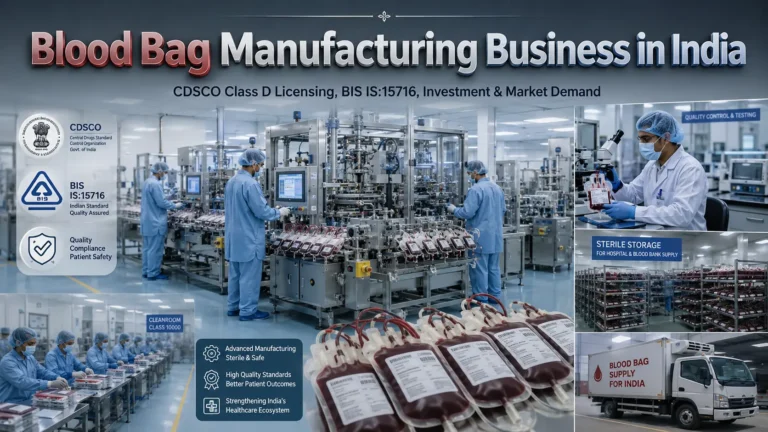
Blood Bag Manufacturing Business in India: CDSCO Class D Licensing, BIS IS:15716, Investment and Market Demand

Blood Bag Manufacturing Business in India: CDSCO Class D Licensing, BIS IS:15716, Investment and Market Demand Read More »

Blood Bag Manufacturing Business in India With less than 15 active manufacturers in India, serving a market of Rs 700-900 crore, every blood bag collected is clinically necessary as there is a shortage of blood units while a non-existent supply chain makes every single blood bag collected indispensable for blood banks across India, with quality manufacturers charging premium prices and secured vendor status. Market Opportunity: Why This Business Cannot Be Ignored Blood bags are added to the highest risk class D medical devices under MDR 2017, as defects may pose a direct threat to patients’ lives during a transfusion. All the class D manufacturers are required to be licensed by central CDSCO in addition to state SLA, have validated ETO processing, have thorough biocompatibility testing as per ISO 10993 and have validated ISO 13485 QMS. The barriers help quality producers to exclude the low-quality producers and make the market very attractive to serious and compliant manufacturers. The National AIDS Control Organisation (NACO), India, oversees more than 3200 blood banks which are licensed and have established certain technical requirements for the blood bags in government blood banking. The approved vendor list is the first step towards national procurement programmes which ensure payment of multi-year supply contracts to technically compliant manufacturers, one of the most predictable, and margin resilient, revenue models within the Indian medical device industry. Get Detailed Insights from This Book: Handbook on Medical and Surgical Disposable Products  Industry Analysis: Growth Drivers and Demand Outlook The blood bag market in India is estimated at Rs. 700-900 crore with 10-12 percent growth year-on-year. The Ministry of Health and Family Welfare has formulated a National Blood Policy that has been implemented in district hospitals under NHM, and which requires hundreds of new blood banks per year, all of which constitute a captive, predictable buyer of blood bags in single, double, triple and quadruple packs. The National AIDS Control Organisation (NACO) Blood bank portal keeps the list of approved vendors, technical specifications, and procurement procedures that blood bag producers need to meet and provide before they can receive contracts for blood bag supply from across 3200+ blood banks across the country. There are very few manufacturers that cater this sector namely BPL Biotech, Span Medical Products, Hi-Tech Medical and international brands. When a new company gets CDSCO Class D approval and NACO vendor list approval, they instantly have access to all the procurement opportunities across the country. Blood bags are identified as a medical devices initiative priority product category by Make in India and available for PLI Medical Devices for Class D approved manufacturers. According to Invest India blood storage systems are one of the high priority local manufacturing segments which can benefit from PLI scheme and also be preferred by the government for procurement as per the blood bag import substitution report, based on government data. India Blood Bag Market Overview Parameter Market Data Source or Notes India Annual Blood Requirement 15+ million units per year Ministry of Health estimates Actual Blood Collection 12-13 million units per year NACO Annual Report Blood Bag Market Value Rs 700 – 900 crore Industry estimates Market Growth Rate 10-12% per year NACO blood bank expansion Number of Licensed Blood Banks 3,200+ across India NACO national survey CDSCO Classification Class D (highest risk category) MDR 2017 India BIS Standard for Blood Bags IS:15716 Mandatory BIS certification How to Start: Step-by-Step Guide for Entrepreneurs Step 1: Technical Feasibility Study and Regulatory Strategy The manufacturing of blood bags is the most technically challenging business in medical devices industry in India. Prior to investment, perform a comprehensive technical feasibility study that includes clean room requirements, ETO sterilisation validation plan, biocompatibility testing, ISO 13485 QMS scope and a CDSCO class D licensing timeline. NPCS can do this feasibility study as the base of your investment decision as well as bank loan application. Blood bag manufacturing units should enrol on the Udyam MSME Registration Portal so that they can avail collateral free loan from CGTMSE, term loan from SIDBI and government subsidy on investment in the huge investment of clean room and ETO sterilisation equipment. Get Detailed Project Report (DPR): Blood Bags Manufacturing Plant Report Step 2: CDSCO Class D Manufacturing Licence Please apply for CDSCO Class D Medical Device Manufacturing Licence in Central office at New Delhi. Requirements are validated ISO Class 7/8 clean rooms, validated ETO sterilisation process with biological indicator monitoring, ISO 13485 QMS certification, biocompatibility data (ISO 10993) and a complete device master record. The whole process of getting CDSCO inspection and approval to get registered as a class D can take 12-18 months, so start preparing early. Step 3: Clean Room, RF Welding, and Sterilisation Infrastructure The required minimum size for a blood bag plant is 6,000-10,000 sq ft, and includes critical assembly (RF or HF dielectric welding machines for sealing PVC bag bodies) and secondary assembly (tube assembly, needle stations, anti-coagulant pre-fill stations) equipment, as well as validated ETO sterilisation chambers. Step 4: Anticoagulant Formulation and Fill Blood bags are provided pre-filled with anticoagulant-preservative solutions: CPDA-1 (blood shelf life of 35 days, most commonly used in India), CPD (blood shelf life of 21 days) or SAG-M (Additive solution bag with blood shelf life of 65 days for the storage of red cells). The formulation needs to be validated for fill accuracy and to be sterile and pharmaceutical grade mixed and filled. The CPD, CPDA-1 and SAG-M blood storage systems are as per the WHO guidelines for Blood Transfusion services and are matched to the BIS IS:15716 compliance of blood bags in India. Step 5: BIS Certification, NACO Approval, and Sales Get BIS IS:15716 certification and join the list of approved Vendors of NACO for Government blood bank procurement. At the same time develop private blood bank connections at corporate hospitals like Apollo, Fortis, Medinat, Max etc., where the premium pricing allows a much larger margin over the government tenders. Find high-return business ideas based on your budget & ROI Project Investment Breakdown for Blood

Techno Economic Feasibility Report for Bank Loan

How to Prepare a Techno-Economic Feasibility Report for a Bank Loan

How to Prepare a Techno-Economic Feasibility Report for a Bank Loan Read More »

Techno Economic Feasibility Report for Bank Loan The Rejection That Wasn’t About the Business In India, about 70% of MSME loan applications may be rejected not due to the strength of the business idea but because of the project documents. That number, often quoted in the Reserve Bank of India’s financial inclusion reports, is an unfortunate paradox – India has the capital, and the ideas are brought to the table by the nation’s entrepreneurs, but the paperwork doesn’t. Techno-Economic Feasibility Report (TEFR) is the document that forms the basis of all possible bank sanction processes. If you ask any MSME relationship manager from Punjab National Bank, Bank of Baroda or SIDBI, they will all reply the same: MSME feasibility report. It’s not about the entrepreneur’s enthusiasm. Not the opportunity pitch for the market. The report. In India, most first-generation entrepreneurs, who are rice mill owners in the state of Chhattisgarh, garment manufacturing in Tiruppur, cold storage investor in Agra, etc., take months to choose the equipment and negotiate land, and invest just two days in the report. That’s the exact opposite ratio. Poorly written TEFR will sink an otherwise good project. With a proper structure a one can sanction a ₹5 crore in 8 weeks. Here’s the inside scoop on what a bank-grade TEFR includes, how to assemble each section, and what sets it apart from the rejected documents that languish in a credit manager’s rejection bin. Related Article: Detailed Project Report (DPR) Consultants in India: How to Get Bank Loan and Government Subsidy for Your Business Why Most Project Reports Fail at the Bank Counter The formal banking system consisting of public sector banks, private banks and development finance institutions (DFIs) such as SIDBI have together allocated more than ₹22 lakh crore to support MSME loans as per their respective priority sector policies. However, penetration of credit into micro and small businesses is still very low. The shortage is not due to the lack of money. It is caused by poor quality project documentation. One of the most consistent findings in the Reserve Bank of India’s annual report on MSMEs is that ‘inadequate financial data’ and ‘insufficient technical details’ are the main reasons for the MSME applications to be rejected. There are many applicants that present what they term a ‘project report’ which is actually a simple spreadsheet with projected revenues and a quotation from a supplier pasted into it. A structured document which contains three layers of analysis is called a Techno-Economic Feasibility Report: Analysis of the technical aspects — what is to be produced, how it is to be produced, and what infrastructure is required for the production. Economic analysis — will the unit be able to produce cash sufficient to pay back the loan and to show a profit? Risk evaluation – what can go wrong and have they done something to minimise the risk? The TEFR is used by banks in India as a report for Due Diligence Input Report (DDIR) before the credit sanction committee meeting. The credit officer has nothing to go on but the entrepreneur’s past, if there is a credible TEFR. As per the Ministry of MSME’s Udyam registration portal, there are more than 4.6 crore MSME’s in India registered with the ministry. Only a small proportion of these have sought formal bank finance. One of the reasons is the quality of documentation – which is 100% fixable. Table 1: Common TEFR Deficiencies and Their Impact on Loan Applications TEFR Deficiency Section Affected Bank’s Concern Rejection Risk No break-even analysis Financial Projections Can the unit survive a bad quarter? High Missing pollution NOC reference Regulatory Compliance Will the plant face shutdown orders? High Equipment cost without quotations Capital Cost Estimate Is the capex realistic or inflated? Medium-High No raw material sourcing plan Technical Feasibility Supply disruption risk unquantified Medium Promoter contribution not shown Funding Pattern Is the promoter committed? High No sensitivity analysis Risk Assessment What if revenue falls 20%? Medium Generic market study, no India data Market Feasibility Is there real demand for this product? Medium-High Missing working capital estimate Financial Projections How will day-to-day operations run? High The Window That Policy Has Opened The credit scenario for MSMEs manufacturing has significantly improved in India. There are now several policy instruments that reduce the risk on bank lending to units that provide a credible feasibility plan. Collateral free loan guarantees up to ₹5 crore have been introduced for micro and small enterprises through the Credit Guarantee Fund Trust for Micro and Small Enterprises (CGTMSE) run by Government of India and SIDBI. Banks are much more likely to make loans through CGTMSE — and a decent TEFR is the most important document needed to activate the guarantee. PMEGP (Prime Minister’s Employment Generation Programme) is administered by KVIC, which provides capital subsidy ranging from 15% to 35% of the project cost for the first-generation entrepreneurs for the setting up of manufacturing units. Subsidy shall be disbursed based on the Detailed Project Report (DPR) – which is equivalent to a TEFR. Production Linked Incentive (PLI) schemes in 14 sectors (food processing, specialty chemicals, electronics, etc.) mandate for larger investments demand techno-economic documents to be submitted when claiming incentives. Some states such as Gujarat, Tamil Nadu, Karnataka and Telangana have state-level MSME investment policies which require a feasibility report for disbursement of incentives. Having a well-balanced TEFR is more than just a business case for bank loans. A well-formulated report is also a: Rationale for the application of CGTMSE guarantee Requests for refinancing by SIDBI will be handled technically by the technical input The main exhibit in an equity investment or joint venture talks The compliance documents required for availing the MSME incentive from the state governments. According to SIDBI’s MSME Pulse report, credit is available at lower interest rates and with faster sanctioning periods at MSMEs with structured techno-economic documentation (6–10 weeks) as compared to the undocumented ones (18–24 weeks). Get Detailed Insights from This Book: Select & Start Your Own Industry

Hidden Charges in MSME Bank Loans: The True Cost of Business Borrowing

Hidden Charges in MSME Bank Loans That Are Eating Your Profit Without You Knowing

Hidden Charges in MSME Bank Loans That Are Eating Your Profit Without You Knowing Read More »

Hidden Charges in MSME Bank Loans The Loan You Got Is Not the Loan You Signed Up For As part of the process, thousands of MSME entrepreneurs in India each year look into business concepts, secure fundings and approach banks for borrowing, only to realize months later that the amount they had to pay for the loan was far more than the interest rate quoted. Sanction letters with embedded processing fees. Embedded processing fees in sanction letters. Buried in a 40-page agreement, clause 18 contained pre-payment penalties. No single conversation required for insurance premiums to be bundled. These are not simple errors. They are the inherent characteristics of business lending in India — and not many MSME founders can identify them. It’s not just a financial disaster. It is informational. When a small manufacturing or trading business is run by a first-generation entrepreneur, it is highly unlikely that he/she will have a CFO to read the loan papers line by line. They are going to trust the relationship manager. What the relationship manager will likely not mention is the true cost of a loan — post all the fine print. The Reserve Bank of India (RBI) mandates banks to show the Annual Percentage Rate (APR) of loans (which includes all charges). But there is limited adherence to this disclosure standard, and even the majority of borrowers are not educated on how to read and understand APR data. It leads to a systematic mismatch between what MSMEs believe they’re paying, and what they actually are. Why MSME Borrowing Is a High-Stakes Game MSME is the backbone of India’s economy. The Ministry of Micro, Small and Medium Enterprises estimates that it contributes almost 30% of the GDP and employs more than 11 crore people. The demand for credit in the sector is enormous – and expanding. However, the average MSME borrower is still not well educated financially, and is especially sensitive to the types of loans that yield the highest profits for the lender. Consider the math. A manufacturing MSME takes loan of ₹50 lakh at a nominal interest rate of 11% per annum. The interest that has to be paid annually is ₹5.5 lakh on paper. However, once you factor in the processing fee (1.5%), the bundled insurance (1.2% per annum), documentation charges (₹15,000) and penal interest incurred during a cash crunch of two months, the annual cost is easily more than 16% to 18%. That’s a huge amount. And it eats into the razor-thin profit margins most MSMEs have. Thus, it’s not a financial literacy exercise to just understand these hidden charges. It’s a must learn skill for every MSME founder in the competitive environments of today. Related Article: DPR for Bank Loan: Format, Example & Step-by-Step Guide for MSME Loan Approval What the Regulatory Framework Says — And Where It Falls Short The RBI’s Fair Practices Code for Lenders says that banks and NBFCs must clearly and simply write down all charges related to their loan in the first place. Further, the MSME Samadhaan platform enables MSMEs to lodge any complaints related to payment. But disclosures of pre-disbursement charges are not enforced very well. There has been some progress made by the government. Pradhan Mantri Mudra Yojana (PMMY) is an initiative by the government to provide collateral-free loans. There are three schemes namely Shishu, Kishore, and Tarun with comparatively transparent fee structures. The Credit Guarantee Fund Trust for Micro and Small Enterprises (CGTMSE) scheme minimizes the requirement for collateral and to a certain degree, insurance bundling. But, none of these schemes has gone to the extent of resolving the issue of undisclosed charges in conventional term loans and working capital facilities provided by the commercial banks. It is also worth noting that the DPIIT has created a Startup India portal with grievance redressal and financial advisory tools for the benefit of the startup entrepreneurs to help them better understand lender disclosures. Furthermore, the Federation of Indian Chambers of Commerce and Industry (FICCI) has been highlighting hidden lending charges as a structural impediment in expanding the MSME growth in India. The Major Hidden Charges That Are Costing MSMEs Dearly 1. Processing Fee: The First Hidden Blow Most founders know of the processing fee, but very few realize just how big it can be. This fee will be deducted from the sanctioned loan amount and is generally 0.5% to 2% of the sanctioned amount. If you apply for a loan of ₹50 lakh, and the processing fee is 1.5%, you’ll receive ₹49.25 lakh, but you’ll be charged interest on the entire amount of ₹50 lakh. It’s a structural feature that results in your effective interest rate starting higher than what it purports to be on the first day. 3. Prepayment and Foreclosure Penalties: The Exit Tax This is where most of the MSMEs really get taken aback. During a boom time, once the business gets better and cash flows are available, the natural inclination is to settle the loan before the time, which helps in reducing interest payments. But a lot of bank loans are subject to prepayment penalties of anything from 2 per cent to 4 per cent of the outstanding principal. A few lenders may have a lock-in requirement of 12 to 24 months, meaning you can’t make a single payment at all. This is effectively locking a borrower in to a high-cost loan when they are able to pay it off. This means that the actual price of borrowing is more expensive than any apparent interest rate comparison might indicate. Your investment deserves the right opportunity 3. Bundled Loan Insurance: The Silent Premium This is probably the most obscure of all the hidden fees. Credit life insurance or loan protection insurance is offered by many banks, especially public sector banks, as a part of the loan disbursement process. This is the premium which is levied on the loan at the rate of 0.5% to 1.5% per annum either as a lump sum or as an additional payment

Organic Food Processing Business in India

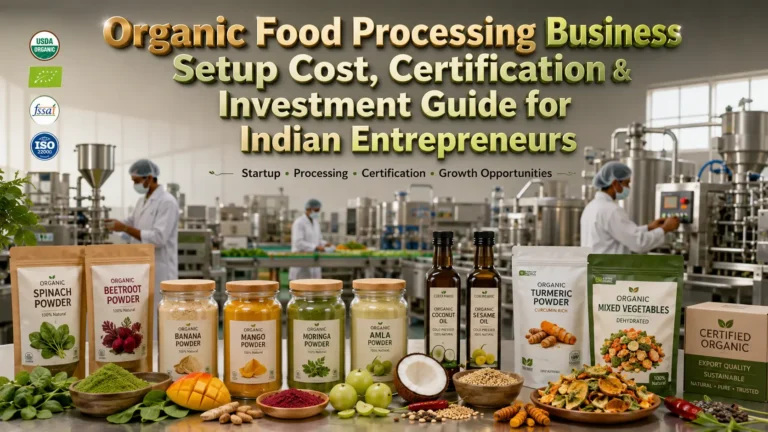
Organic Food Processing Business: Setup Cost, Certification & Investment Guide for Indian Entrepreneurs

Organic Food Processing Business: Setup Cost, Certification & Investment Guide for Indian Entrepreneurs Read More »

Organic Food Processing Business in India The Counter-Intuitive Truth About Organic Food in India India is exporting more than ₹5,300 crore of certified organic products annually, while it imports the processing technology to process them. Let that sink in. The nation that has over 30% of the organic produce grown in the world, the majority of which is cardamom, grown in the cardamom hills of Kerala, to the spices of the Rajasthan spice belts, are sold mostly as raw commodity. That is the profit realization, that is the packaging, that is the branded product – that goes overseas. A company from Germany imports organic turmeric powder from India and places it in a glass jar bearing a serif logo and sells it for €14. The Indian farmer received ₹42 for every kilo he sold. It is in this space between raw organic produce and finished certified organic produce that the true business is going to be. The Agriculture and Processed Food Products Export Development Authority (APEDA) has reported that demand for certified organic food has increased at the rate of 12–15% every year for the last five years in India. In the three cities, the average urban household in Bengaluru, Pune, and Delhi-NCR spends 22% more per grocery basket when shopping for organic than conventional products, on average, 5 years ago. It is not sufficiently available in the region where it is made, there is no traceability, and it is not properly certified. Get Detailed Project Report (DPR): Food Processing and Agriculture Based Projects The Supply Gap Nobody Is Filling Fast Enough India has the maximum area (36.53 lakh hectares) of certified organic farming in the world, according to the National Centre of Organic and Natural Farming (NCONAF). Less than 12% of the small and medium organic processors have been certified in India as per the minimum requirement of NPOP (National Programme for Organic Production) to be able to label a product as ‘certified organic’ for domestic retail and export market. The outcome: a deficiency in structural processing. Raw sales dominate to large aggregators, most of these who are also organic farmers sell at prices slightly higher than conventional producers. At the processed and value-added segment, less than 200 brands have a national presence with the bulk of them concentrated in Maharashtra, Gujarat and Karnataka. States such as Uttarakhand, Himachal Pradesh, Odisha and Chhattisgarh which have more than 8 lakh hectares of organic farms have virtually no processing infrastructure. The Indian Council of Food and Agriculture (ICFA) believes the India domestic organic food market has total value of around ₹9,000 crore and is estimated to reach ₹30,000 crore within a decade. Retail outlets such as the DMart, BigBasket and Nature’s Basket have admitted that there is less space for certified organic essentials priced between ₹100 and ₹500. The supply situation is even more constrained for smaller categories of organic food, such as immunity boosters, millets and cold-pressed oils. Demand from exports is just as poor. More than 85% of the certified organic exports from India are consumed by the EU, USA and the Gulf markets. Processing units that are able to ensure traceability, hygiene and NPOP or NOP (USDA Organic) certification can charge 25-40% price premium on uncertified Indian exports. TABLE 1: State-Wise Organic Demand, Key Crops & Industrial Clusters State Key Organic Crop / Product Industrial Cluster / Hub Estimated Demand Growth (Annual) Export Potential Sikkim Organic vegetables, ginger, cardamom Gangtok Agro-Processing Zone 18% High (EU, USA) Madhya Pradesh Soybean, wheat, pulses Indore, Jabalpur 14% Medium-High Rajasthan Cumin, coriander, fennel Jodhpur, Kota Spice Cluster 16% High (Middle East, EU) Uttarakhand Basmati rice, herbal extracts Rudrapur, Haridwar Food Park 12% High (USA, Japan) Maharashtra Soybeans, millets, sugarcane jaggery Pune, Nashik Agri-Zone 11% Medium Kerala Coconut oil, spices, black pepper Kochi Spice Park, Thrissur 15% Very High (Gulf, UK) Source: APEDA Organic Export Data; NCOF Annual Report; State Agriculture Department estimates Why Entry Right Now Makes Commercial Sense Organic food processing is an appealing proposition right now in three ways. First: Policy tailwinds are there and backed by cash. Organic clusters are eligible for up to ₹50,000 per hectare under the Government of India’s Parampara at Krishi Vikas Yojana (PKVY) for support in the certification process and farmer group formation. This directly lowers sourcing cost of raw material. The processors who coordinate with PKVY clusters are provided with a cost and supply benefit at the same time. Second: The demand for exports is growing faster than the supply. As per the export data from APEDA, the value of organic exports increased from ₹1,900 crore to more than ₹5,300 crore during the last decade. They are mostly made of turmeric, ginger, pulses and rice. But only part of these flows as a complete branded product. This market can be reached directly by a processing unit certified to the NPOP standards. Thirdly, the processing sector of the MSME is undercapitalized — on purpose. There has been no meaningful presence by big FMCG players in the organic sub ₹300 SKU segment. It is structurally inefficient because of their small production volumes and high marketing expenses. The price band of ₹80-250/unit is left open for agile MSME processors in this regard as it is the optimum sweet spot of the metro consumers. The Ministry of Food Processing Industries (MoFPI) has earmarked more than ₹10,000 crores for the food processing industry under the Production Linked Incentive (PLI) Scheme. Organic processors whose sales is more than ₹1 crore per year will get a 4-10% incentive on incremental sales, thus reducing the payback period by 8-12 months. The MUDRA Kishore and Tarun loan categories offer a loan of up to ₹10 lakh, which is enough for a micro-processing unit, but it does not require any collateral. The Prime Minister’s Employment Generation Programme (PMEGP) is a scheme offered by KVIC, which provides 15–35% capital subsidy based on the geographic location of the project and the type of the founder (women, SC/ST entrepreneurs receive higher subsidy). Get Detailed Insights

Green Chemical Business in Odisha

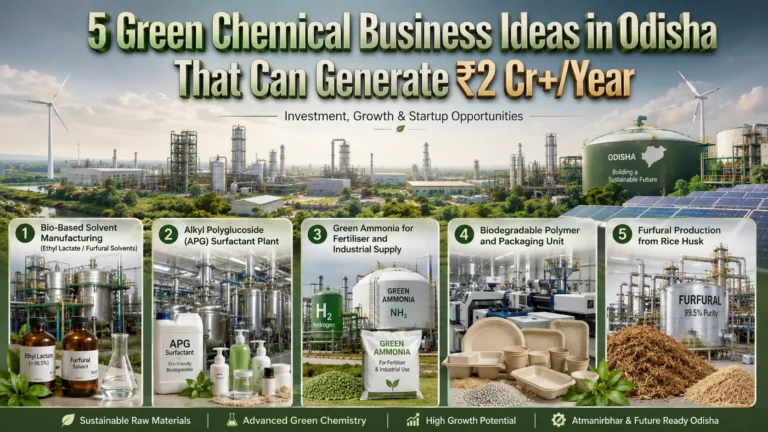
5 Green Chemical Business Ideas in Odisha That Can Generate ₹2 Cr+/Year

5 Green Chemical Business Ideas in Odisha That Can Generate ₹2 Cr+/Year Read More »

Green Chemical Business in Odisha The Green Chemistry Opportunity India Cannot Afford to Miss The size of India’s green chemicals market is now over USD 15 billion and it’s expanding by more than 10% annually. However, most chemical business owners are still trying to find a business concept that involves the same sort of products that were created 30 years ago. That is a big error! Green chemistry—biodegradable, bio-based and low-carbon specialty chemicals—is the next 10 years of Indian specialty chemicals, consumer demand and preference, and regulatory requirements of global buyers. The advantage that Odisha, which is located on a world class port, huge agricultural biomass and has a government supported petrochemical anchor at Paradip, is unparalleled in the eastern part of the country. There is no question about the growth of the green chemicals market. But who will construct it first? Why Green Chemicals — and Why Odisha? Sustainability is a hard trend. It is difficult to do this as a hard rule. Bio content for cleaning and personal care products is required for all products sold in 27 EU countries under European Union’s Green Deal requirements. Methanol and ammonia are being replaced with green alternatives by shipping lines. Exporters of pharmaceuticals to the US FDA and EMA are increasingly being encouraged to use bio-based solvents as a result of the laws and regulations concerning solvent usage in India. As the laws and regulations pertaining to solvent usage in India are moving more towards bio-based solvents, the pharmaceutical exporters are increasingly encouraged to use it for export to US FDA and EMA. All Indian manufacturers have to go green otherwise they have to lose the business in these markets. Among the three, Odisha has three attributes, which make it uniquely suited for green chemical manufacturing. The first plant, Indian Oil Paradip Petrochemical Complex, will manufacture all the key intermediates used in green formulation chemistry (IPA, phenol, MEG) with an investment of ₹61,077 crore. Second, the rice husk and agricultural biomass produced in Odisha is in millions of tonnes each year, which is the raw material for making bio-based chemicals. Third, Paradip Port has been officially named one of the three Green Hydrogen Hubs under the National Green Hydrogen Mission, which provides a policy and infrastructure benefit that no landlocked port can offer. Source: Invest India – Chemicals Sector Get Detailed Insights from This Book: The Complete Book on Biomass Based Products (Biochemicals, Biofuels, Activated Carbon) Government Policies Supporting Green Chemical Manufacturing The Union Budget has specifically provided money for the Ministry of Chemicals and Fertilizers. It has also launched three chemical parks based on clusters on a plug-and-play basis, which were developed specifically to boost specialty and green chemical manufacturing. Furthermore, the PCPIR policy in Paradip provides shared effluent, power and jetty facilities, and this significantly decreases the project setup costs. The National Green Hydrogen Mission (NGHM) offers financial incentives and financial grants to the manufacturers of green ammonia and green methanol. The SIGHT Scheme provides government offtake guarantees which lowers the risk of the revenue stream for the green chemical projects of the first movers. Another positive lever is the Production Linked Incentive (PLI) scheme for specialty chemicals. Moreover, the MSME and Large Industry policy of Odisha also offers capital subsidy of 15–25%, duty waiver on electricity for 5 years and exemption from stamp duty for qualified manufacturing unit. Source: DPIIT – PCPIR Policy Framework Source: MNRE – National Green Hydrogen Mission Green Chemical Business Ideas for Startups in Odisha Business Idea 1: Bio-Based Solvent Manufacturing (Ethyl Lactate / Furfural Solvents) VOC regulations, and buyer demand, are driving the replacement of toluene, xylene, and methyl ethyl ketone in pharmaceuticals, coatings, electronics cleaning and more with bio-based solvents. The one green solvent in this category that is most versatile is ethyl lactate which is made from lactic acid and ethanol. A small-scale ethyl lactate manufacturing plant in Odisha, using locally available broken rice to produce lactic acid and then esterifying it with bio-ethanol, could generate income of ₹80-250 per kg of ethyl lactate, whereas petro-chemical based ethyl lactate can generate income of only ₹25-35 per kg. The Paradip Pharma cluster is an indigenous buyer. The export potential for such solvents to Europe—the region where these solvents are required for pharmaceutical production — is significant. The investment required for setup is in the range of ₹15 crore to ₹50 crore, depending on the scale. Related Article: Bio-Based Chemical Business Idea: Furfural Plant Cost, Profit and Market Demand in India Business Idea 2: Alkyl Polyglucoside (APG) Surfactant Plant APG surfactants are bio-based; they are made from glucose and fatty alcohols. They’re the highest quality in personal care products – baby shampoos, personal luxury products hand washes, and sulphite-free products. They are 100% biodegradable and can be used under EU Ecolabel. There are no major APG production units in the East India. A manufacturer setting up an APG unit at or close to the port of Paradip has direct access to fatty alcohol through coastal shipping from Tamil Nadu, Andhra Pradesh and to glucose from the starch industry in Odisha. APG is priced 40-80% higher than “traditional” surfactants, and European personal care companies continue to demand it steadily making this one of the highest margin green chemical business opportunities in the country today. Capital requirement: ₹30–100 crore. Business Idea 3: Green Ammonia for Fertiliser and Industrial Supply ACME Group has already pledged a green methanol plant of capacity 200,000 TPA in Odisha. SECI will also provide ACME with 370,000 MT per year green ammonia supply under an 10-year offtake agreement to Indian fertiliser companies through its SIGHT Scheme. This indicates that the infrastructure for green ammonia offtake in Odisha is already in place. For the entrepreneur who is looking to enter this area at a smaller level of 20,000 to 100,000 TPA, the opportunities include the industrial refrigeration market, ammonium nitrate for mining chemicals, specialty nitrogen applications for agriculture, etc. By designating the port as a green hydrogen hub, it ensures

Solar Installation Business in India

Scrap Dealer to Solar Entrepreneur: The Telangana Story That Belongs in Every Business School

Scrap Dealer to Solar Entrepreneur: The Telangana Story That Belongs in Every Business School Read More »

Solar Installation Business in India A man who didn’t have a formal education read the renewable energy boom right, and made his way to 20 MW projects under MSME finance The Man Who Sold Scrap and Bought the Sun Ravi Shankar Reddy was an uneducated person. He went into the business of buying old transformers, old machinery and industrial waste to run a scrap metal yard in Nizamabad, Telangana. His understanding of the metal was more than just a knowledge of its weight and grade; it extended to its market value. Little did he know that this skill would help him to become one of the most successful solar installation entrepreneurs in the Deccan belt someday. The surprising reality about the Indian solar industry is that the largest profits aren’t being generated by IIT engineers backed by VC investment. It is being produced by solar channel partners, contractors and former electricians who got it right from the off: the channel partner model in solar is just like the distribution model in FMCG. You don’t manufacture. The panels are not your property. You bring buyers and installers together, deal with the paperwork with DISCOMs and earn a margin for every kilowatt installed. Within 4 years of his first installation, Reddy had crossed the ₹12 crore annual revenue mark. He never took a rupee from a venture capitalist. The funding was provided by IREDA, an Indian Renewable Energy Development Agency, and a loan from a cooperative bank in Karimnagar from the CGTMSE scheme to the tune of ₹50 lakh. He’s not the only one who had a story. It is a blueprint. Read the Complete Book Here: Solar PV Power and Solar Products Handbook The Gap That’s Still Wide Open India has made a pledge to achieve 500 GW of non-fossil fuels electricity generation. The installed solar power is about 90 GW as per data from the Ministry of New and Renewable Energy (MNRE). The country must increase the supply of electricity by about 400 GW — in a decade or so. The math alone will give you the opportunity. It’s not about utility-scale solar farms in Rajasthan. It is the unmet demand in small and medium industrial estates in Telangana, Maharashtra, Gujarat, Tamil Nadu and Madhya Pradesh. The industrial parks accommodate 200-500 MSMEs each with heavy machinery running on the grid at a cost of ₹8-11 per unit. With 25 years’ cost, Rooftop Solar can reduce this cost to ₹3.50 – 4.50 per unit. Nearly 25% of the total electricity consumption in India is used by MSME sector as per the Bureau of Energy Efficiency (BEE). However, the penetration of rooftop solar on the MSME sector is still around 8%. The answer is not price — it’s economics that make it the reason. The obstacle is the awareness of the entrepreneur, the trust of the vendors and working capital for the entrepreneur who starts the installation business. States such as Telangana, Andhra Pradesh, Karnataka and Rajasthan have been very aggressive with their state solar policies, providing faster DISCOM approvals and net metering policies. Rooftop solar is set for 2,000MW capacity for the residential and commercial segment in Telangana. At the present, only less than 400 MW are installed. The gap is 1,600 MW and actively seeking channel partners to fill. TABLE 1: State-wise Solar Opportunity — Rooftop & Industrial Captive Power State State Solar Target (MW) Current Installed (MW) Gap (MW) Key Industrial Clusters DISCOM Approval Timeline Telangana 2,000 ~400 ~1,600 Patancheru, Bollaram, Nacharam 45–60 days Andhra Pradesh 10,000 ~4,200 ~5,800 Visakhapatnam, Tirupati, Chittoor 30–45 days Karnataka 8,000 ~3,800 ~4,200 Peenya, Bommasandra, Hubli 30–60 days Gujarat 30,000 ~14,000 ~16,000 Surat, Rajkot, Anand, Vapi 21–30 days Rajasthan 40,000 ~18,500 ~21,500 Bhiwadi, Jodhpur, Alwar 30–45 days Maharashtra 12,000 ~5,200 ~6,800 Pune, Nashik, Aurangabad, Nagpur 45–75 days Why This Is the Right Window — And It Won’t Stay Open Forever The opportunity window is narrowing thanks to three policy tailwinds. Firstly, the PM Surya Ghar Muft Bijli Yojana is promoting rooftop solar in residential demand by offering up to ₹78,000 per household as central subsidy. This is building a pipeline of trained installers and familiar customers for channel partners to upsell to commercial and industrial customers. Secondly, the Production Linked Incentive (PLI) scheme for the solar module has begun to decrease the reliance on Chinese solar panels. There have been a lot of changes in the price of domestic modules, but the PLI is building a supply chain that will ensure a stable supply price in coming years, thereby providing installation companies with more predictable input costs. Thirdly, the IREDA financing structure explicitly identifies MSME solar installers and small-scale project developers as a priority lending segment. IREDA has established competitively 10 – 11 per cent per year term loan rates for solar projects and provided a moratorium of up to 12 months — a much-needed breathing space for a business which takes 3 – 6 months to commission its first project. On the finance side, the MSME (Credit Guarantee Fund Trust for Micro and Small Enterprises) enables solar channel partners with no tangible assets to pledge to avail loans up to ₹2 crore for their first-generation entrepreneurs. The PMEGP scheme of KVIC offers a capital subsidy of 25% to 35% in the manufacturing or service unit to the solar installation companies who are registered in the rural areas or semi-urban. One of the biggest structural hurdles that most potential solar entrepreneurs overlook – vendor empanelment with state DISCOMs is a real entry barrier – but good news for those who are successful. If a vendor is on Telangana’s DISCOM approved vendor list or on Karnataka’s BESCOM empanelled list, then the vendor will have a recurring pipeline which the new vendors will not get for 6 months to 18 months. This is the moat for which Ravi Shankar Reddy fought a long battle. View Full Project Details: Renewable Energy Sector: Green Power & Sustainable Technologies  How to Set Up a Solar Installation Business in

Defence Manufacturing Business Ideas in India 2026

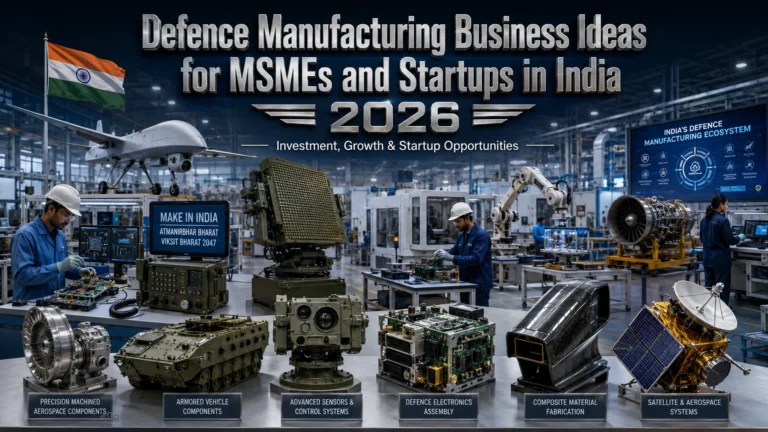
Defence Manufacturing Business Ideas for MSMEs and Startups in India: The 2026 Opportunity Guide

Defence Manufacturing Business Ideas for MSMEs and Startups in India: The 2026 Opportunity Guide Read More »

Defence Manufacturing Business Ideas in India 2026 India’s path of Defence is now different. Over the years, the country became the world’s biggest importer of arms. This is completely different now in New Delhi. During the National Defence Industries Conclave 2026, the Minister of State for Defence announced that MSMEs and startups have now become a key driver towards India becoming a global defence manufacturing hub. Businesses ideas which are available in this sector now, would have been unimaginable just 10 years ago. The Union Budget 2026–27 has allocated ₹7.85 lakh crore to defence, the highest ever, which is an increase of 15.19% year-on-year, according to the Ministry of Defence. The volume of Defence production has just touched new heights and the message to small manufacturers is loud and clear: The gates of one of India’s most protected industries have opened! The Gap Nobody Talks About The paradox at the core of India’s defence build-up. Large Defence Public Sector Undertakings (DPSUs) and a few big private companies seem to be in the news but they cannot do everything themselves. There are tens of thousands of parts in one fighter aircraft! From precision-machined valves and special cables to fasteners, castings, forgings, rubber gaskets and electronic sub-assemblies, all are necessary for a warship. The DPSUs are supposed to do their business on the clear directive of the government to boost outsourcing to Indian vendors. In the meantime, thousands of items have been added to the Positive Indigenisation Lists and no longer can be imported into this country. The actual number of MSMEs working in the defence sector is about 16000 but the number of registered, qualified MSME vendors in defence sector is far less than the actual requirement, according to IBEF. That disparity is the opportunity. Why 2026 Is the Inflection Point Various forces have converged at one time and 2026 is the most apt time for MSME defence suppliers of India in the history of the country. Reflect on change: All-time high defence budget: The defence budget in the Union Budget 2026–27 is the highest ever, and approximately ₹1.39 lakh crore has been allocated for procurement from domestic industry only. Capital Acquisition funds are now mostly assigned to Indian companies with close to 75% of the budget dedicated to them. Indigenisation lists: Thousands of components and sub-systems are reserved for Indian manufacturers under the Positive Indigenisation Lists of the Ministry of Defence and DPSUs. More than 34,000 items are listed on the SRIJAN portal, of which over 10,000 have already been indigenised. iDEX grants: Startups and MSMEs working on defence prototypes can avail of a grant of not less than ₹1.5 crore under the SPARK scheme and up to ₹25 crore under the ADITI scheme from the iDEX (Innovations for Defence Excellence) framework. Up to 676 startups, MSMEs and innovators are part of the iDEX ecosystem as of early 2026. Defence corridors: Two dedicated Defence Industrial Corridors in Uttar Pradesh (Aligarh, Agra, Jhansi, Kanpur, Chitrakoot, Lucknow) and Tamil Nadu (Chennai, Coimbatore, Hosur, Salem, Tiruchirappalli) offer plug-and-play infrastructure, land incentives, and state subsidies. Defence exports have improved: India’s defence exports are estimated at a record ₹23,622 crore during FY 24–25, which is more than 34 times the figure in the previous decade. According to PIB, private players like MSMEs contributed to the increasing share of defence exports, and the number of defence exporters grew by 17.4% during a single year. Related Article: India’s Defence Manufacturing Boom: A $15 Billion Opportunity for MSMEs and Startups Entry Routes: Where a Small Manufacturer Fits It is not necessary to create a missile in order to be in defence manufacturing. The realistic and practical entry points for an MSME or start-up are clearly defined: Tier-2/Tier-3 vendor: Register with the DPSUs like HAL, BEL, BDL, GRSE, Mazagon Dock and seven new corporatised ordnance units. Each has a vendor registration portal, as well as regular publications of outsourcing needs. Private prime supply chain: Provide parts for the large prime vendors like L&T, Tata Advanced Systems, Bharat Forge, Adani Defence, etc. who do their own prime assembly. Innovation route: Address problem statements from iDEX/ DISC with working prototype. Meaningful de-risking of the whole trip is achieved through grant support and guaranteed first customer – the military. Direct procurement: Items like Protective equipment, Drone Components, Batteries, Optics, Simulation Software, MRO consumables and Ground Support Equipment are being purchased through the GeM portal and defence tenders available for MSMEs. These are all different risk/reward scenarios. Tier 2/Tier 3 vendor work is stable and repeat order. The innovation route will have higher margins and will provide IP ownership. The majority of successful MSME defense suppliers start their business with build to print vendor products and then move on to product development. The high-potential ideas for businesses are the Products Segments for MSMEs. The table below provides an overview of eight categories of products in which MSMEs can realistically and commercially participate. These are the best business concepts for engineers, electronics, chemicals or textile entrepreneurs: Product Segment Why It Suits MSMEs Indicative Investment Precision machined components (CNC) Recurring DPSU/prime orders; existing job-shops can upgrade ₹1.5 – 5 crore Cable harnesses & connectors Labour-intensive, low capital; AS9100/defence specs achievable ₹75 lakh – 2 crore Drone frames, propellers & sub-systems Fast-growing UAV ecosystem; iDEX-friendly ₹1 – 4 crore Rubber & polymer parts (seals, gaskets, mounts) Indigenisation list items; moderate technology barrier ₹1 – 3 crore Defence-grade fasteners & springs High-volume consumables across platforms ₹1 – 2.5 crore Ballistic protection & technical textiles Body armour, helmets, camouflage nets; export demand ₹2 – 6 crore Batteries & power systems Soldier systems, UAVs, communication sets ₹2 – 8 crore EMI/EMC shielding & enclosures Electronics-heavy platforms need certified enclosures ₹1.5 – 4 crore All items on this list are found on the government’s Positive Indigenisation Lists, thus encouraging import-substitution. In fact, Goldman Sachs estimates the earnings growth of private defence companies in India at a steady 32% from FY25 to FY28, with the very areas MSMEs cater to

TReDS invoice discounting for MSME

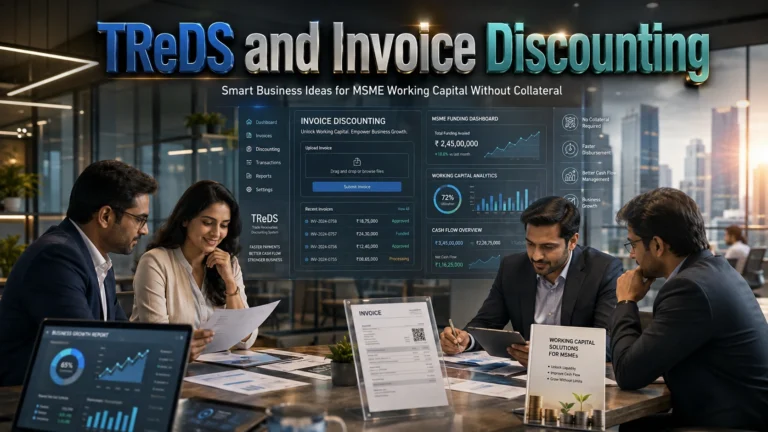
TReDS and Invoice Discounting: Smart Business Ideas for MSME Working Capital Without Collateral

TReDS and Invoice Discounting: Smart Business Ideas for MSME Working Capital Without Collateral Read More »

TReDS invoice discounting for MSME Without Collateral This is a phenomenon that all manufacturers are familiar with. Once you’ve sold the product, you send the invoice, and then wait. Forty-five days. Sixty days. Ninety. In the meanwhile, salaries, electric bills, and raw material payments continue undisturbed. In most MSMEs, the problem is not the demand issue, it is working capital shortage. If you are thinking of starting a business in manufacturing or supply, you may have heard this more than once: It is not too difficult, or even impossible, to cash up unpaid receivables. Nowadays, it is a fact of regulation with the RBI’s back. Consider the numbers. One of the three RBI-licensed TReDS, RXIL has been facilitating discounting of more than 88.5 lakh invoices through a completely digital platform. Consequently, the registrations of MSMEs on TReDS platforms have increased. Meanwhile, the level of MSME loans in the banking sector is falling short of the five-year benchmark at around 1.8% of the total credit while the overall credit sector has crossed Rs. 35 lakh crores. Lenders are more comfortable with MSMEs than ever before and the back-end processes to convert unpaid invoices to same-week cash have evolved into a viable, viable, and widely available system. The Working Capital Gap: Why Receivables Trap Small Businesses The combined value of all MSMEs’ receivables is a huge pool of money stuck in their inventories from large corporate and government buyers. The issue is the structure. Long payment cycles are the norm for large buyers. Smaller suppliers are less likely to be able to bargain. The classic answers — a mortgage on the property or postponing payment — either require the property as security that the entrepreneur may not have, or they slowly eat away at the profit margin – the entrepreneur is forced to resort to emergency loans with steep interest rates. This imbalance in the structure has been recognised by the Ministry of MSME as well, which has released a notification to ensure that buyers with turnover exceeding Rs. 500 crores have to be uploaded on TReDS platforms. The RBI took the initiative to implement the Trade Receivables Discounting System (TReDS) just to stop this cycle. It enables an MSME to sell the approved invoice to other interested banks and get the amount paid to it within days, without having to take the credit risk on its books. Get Detailed Project Report (DPR): Business Ideas with High Investment (₹65 Crore+) Project Profiles How TReDS Actually Works: A Step-by-Step Business Overview This is easy to do. If you know it, you know the efficiency difference. Step 1 — Registration: All three actors (MSME seller, corporate buyer and financiers/banks or NBFC factors) register on an RBI-approved TReDS platform. There are three licensed operators (RXIL, M1xchange and Invoicemart). Step 2 — Invoice Upload: Once goods/services are delivered the MSME uploads the invoice digitally. The buyer then takes it on the platform, which becomes a ‘factoring unit’. Step 3 — Competitive Auction: Several financial institutions bid to provide a discount on the accepted invoice. Financiers are competitive, which is why the interest rate is normally lower than the typical working capital loan interest rate. The seller has the ability to determine the price. Step 4 – Payout: When the bid is accepted, the winning financier deposits the money into the MSME’s bank account, typically within 24-72 hours. No security is taken. No paperwork trail — just digital confirmation. Step 5 — Settlement: On the due date, the buyer pays the financier directly. In the standard ‘without recourse’ factoring structure, the credit risk of the buyer rests entirely with the financier — not the MSME. The final one is really important. MSME gets prior payment and is not liable to the buyer if delay or default occurs. This is a complete reversal of the normal lending process. TReDS vs. Traditional Working Capital: An Honest Comparison In the beginning, many MSME owners compare TReDS discounting with their existing bank overdraft/cash credit facility. The difference is clear in the table below: Parameter TReDS Invoice Discounting Bank OD / CC Limit Collateral None — invoice is the asset Property or FD usually required Speed of Cash 24–72 hours after acceptance Weeks for sanction; drawal limits apply Pricing Basis Linked to buyer’s credit rating Linked to MSME’s own rating Balance Sheet Impact Off-book in without-recourse factoring Adds to borrowings on books Paperwork Fully digital, one-time KYC Annual renewal documentation Best For Receivables from rated corporate or PSU buyers General operational float Who Should Register: Eligibility and the Business Sweet Spot Eligible for any Udyam registered MSME who sells to corporates/PSUs/ Government departments. Your big customers may well be on these platforms anyway, as buyers over the turnover threshold are already required to be on these platforms by law. The areas with the greatest acceptance rates and competition for the best discounts are: Automotive original equipment manufacturers (OEMs) and Tier 1 suppliers and Tier 2 suppliers FMCG distributors, retail chains and major FMCG companies A railway company, defence PSUs, and power sector utilities Small-scale producers of ingredients for the pharmaceutical industry Large Construction and Infrastructure rated credit profiles Importantly, there are no minimums in practice, on the platforms. However, even a small volume supplier benefits! Registration fees are inexpensive—just a small percentage of the interest saved on just one of the paid invoices. Get Detailed Insights from This Book: 50 Best Home Businesses To Start With Just 50,000 Real Numbers: What Invoice Discounting Actually Costs It is hard to see the value of any abstract benefit unless there is a tangible monetary component. Let’s use this hypothetical example: Parameter Indicative Value Invoice value Rs. 10,00,000 Buyer payment terms 60 days Auction discount rate (indicative) 8.5% per annum Discount charge for 60 days Rs. 13,972 (approx.) Cash received within 72 hours Rs. 9,86,028 (approx.) Saving vs. 14–18% emergency borrowing Rs. 9,000 – Rs. 16,000 per Rs. 10 lakh Hidden benefit No collateral blocked; limits stay free for expansion Note: Rates vary with

Manufacturing Business Ideas in West Bengal

10 Manufacturing Business Ideas in West Bengal with 12–26% Net Margins Under ₹80 Lakhs

10 Manufacturing Business Ideas in West Bengal with 12–26% Net Margins Under ₹80 Lakhs Read More »

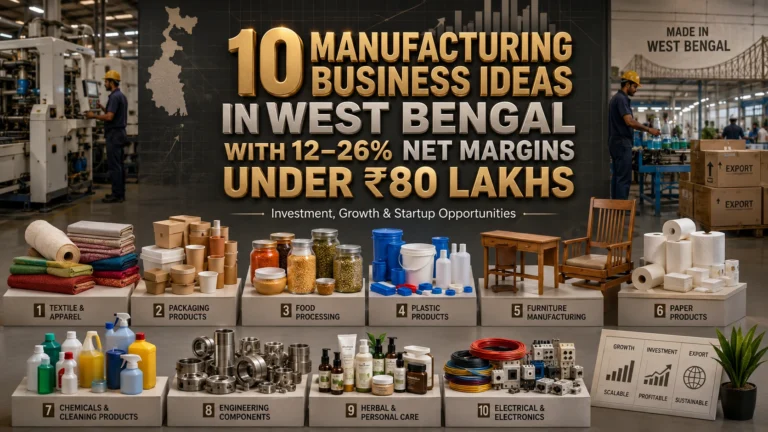
Manufacturing Business Ideas in West Bengal When it comes to the most preferred choice of location for a startup, most entrepreneurs would think of Gujarat, Maharashtra or Karnataka. There were hardly any who included West Bengal in their list of contenders. That’s a thing which has to be fixed — the state government of West Bengal currently grants capital subsidy of 15-30% on plant and machinery, power tariff rebate, stamp duty waiver and a single window clearance system which can issue 36 licences in 30 working days. No state in the eastern part of the country boasts that incentive package for the first time manufacturer. The state’s premier nodal agency, West Bengal Industrial Development Corporation (WBIDC), has developed more than 20 functional industrial parks in various districts from Howrah to Haldia to Barjora, where the land has already been pre-cleared, infrastructure has been laid out, and all the utilities are connected. Everything can be done on the Internet, including Factory Licences and Environmental NOCs on the Silpa Sathi portal. There’s another number that makes it more directly. Yet, there are only 4% industrial investments in West Bengal despite having more than 900,000 MSME units in the state, which is the third among the most important industrial hubs of the country based on the MSME Annual Report, released by the Ministry of MSME. That gap exists because of perception, not ground reality. Get Detailed Project Report (DPR): Best Business Opportunities in West Bengal What West Bengal Has That Other States Do Not The geographical location of the state gives business opportunities which are unattainable elsewhere in India. West Bengal shares its borders with another nation with 170 million people, Bangladesh, which is experiencing a growth in incomes and enormous demand for processed food, garments and consumer goods. The port of Kolkata, Syama Prasad Mookerjee, imports more than 17 million metric tonnes of cargo annually, and has direct shipping routes to the South-East Asia. The National Fisheries Development Board (NFDB) says West Bengal has an annual rice production of 15.7 million tonnes, is the biggest producer of vegetables by volume in the country and contributes almost one-third of inland fisheries production. However, food processing penetration remains at between 12-15% of overall agricultural production, which is less than the average for agricultural economies in similar countries, which is between 25-40%. Thousands of viable business units exist but have not been created, just this one. The jute narrative is as compelling. Jute crop in the state contributes 75% of the total jute production of the country, but most of this is exported as raw fibre. As part of the sustainability requirements imposed by European retailers, finished jute products (such as bags, composites and technical textiles) are in growing demand from FMCG companies. Domestic demand for jute bags has been increasing at more than 12% compounded rate according to the National Jute Board (Ministry of Textiles). A unit for jute bag manufacturing in Howrah or Hooghly can make bags for ₹18/$-22/bag and sell for ₹35/$-50/bag for corporate customers. Howrah, one of the oldest metal fabrication clusters in Asia, continues to provide the unfinished castings to customers in other states in light engineering. Moving to the value chain of “machined parts”, “precision parts”, or “finished sub-assemblies” could see revenue per tonne of produced parts treble from the same raw materials. TABLE 1: Top 10 Business Ideas in West Bengal — Sector, Investment, Schemes & Returns # Business Idea WB District / Cluster Min. Investment (INR) Applicable Scheme Net Margin Range Payback Period 1 Agro-processing & Vegetable Packaging Nadia, Murshidabad, Bardhaman ₹20–₹50 lakh PMEGP, PLI Food 14–20% 3–5 years 2 Fish Processing & Cold Storage South 24 Parganas, North 24 Parganas, Purba Medinipur ₹35–₹80 lakh PMEGP, CGTMSE, NHB 16–22% 3.5–5 years 3 Jute Bags & Eco-Packaging Manufacturing Howrah, Hooghly, North 24 Parganas ₹15–₹40 lakh PMEGP, JUTE-ICARE, SFURTI 12–18% 3–4 years 4 Ready-made Garments & Knitwear Kolkata, South 24 Parganas, Nadia ₹25–₹60 lakh PMEGP, TUFS, WB Textile Policy 10–16% 3–5 years 5 Light Engineering & Metal Fabrication Howrah, Durgapur, Kharagpur ₹30–₹75 lakh CGTMSE, WB MSME Policy 10–15% 4–6 years 6 Plastic Moulding & Packaging Components Barjora (Bankura), Durgapur ₹40–₹90 lakh PMEGP, CGTMSE 12–18% 4–5 years 7 Dairy & Milk Products Processing Nadia, Hooghly, Bardhaman ₹25–₹65 lakh PMEGP, DEDS, NHB 14–20% 3–4 years 8 Gems & Jewellery Manufacturing Kolkata (Manikanchan SEZ, Ankurhati) ₹10–₹30 lakh (artisan unit) PMEGP, GJC Schemes 15–25% 2–4 years 9 Herbal & Ayurvedic Products Jalpaiguri, Darjeeling, Alipurduar ₹20–₹50 lakh PMEGP, ASPIRE 18–26% 3–4 years 10 EV Component & Auto Parts Manufacturing Durgapur, Kharagpur, Haldia ₹75 lakh–₹2 crore PLI (Auto), CGTMSE, WB MSME Policy 12–18% 4–6 years Get Detailed Insights from This Book: Herbal Cosmetics & Ayurvedic Medicines (EOU) (3rd Revised Edition) Why Now: Policy, Infrastructure, and Market Timing The WB Government has been actively working towards building its EoDB ranking in the industrial sector. Now supported by WBIDC, the Silpa Sathi single-window system encompasses 36 pre-establishment and pre-operation approvals all online with guaranteed delivery dates. Key schemes creating an entry window right now: PMEGP: Capital subsidy of 25-35% on the project cost (upto ₹25 lakh) for manufacturing units. District level administration via KVIC and DIC offices. Capital subsidy for plant and machinery: 15–30% at state level; power tariff rebate; exemption of stamp duty on land registration—WB MSME Incentive Policy. CGTMSE: Credit cover for ₹5 crore up to 100% without collateral through scheduled banks. SIDBI’s Credit Guarantee Fund Trust for Micro and Small Enterprises. This is the crucial scheme for a first-generation founder who didn’t have property to pledge. PLI for Food Processing: 10% production linked incentive for 6 years for units with investment of ₹10 crore or above. SFURTI: Cluster development grants for jute units, khadi and handicraft units and soft loan facilities. How to Form a Company and Start a Business in West Bengal: Step-by-Step The incorporation process outlined below applies to the most usual structure for a manufacturing or trading business that is looking to scale up, and that is the Private Limited

India Oman CEPA export opportunity MSME

India-Oman CEPA: The Trade Gateway Every Indian Exporter Has Been Waiting For

India-Oman CEPA: The Trade Gateway Every Indian Exporter Has Been Waiting For Read More »

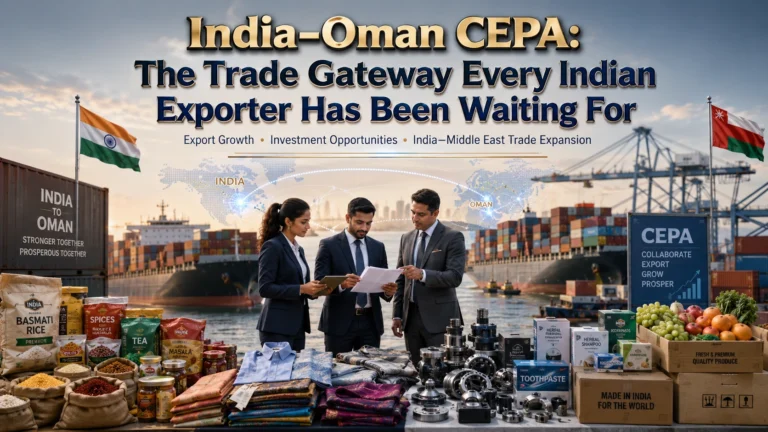
Source: Ministry of Commerce & Industry, Government of India | Press Information Bureau India Oman CEPA export opportunity MSME Until June 1st this year, there was a quiet competition between Italian jewellers, Thai seafood processors and Chinese engineering exporters for a share in the USD 28 billion import market in Oman; a market which had been dominated by Indian players. Until June 1st this year, outsiders — Italian jewellers, Thai seafood processors and Chinese engineering exporters — enjoyed a quiet lead in the USD 28 billion import market in Oman, which was dominated by Indian players. They both had the same 5% tariff. So did the Indians! This balance is now out of equilibrium. Under the new norms of India-Oman CEPA, 99.38% of India’s exports are being duty-free. Not next quarter. Today. Imagine the implications for a textile exporter in Surat, a seafood processor in Andhra Pradesh or a pharmaceutical manufacturer in Ahmedabad. From Italy, Turkey, Thailand and China, each competitor is now at a structural disadvantage in Oman because of the tariffs they still have to pay. India and Oman have also signed an all-embracing bilateral trade pact, a first for a country after the USA. This exclusivity is what creates a time-sensitive window. MSMEs and Industrial Units that are first in the queue, getting Compliant, Export Ready and connected to Oman’s Ports will grab their market share before it is too late. Oman is not a far-remote destination in the Gulf. It provides access to the broad market of the rest of the GCC and East Africa via hubs in Sohar, Duqm and Salalah. Three ports that link South Asia with some of the world’s fastest growing consumer markets. View Full Project Details: Investment Opportunities and Business Ideas in Oman (Middle East) The Gap That Has Held Indian Exporters Back Bilateral trade between India and Oman was worth USD 11.18 billion during the previous financial year as compared with USD 10.61 billion during the previous year. Impressive on paper. However, when looking carefully at sector level data, the difference is stark. Bring gems and jewellery. Oman’s total imported market for this is USD 1.07 billion per year. India’s current share? Just USD 25.78 million, less than 2.5%. The clusters, which are key suppliers of polished diamond and gold jewellery export to the world, are excluded from the market which is sitting on India’s doorsteps, as the Italian, Turkish and Thai competitors are also paying the same import duty of five per cent as the Indian exporters. Marine products tell an even more clear-cut story. Oman imported USD 35.3 million in seafood and India, despite being home to some of the biggest clusters of shrimp and fish processing in the world in Andhra Pradesh, Kerala, Tamil Nadu and Gujarat, had only imported USD 10 million of seafood. A 5% import duty on shrimp and cuttlefish was sufficient to kill the exporters’ business, operating on slim margins. Oman’s import market is worth USD 302.84 million and expanding at 6.6% CAGR in the pharmaceutical sector. Approve­ment delays, duplicate inspections and regulatory bumps delayed Indian generic drug makers from gaining market access and took months to approve. The USFDA, EMA or UK MHRA approved products now receive marketing authorization in Oman within 90 days. The acceleration is not just a minor bureaucratic adjustment but a structural change. In the previous financial year, India exported USD 875.83 million of engineering goods to Oman, such as machinery, electrical products, automobiles, iron and steel. The actual “total addressable market” is much bigger. The imports of electronics are only USD 1.7 billion in Oman, whereas India claims only USD 146 million. Source: Ministry of Commerce & Industry, Press Information Bureau | APEDA Export Statistics TABLE 1: Sector-wise Export Opportunity Under India-Oman CEPA Sector India’s Current Exports to Oman Oman Market Size Duty Before CEPA CEPA Duty Status Gems & Jewellery USD 25.78 mn USD 1.07 bn Up to 5% Zero (Day 1) Marine Products USD 10 mn USD 35.3 mn Up to 5% Zero (Day 1) Agriculture & Processed Food USD 552.85 mn ~USD 3.1 bn share Varies Eliminated Pharmaceuticals Growing USD 302.84 mn Varies Zero (binding) Engineering Goods USD 875.83 mn USD 1.7 bn (electronics alone) 0-5% Zero Textiles & Footwear Significant Large Varies Eliminated IT & Professional Services USD 863 mn (bilateral services) USD 12.52 bn (Oman global) Various barriers 127 sub-sectors opened Source: PIB Press Release, Ministry of Commerce & Industry, Government of India Why This Is the Right Moment to Move There are various forces in play at this moment and an alert MSME operator shouldn’t underestimate any of them. The duty removal is immediate, that’s the first. As of June 1st, the day the agreement entered into force, all concessions with a zero duty rate were to be implemented. There is no phased schedule, no waiting period, no transitional clause for the 99.38% of export lines covered. Exporters who ship now reap rewards now. Second, the NTBs have been addressed head on. Oman will now accept mandatorily, at its ports, Indian certificates from the Export Inspection Council (EIC) eliminating any duplicate testing. Both NPOP Organic and halal certification is recognised in India. This eliminates months of compliance hassles at the border for food processors, agri-exporters and organic product producers. Third, the services and professional mobility provisions open up doors which pure goods exporters do not often reach. Oman has offered 127 services sub-sectors, the most comprehensive offer to India by any GCC country. Oman has now provided legally binding certainty for IT professionals, engineers, doctors, architects and educators. Independent professionals have a time limit of up to 180 days. The Intra-Corporate Transferees are allowed to remain for a period of up to four years. Almost 6000 joint ventures between India and Oman are directly affected. There are various support mechanism provided by the government that can be utilized by the MSME manufacturers for export market. Production Linked Incentive (PLI) offers 4-6% incentive on incremental sales for sectors that are directly

Have a business idea? Let's make it happen together-contact us now!


Contact Form Demo

This will close in 0 seconds

Translate »