
Our Categories

Our Categories

P.K. Chattopadhyay

P. K. Chattopadhyay is a seasoned Project Consultant with over 45 years of hands-on experience in project consultancy across diverse industries. He has guided hundreds of companies and entrepreneurs through project planning, feasibility studies, and industrial setup — turning business ideas into practical, scalable ventures. A prolific author of business and startup-focused books, P. K. Chattopadhyay brings together real-world industry data, actionable insights, and proven execution strategies tailored for entrepreneurs and investors at every stage of their journey. His core expertise spans manufacturing projects, market analysis, and business viability assessment — making his work an indispensable resource for anyone building a sustainable and profitable business from the ground up.

4 Profitable Chemical Manufacturing Business Ideas India

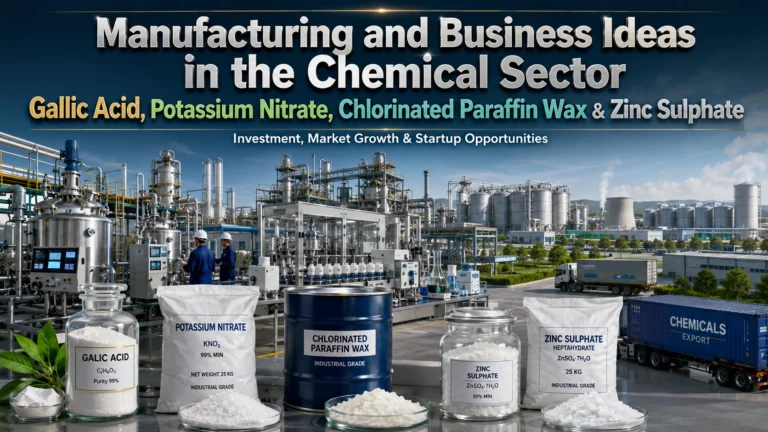
Manufacturing and Business Ideas in the Chemical Sector: Gallic Acid, Potassium Nitrate, Chlorinated Paraffin Wax and Zinc Sulphate

Manufacturing and Business Ideas in the Chemical Sector: Gallic Acid, Potassium Nitrate, Chlorinated Paraffin Wax and Zinc Sulphate Read More »

Chemical Manufacturing Business Ideas India The Indian chemical economy has morphed itself into one of the most promising business incubators for 1st generation entrepreneurs to execute without resorting to a multinational balance sheet. Over the years, I have seen hundreds of feasibility reports on small and mid-sized chemical companies and am always coming back to a few products that meet the criteria of reasonable capital investment, reasonable demand and a true import substitution rationale. There are four such opportunities that include gallic acid, potassium nitrate from tobacco waste, chlorinated paraffin wax, and a combined zinc sulphate heptahydrate–monohydrate unit. There is no glamour about them as there is about a battery gigafactory, and each are part of a supply chain that Indian industry relies on every day, be it from pharmaceuticals to leather, fertilisers to plastics to textiles. Why This Sector, Why Now Speciality and fine chemicals are in a strange situation in the Indian manufacturing industry because, although the local market is large and expanding, there has never been a significant expansion of the local production of meaningful intermediates, and so they have remained imports from China and Europe. It is here that the right kind of an MSME can fill that void. Process chemistry rewards consistency and quality control and reliable sourcing more than R&D expenditure, and that’s what the tannin derivatives, nitrate salts, chlorinated wax and zinc-based micronutrients are. The rationale for profitability is further complicated by export potential: buyers in SE Asia, the Middle East and Africa are actively seeking to de-risk their China-dependent supply chain and Indian producers offering consistent purity specifications are taking their business. The margins in this space are decent, not brilliant, and typically in the 15-25% operating range, when a plant operates at reasonable capacity utilisation, but the demand base is sticky because these are input chemicals that are used continuously by the downstream industries as opposed to discretionary purchases. Explore This Book: Handbook On Chemical Industries (Alcohol Based) Government Policies and Incentives Supporting New Entrants Business owners who move into this area do not need to give money their own way. The Ministry of MSME’s Credit Guarantee Fund Scheme and the Prime Minister’s Employment Generation Programme are loan support schemes which provide collateral-free loans for new manufacturing units, especially for chemical projects which also involve high investments in machinery. The PLI scheme for specialty chemicals, which is now being administered by the Department of Chemicals and Petrochemicals, has also created space for downstream players even if the main beneficiary of the PLI scheme is a larger integrated producer, because the demand pull from the PLI generates for ancillary/in-between suppliers. Gujarat, Rajasthan and Tamil Nadu have established industrial policies, especially for industrial clusters in these states to provide power tariff concessions and stamp duty exemption along with capital subsidy to new small-scale chemical / MSME units. Besides, time for environmental and factory licences, the biggest bottleneck for chemical start-ups, has been reduced significantly thanks to the Stand-Up India scheme and a number of state-level single-window clearance portals. A business man can check out the existing scheme information straight on the. The entrepreneurs can check the details of the schemes available at the portal of the Ministry of MSME. Multiple Business Ideas Within This Chemical Cluster 1. Gallic Acid Production from Tannic Acid Gallic acid is at an interesting crossroads of pharmaceuticals, ink making and the leather and dyeing industries and is the kind of product that demands a consultant’s eye rather than just an academic one. The major consumers of gallic acid are pharmaceutical intermediate manufacturers for trimethoprim and propyl gallate and the food industry for its use as an antioxidant preservative, which is synthesized by the acid or enzymatic hydrolysis of tannic acid (which is derived from natural material, such as tara pods, myrobalan or gallnuts). The key to the attractiveness to a new entrust for this business concept is that the basic hydrolysis work does not require any special equipment – a reasonably sized hydrolysis reactor, crystallisation and drying plant can be set up with moderate investment; the raw material – tannic acid – can be obtained locally from a number of well-established suppliers, and therefore the risk of dependence on imported raw materials is low. The realistic challenge is quality consistency: pharma-grade buyers are not only looking for production capacity but also for capability in analytical testing, for which the initial investment is the key to success for a new unit. Indian pharma intermediate manufacturers have been increasingly acquiring the necessary intermediate gamma in order to shift away from a dependence on Chinese imports and that opportunity is enough to keep a well-run plant busy. Discover business ideas that actually make money 2. Potassium Nitrate from Tobacco Waste This one’s a business concept that seems like a crazy idea until you plow through the economic math and realize that it only makes sense for there to be several well-established businesses out there making money around this concept. Tobacco waste, which is made up of stems, dust and rejected tobacco leaves from bulk tobaccos processors, contains high concentrations of potassium and nitrate, which can be extracted using a leaching/crystallisation process to create potassium nitrate, a high-value nitrate compound employed in a variety of industrial applications including fertilizer formulations, fireworks production, glass and ceramics manufacturing, and food preservation. The investment thesis here is that the raw material cost advantage: tobacco waste is usually at low or even negative cost, as the processor has to pay someone to dispose of it. The processing itself includes aqueous extraction, purification and controlled crystallisation, which is readily handled by a medium scale MSME chemical plant. For this business, location is a critical factor – the nearer they are to tobacco processing centres in Andhra Pradesh, Karnataka, Gujarat, the lower will be the cost of feedstock logistics, and so any entrepreneur looking at this opportunity should establish the location of the plant based on the availability of waste first and market access second. 3. Chlorinated

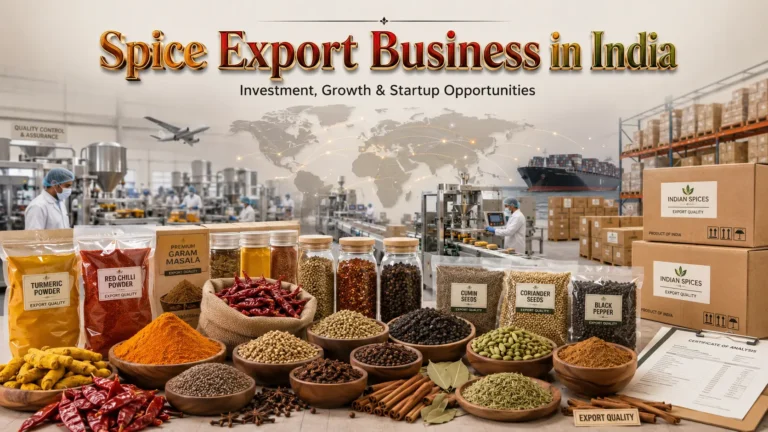
Spice Export Business in India

How to Start a Spice Export Business in India: APEDA, Spices Board & Investment Guide

How to Start a Spice Export Business in India: APEDA, Spices Board & Investment Guide Read More »

Spice Export Business in India The spice industry is a unique one in the Indian food culture and is an industry which, for the aspiring entrepreneurs with serious business ideas in the agricultural exports, has a significant opportunity both in terms of heritage and a present-day business opportunity of Rs.20 Crore Spice Exports Business. The Ministry of Commerce has established the Spices Board of India to oversee the entire spice export development ecosystem and provides subsidies on spice processing infrastructure, quality testing equipment and organic certification expenses. India is the world’s biggest producer, consumer and exporter of spices. However, the benefit that the Indian exporters are able to reap is limited to bulk commodity exports and not on premium branded exports, which can be tapped by organised entrepreneurs having appropriate processing and certification facilities. Why India’s Spice Export Sector Is a Global Opportunity The demand for genuine Indian spices has been rising worldwide, especially in North America, Europe and the Gulf, where ethnic cuisine has become increasingly popular — and so has the demand for authentic Indian spices in the organic, premium, and culinary specialty categories. Spices Board of India keeps a close watch on export statistics that have been showing positive double-digit growth in value added spices export. The European Union’s food safety standards have made buyers prefer certified Indian exporters who can certify pesticide residue compliance, creating a quality barrier in favour of organised Indian exporters as compared to unorganised traders. In the west, the functional food trend has made turmeric, ginger and black pepper superfood status, forming new food segments beyond traditional food buyers. Read the Complete Book Here: Handbook on Spices Government Schemes Supporting Spice Export The Spices Board of India (SBI) offers subsidies for the installation of spice processing infrastructure, quality testing equipment, and costs of organic certification. APEDA organises buyer-seller meets, export pavilions at international trade fairs and market intelligence reports of particular country requirements for the export of spices. Ministry of Commerce has given a framework for the export of value-added spice products under the name of Agriculture Export Policy with the identification of agri-export zones in the spice producing states. There is farm level support in the form of spice boards from Kerala, Karnataka and Andhra Pradesh states. DGFT’s RoDTEP scheme will help exporters get back domestic taxes which are hidden in export goods, making them more competitive in the international markets. Top Business Ideas in Spice Export at Rs.20 Crore Scale Certified Organic Spice Processing and Export Organic certified spices (such as turmeric, chilli, cumin, coriander, ginger and cardamom) sell at a premium of 50-200% in markets in Europe and North America. A Rs.20 Crore organic spice processing industry is using farmer network aggregation and advanced processing technologies such as steam sterilisation, colour sorting, grinding and blending along with certified organic cultivation. The organic promotion scheme by the Spices Board gives partial refund on the certification cost. NPOP and EU Organic certification are the main export certifications, apply through an APEDA accredited certification body. Steam Sterilised Spice Powder for Retail Export The technology investment for Indian spice exporters to comply with the European and American food safety standards on microbial limits is steam sterilisation (microbial elimination) of spice powders. A state-of-the-art Rs.20 Crore plant equipped with modern steam sterilisation technology and extensive quality testing, can deliver high quality spice powders that comply with the most rigorous import standards. FSSAI lays down the standards for spice quality and the Spices Board offers technical assistance to the processors aiming at upgrading to the steam sterilisation technology. Access Complete Business Plan: Curcumin Manufacturing, Extraction & Turmeric Processing Value-Added Spice Products: Cooking Pastes, Blends, and Extracts Moving beyond raw and powdered spice to value added products (oleoresins and essential oils) in flavour and fragrance industries captures much more value in the same raw materials. The price of spice oleoresins and essential oils is much higher than the price of food-grade spice powder in an industrial level. A solvent extraction/steam distillation technology is available to an entrepreneur for spice oils and oleoresins at Rs.20 Crore. The Spices Board has a list of oleoresin exporters, and it also supplies information on the world markets for spice extracts. Import-Export Opportunity Analysis India ships spices to more than 180 countries and the largest buyers are USA, China, Vietnam, Bangladesh and UAE. Export data is published by Spices Board of India on an annual basis, based on the product and country exported. The EU’s market need for organic spices, especially as part of the EU Farm to Fork Strategy, is a long-term positive trend for Indian exporters. In fact, regulatory environment is propping the quality-oriented Indian exporters as they are reducing the competition from the unorganised players in the market due to the updates of MRLs by EU. Early Registration with APEDA and Spices Board for export promotion benefits. Indian MSME Success Stories in Spice Export MDH Spices: Building India’s Most Recognised Spice Brand Established by Dharampal Gulati in Delhi, MDH (Mahashian Di Hatti) started as a small spice shop in Old Delhi and is one of the most popular spice brands in India today, both nationally and internationally. They had an international distribution network established in the UK, USA and Canada, with their own grocery stores from the Indian people, which provided an international income stream without an export setup. MDH illustrates how brand consistency – same taste, same packaging – every time is the key to a spice export business that stands the test of time. Related Article: MDH Masala Story: How Dharampal Gulati Built a Spice Empire Synthite Industrial Chemicals: Spice Extracts Export Pioneer Synthite Industrial Chemicals, Kerala, is one of the world’s biggest manufacturers of oleoresins and essential oils of spices and exports to the flavour houses of USA, Europe and Japan. The Company’s competitive edge was created through its perpetual investments in extraction technology and direct technical relationships with international flavour and fragrance firms, led by K.V. Jose. The success of Synthite has proven

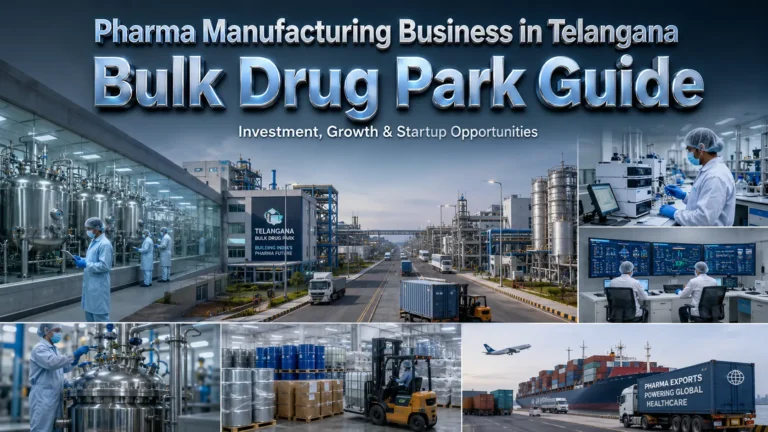
Pharma Manufacturing Business Telangana

Pharma Manufacturing Business Telangana: Bulk Drug Park Guide

Pharma Manufacturing Business Telangana: Bulk Drug Park Guide Read More »

Pharma Manufacturing Business Telangana The Hyderabad alone produces about one third of India’s output of bulk drugs and APIs, with the core of these activities being Genome Valley and a pharma manufacturing base, which has been created over 30 years. It’s actually this concentration that makes the pharma manufacturing business that the Telangana entrepreneurs think about today appear daunting from the exterior: Dr. Reddy’s, Divi’s Laboratories and Hetero already possess the cake. But the state’s own Bulk Drug Park initiative, which has been aided by capital subsidy from the central government, has been created because the policy makers have realised that there is a room for new and specific players in the market, apart from the giants who are already working on a large scale. It is not an opportunity for a founder looking for a product for which every other unit in Hyderabad is doing business. It’s an invitation for one trouble-prone founder to focus on a single facet — one intermediate, one niche API, one contract manufacturing partnership — within a regulatory framework, a workforce, and a buyer base that other states take years to develop. Read the Complete Book Here: Business Ideas for Startup in Drugs & Pharmaceutical Industry with Project Profiles Why Telangana’s Pharma Cluster Is a Genuine Opening Get started with talent density. An advantage for Hyderabad over the pharma companies that have not built their capacity with API and formulation manufacturing in the city, is that a new startup can easily find experienced process chemists, regulatory affairs personnel and quality control staff, without having to import them from across the country. Add to this the government’s support. The special Bulk Drug Park developed with central PLI linked capital subsidy and allotted through Telangana State Industrial Infrastructure Corporation has plug and play infrastructure with shared effluent treatment specifically for API and intermediate manufacturing thereby reducing capex and approval time for the units to be located inside the park. The state’s own industrial policy with a focus on the pharmaceutical sector has another layer of capital and power tariff benefits that sit on top of central schemes implemented through the Ministry of Micro, Small and Medium Enterprises. The basic intermediate manufacturing unit costs start around fifteen to two dozen crore rupees for two hundred to three hundred tonnes per year, while API manufacturing for regulated markets is thirty to fifty crore rupees based on stringent quality and validation regulations. It takes around 10-14 months for the Telangana State Pollution Control Board to approve licenses and the Central Drugs Standard Control Organisation for drug manufacturing to approve infrastructure, specifically Bulk Drug Park. Business Selection Logic The margin structure is as elsewhere in the bulk drug industry in India: commodity intermediates, which a handful of existing firms in Hyderabad produce, trade at 12 to 18% margins, while specialty intermediates or niche APIs that cater to a single innovator molecule trade at 25 to 35%. The pharma cluster in Telangana is scalable because of the presence of well established buyers. A founder can launch with one multipurpose batch reactor, test one or two products with a local formulation company that doesn’t have to look far to find a qualified supplier, and then expand when repeat orders are received and the product has been proven to be in demand. The same risks identified in bulk drug manufacture in the country, such as regulatory clearance timelines and buyer concentration, apply in Telangana, however, the buyer search risk that the founders of companies in less pharma-dense states face is significantly less in Telangana due to the high concentration of buyers of bulk drugs in the state. Get Detailed Project Report (DPR): Business Opportunities in Telangana – Startup & Entrepreneurship Guide Product and Project Opportunities Worth Evaluating Antibiotic and Antiviral Intermediates Antibacterial and antiviral intermediates are being used by Hyderabad’s formulation units all the time and also the volume of customers within the state is such that if a new intermediate manufacturer wants to find a customer, they have to look within 50 km of Hyderabad. The capex for a plant of 150-250 tonne per annum is 18-25 crore rupees. The margins range from eighteen to twenty-two percent after the quality certification process with a formulation buyer is completed, which is quicker in Telangana than states with lesser concentration of pharma buyers because of their prior understanding of the qualification of suppliers. Contract Manufacturing for Global Innovator Companies With its proven regulatory track record, Telangana is a logical base for the CRAMS approach of contract manufacturing, offering global innovator pharma companies to explore India as a production partner for complex intermediates. A separate unit – one with capex of 12 to 20 crore rupees – enters into multi-year supply contracts instead of looking for volumes in the spot market. The margins are 22-28 per cent and the existing standing that Hyderabad has with the regulatory authorities is a good advantage in terms of trust building for the buyer than if the founder was coming from a lesser- established pharma hub. Niche API Manufacturing for Regulated Export Markets The best chance for a founder to carve out a niche in the Telangana pharma market is niche APIs which are molecules with a small number of qualified global manufacturers. A dedicated facility, the capex is in the range of Rs. 30 to 40 crore, which takes into consideration quality and validation infrastructure requirements, directly targets export formulation buyers in regulated markets. Once a Drug Master File (DMF) is filed and approved, the margins are twenty-eight to thirty-five percent, but the filing of a DMF takes between twelve to twenty-four months. Related Article: India’s ₹27,000 Crore API Import Problem Is Your Biggest Business Opportunity Pharma Packaging and Ancillary Component Manufacturing In addition to direct drug production, Telangana’s pharma density ensures a consistent demand for such special packaging and blister components, as well as ancillary manufacturing that every formulation and API unit in the state will need. The dedicated line requires capes expenditure of Rs 8-12

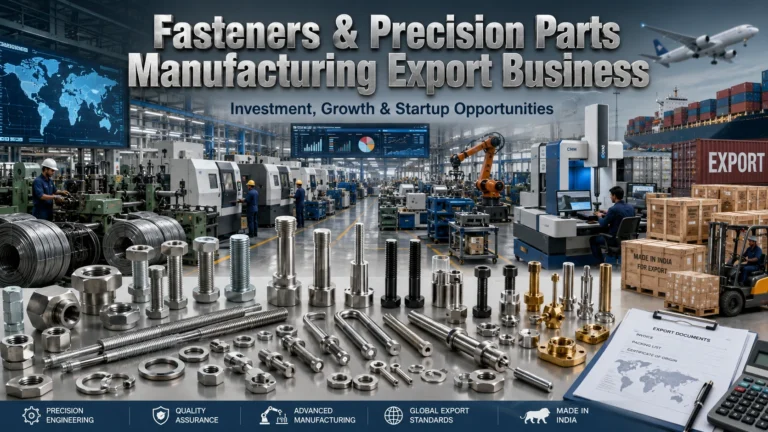
Fasteners and Precision Parts Manufacturing Export

How to Start a Fasteners and Precision Parts Manufacturing Export Business in India

How to Start a Fasteners and Precision Parts Manufacturing Export Business in India Read More »

Fasteners and Precision Parts Manufacturing Export Business One of the most important and globally consistent engineering business ideas of EEPs portfolio is the manufacturing of fasteners and precision parts for exports. Bolts and nuts, screws and washers, rivets and specialty fasteners are the major products exported from India to more than 50 countries, and the Ludhiana, Rajkot, Mumbai and Pune clusters provide automotive, aerospace, construction, electronics and industrial equipment buyers around the world with both commodity and precision engineered fasteners. The demand for this category is structurally non-discretionary – all mechanical assemblies need fasteners and all engineering products produced around the world generate downstream demand. The world fastener industry is more than $100 billion per year and steadily expands in parallel with the growth of industry. Explore This Book: The Complete Technology Book on Steel and Steel Products (Fasteners, Seamless Tubes, Casting, Rolling of Flat Products & others) EEPC and Government Policy Support The Engineering Export Promotion Council (EEPC India) provides assistance to fastener exporters in the following areas: Buyer-seller meets for automotive and industrial OEM procurement managers, Fastener Fair Stuttgart and International Fastener Expo USA, and market intelligence on the trends in fastener demand in target markets. The EEPC RCMC facilitates RoDTEP benefit on exports of fasteners. The DGFT EPCG Scheme provides zero duty on importation of cold forging presses, thread rolling machines, CNC turning centre, CMM inspection machines and heat treatment furnaces – the core manufacturing equipment for the production of fasteners and precision parts. EPCG automated fastener production has great advantages in improving production efficiency and quality consistency. Business Ideas 1. Standard Fasteners for Construction and Industrial Use Carbon Steel and Stainless-Steel Hex bolts, Hex nuts, Washers, Threaded Rods, Anchor Bolts are exported in container loads to Hardware Distributors and Industrial MRO buyers in the Gulf, Africa, South East Asia and Latin America. Investment of ₹50 lakh to ₹1.5 crore in cold forging, threading, heat treatment and zinc plating. Must be DIN/ISO/ASME dimensional standards. Related Article: Business Ideas for Automobile Parts Manufacturing. Highly-Demanded Automotive Components Business 2. Automotive Grade Fasteners for OEM Supply High strength automotive fasteners used for vehicle assembly are the top-of-the-line export market for fasteners: Class 8.8, 10.9 and 12.9. India’s car component producers that get certified by IATF 16949 are eligible for multi-year supply contracts with key buyers worldwide that have volume commitments. The investment will be in range of ₹1 crore to ₹4 crore. A major quality requirement is hydrogen embrittlement test and zinc-nickel plating. 3. CNC Precision Turned Parts Precision turned parts (shafts, bushings, pins, connectors and fittings) used in automotive, electronics, medical device and industrial applications are the highest margin market segment. Modern CNC turning centres and grinding machines with tolerances as low as ±0.005mm to be built with investment ranging between ₹80 lakh and ₹3 crore. The export markets are Germany, US, Japan and Taiwan, where there are active lookouts for cost competitive Indian alternatives. 4. Stainless Steel and Specialty Fasteners The price of stainless-steel fasteners (grades 304 and 316) is much higher than the price of carbon steel fasteners used for the marine, chemical, and food industry equipment. The investment in a stainless-steel fastener unit is from ₹60 lakh to ₹2 crore. Stainless fastener conformance to BS, DIN and ASTM standards and material certification required. Process industries exports are to the US, EU, Australia and the Middle East. Get Detailed Project Report (DPR): Steel and Steel Products Projects Guide Import-Export Opportunity Analysis The exports of fasteners have steadily increased in India. Leading destinations include the USA, UK, Germany, UAE and Australia. Active effort by the US market to qualify nonchains suppliers, both due to the Section 301 tariffs on Chinese fasteners and due to security concerns in the supply chain, is generating opportunities for Indian fastener manufacturers to invest in quality certifications and testing to become qualified by the US market. Many Indian fastener suppliers have been successful in becoming primary suppliers to US hardware distributors and OEM procurement programs. Indian MSME Success Stories Sundram Fasteners developed a world-class automotive fastener business by meeting Toyota Supplier Quality Standards and continually developing their OEM customer base in automotive companies from Japan, Europe and North America. They have gone on a decades-long journey of quality improvements that led to a globally trusted brand of fasteners. Precision Camshafts and a few precision machining firms in Pune have created sizeable export businesses for the production of precision components for automotive buyers in Europe and America by investing in high-precision CNC machines and IATF quality certifications. Rajkot-based MSME fasteners manufacturers have developed export business in the range of ₹10 crore to ₹30 crore in the countries of the Gulf and Australia, by attending EEPC buyer-seller meets. How NPCS Supports This Business Niir Project Consultancy Services (NPCS) offers Professional Consultancy Services for Market Survey cum Detailed Techno-Economic Feasibility Reports (DPRs) for establishing new manufacturing/export businesses in this sector. We have complete reports which contain details of the manufacturing process, market research, and market demand analysis, process flow diagrams, product mix and capacity planning, details of machinery and raw materials, details of the project and complete financials with profitability analysis. We want to help entrepreneurs understand the feasibility, profit and scalability of their business before investing. Build a profitable business with the right idea Key Data Overview Product Category Investment Range Key Standard Target Markets Typical Margin Standard Construction Fasteners ₹50L – ₹1.5 Cr DIN/ISO + Zinc Plated Gulf, Africa, SE Asia 15–25% Automotive Grade Fasteners ₹1 Cr – ₹4 Cr IATF 16949 + OEM Spec Germany, US, Japan 20–35% CNC Precision Turned Parts ₹80L – ₹3 Cr ISO 9001 + CMM Certified Germany, US, Japan, Taiwan 30–55% SS and Specialty Fasteners ₹60L – ₹2 Cr ASTM/BS + Material Cert US, EU, Australia, ME 25–45% Rivets and Special Fasteners ₹40L – ₹1 Cr ISO + Customer Spec US, EU, SE Asia 22–38% Frequently Asked Questions (FAQ) 1. For what property class are fasteners? Property class refers to the strength of a fastener. Class 8.8

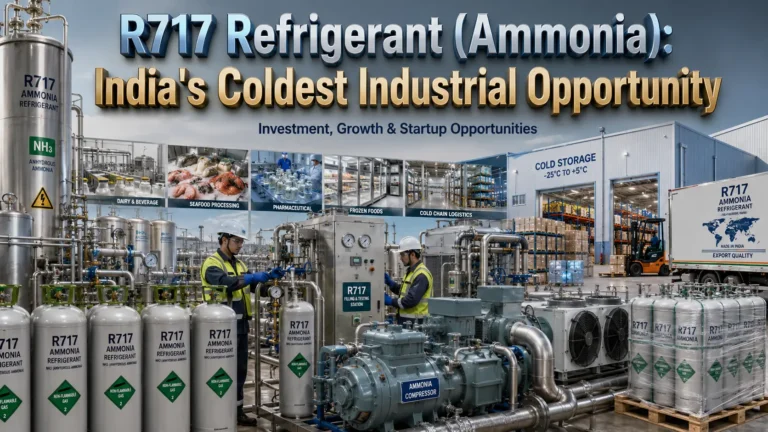
R717 Refrigerant Manufacturing Business in India

R717 Refrigerant (Ammonia): India’s Coldest Industrial Opportunity

R717 Refrigerant (Ammonia): India’s Coldest Industrial Opportunity Read More »

R717 Refrigerant Manufacturing Business in India Market Insight: The global R717 (ammonia) refrigerator market is valued at USD 1.8 billion and is expected to grow at 5.2% CAGR throughout the decade, thanks to the growth in cold chain infrastructure, food processing and fertiliser industry. India is estimated to be a USD 180 – 200 million market with the majority of demand in industrial refrigeration, food storage, breweries, and pharmaceutical cold chains. Why R717 Refrigerant Is Regaining Its Industrial Crown Known as R717 by the ASHRAE refrigerant classification, ammonia is one of the oldest and most thermodynamically efficient refrigerants used in industry. It has zero ozone depletion potential (ODP) and global warming potential (GWP) as compared to synthetic fluorocarbon refrigerants, now phased out under international climate accords. The Kigali Amendment on the Montreal Protocol will force countries, including India, to reduce the use of HFCs by more than 80% by 2047, making R717 the only ‘old-school industrial option’ again. The future proof solution that is attracting new investments and policy interest throughout the global cold chain supply chain. The industrial demand for industrial refrigerants is increasing with the expansion of food processing capacity, advancement of cold chain logistics infrastructure under various Government initiatives such as PM Kisan Sampada Yojana and the booming pharmaceutical manufacturing sector. R717 combines all the properties of efficiency, environmental friendliness and cost-economics and thus is the refrigerant for large-scale industrial applications. Entrepreneurs and MSMEs joining this market now will be at a competitive advantage to a structural change that India’s refrigeration industry will undergo in the next ten years. Related Article: Green Ammonia & Methanol from Odisha’s Coastal Ports: The Industrial Chemical That Could Power India’s Decarbonisation Global Market Landscape and Key Participants Essentially, the R717 refrigerant market is fragmented between a mix of multi-national industrial gas major companies and regionally dominant specialty chemical companies. The market is somewhat consolidated at the global level, with some large players controlling a significant capacity, but is rather fragmented at regional and national levels such as India, with ample opportunities for entry. The leading global players influencing R717 supply, pricing and technology specifications are: Company Country / Region Market Role Danfoss Group Denmark / Global Industrial refrigeration systems & ammonia-compatible components The Linde Group Germany / Global Largest industrial gas supplier; major R717 producer & distributor Dehon Group France / Europe Specialty refrigerant distributor; strong European market presence National Refrigerants USA North American R717 supply; reclamation & recycle services Sinochem Group China Leading Chinese producer; growing Asia-Pacific supply chain Tazzetti Italy / Europe Specialty gas and refrigerant distributor across EU A-Gas International UK / Global Refrigerant lifecycle management, recovery, and resale Harp International UK Specialty gas blending and distribution Aditya Air Products India Domestic industrial gas and refrigerant supplier Jai Maruti Gas Cylinders India Ammonia cylinder filling and distribution Brooktherm Refrigeration South Africa / Africa African market refrigeration gas supply Engas Australasia Australia / NZ Australasian industrial refrigerant distribution Hychill Australia Australia Natural refrigerant promotion and supply Data from the United Nations Environment Programme (UNEP) Ozonation indicates that more than 50% of the refrigerant capacity installed in large industrial refrigeration systems worldwide are ammonia (R717). This dominance is due to its superior Coefficient of Performance (COP), 0 climate impact and its well-established supply chain in industrial economies. India Market Overview: Consumption Trends and Growth Drivers The five end-use sectors namely food processing, cold storage, breweries and beverages, dairy processing, and fertiliser plant refrigeration systems are the key customers for R717 refrigerant in India. These sectors account for the majority of domestic ammonia refrigerant usage, and the cold chain logistic sector is the fastest-growing demand segment. End-Use Sector Estimated Demand Share (%) Growth Outlook Cold Storage & Warehousing 32% High — driven by PM Kisan Sampada Yojana & e-commerce logistics Food Processing & Dairy 26% High — National Mission on Food Processing support Breweries & Beverages 18% Moderate-High — rapid capacity expansion Pharmaceutical Cold Chain 13% Very High — post-pandemic pharma investment surge Fertiliser & Chemical Plants 11% Stable — existing captive ammonia infrastructure The cold chain industry in India, backed by the Ministry of Food Processing Industries (MoFPI) is gaining momentum in investments. According to government estimates, India requires more than 50 million metric tonnes of extra cold storage units to counter the losses of food in the post-production chain, which currently account for more than 15-18% of the total food produced. The moderate-size cold stores consume 50 to 150 MT of ammonia refrigerant, and the demand is recurring and increasing, which domestic cold store producers have not yet been able to meet on their own. Get Detailed Project Report (DPR): Fertilizers & NPK: A Complete Guide Demand–Supply Gap: India’s Critical Dependency Demand–Supply Gap: Domestic production of R717 in India is concentrated at a few small and big integrated fertiliser complexes and single small to medium-sized standalone industrial gas producers and is estimated to be covering only about 60–65% of the total addressable refrigerant-grade ammonia market. The situation is especially critical for the shortfall of high purity anhydrous ammonia as per IS 799:2002 and BIS requirement for precision refrigeration application. This disparity forces buyers in industry to find supplies from other sources, which adds to cost and supply assurance risks. Most of the ammonia produced in India is used in the production of fertilizers and purity requirements for the ammonia used for refrigerants is more stringent, while nitrogen-grade ammonia is produced in bulk. The supply chain of the dedicated R717 refrigerant (anhydrous ammonia) is not as well developed as the expanding industrial refrigeration market, covering aspects such as purification, pressurised filling of cylinders and cold chain distribution. Import data from the Directorate General of Foreign Trade (DGFT) and trade intelligence sources suggest that India imports large quantities of refrigerant grade ammonia and its related refrigerant gases every year from China, EU and Middle East. High purity anhydrous ammonia demand for precision cooling has increased the import dependency of this market, indicating a clear opportunity for investment in domestic production.

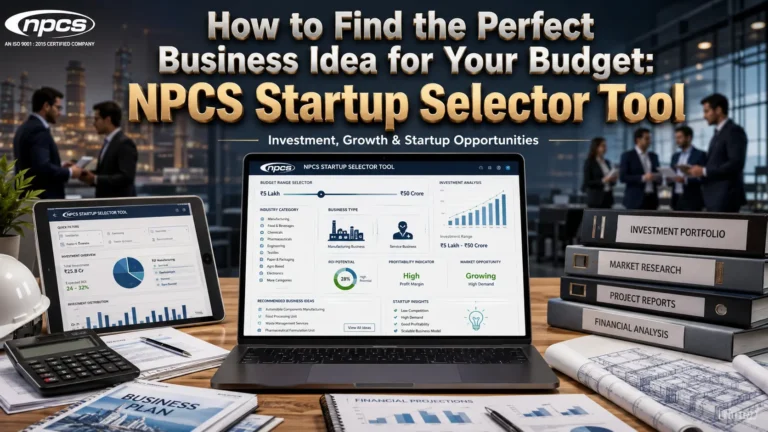
NPCS Startup Selector Tool India: Find the Best Business

How to Find the Perfect Business Idea for Your Budget: NPCS Startup Selector Tool

How to Find the Perfect Business Idea for Your Budget: NPCS Startup Selector Tool Read More »

Startup Selector Tool India Each year, thousands of career professionals, MSME investors, and first-time entrepreneurs find themselves with the same question to ponder: what business should I really start? Most people spend weeks, even months, reading through random blogs, YouTube videos and even old, outdated lists trying to correlate a business idea with available resources and come up with a solution and then end up even more confused than they were at the beginning. The problem is an issue that Niir Project Consultancy Services (NPCS) has hidden away until now — a free, instant Startup Selector tool that matches entrepreneurs to real, data-driven business ideas in terms of their own investment capacity and financial goals — and few entrepreneurs looking for business ideas online even realize it exists. If you are looking for how to choose a business to start, best manufacturing business ideas within my budget or a free startup idea finder tool in India, this article gives you a resource that can save a lot of your scattered research – NPCS Startup Selector, available free at niir.org/startup-selector. Explore This Book: Just For Starters: How To Start Your Own Export Business What Is the NPCS Startup Selector and Why It’s a Genuinely Useful Tool Designed to automatically generate a list of projects that match the criteria you enter, the Startup Selector is a quick and easy project identification and selection tool based on NPCS’s comprehensive database of over 12,000 project reports and business profiles covering manufacturing, agro-processing, chemicals, food processing, packaging, engineering, and dozens of other industrial sectors. It eliminates the need for entrepreneurs to sift through thousands of pages to find the right business ideas and instead allows them to input their own financial considerations and get a short list of business ideas that really align with them. The Startup Selector personalises to each entrepreneur’s actual budget — giving far more actionable content than the majority of lists of business ideas found online today, which are the same for every reader. How the Startup Selector Works: Five Simple Search Parameters The entrepreneurs can use any combination of the following inputs to search the entire NPCS project database: Plant & Machinery Cost (in Lakhs): these are filters to help narrow down ideas depending on the type of machinery investment that you are willing to make Total Capital Investment (TCI) (Lakhs): align concepts with the overall capital available, including working capital. This filter is useful for planning bank loan or subsidy applications and helps narrow down the projects by total project cost (in Lakhs). This filter is useful to help narrow down the projects by the overall cost of the project (in Lakhs) when planning bank loan or subsidy applications. The business ideas must have the rate of return (ROR) (%) that is above your minimum desired rate of return. Break Even Point (BEP) (%) — recognize ideas that have a breakeven profile that are consistent with your risk tolerance These parameters can be entered in seconds and the tool returns a short, carefully selected list of matching project ideas and project profiles – from small businesses to larger industrial projects – from NPCS’s ever-growing database of business opportunities. Why This Tool Solves a Real Problem for Indian Entrepreneurs There are a number of honest reasons why this is a good idea for anyone considering a new business venture: It’s a free tool: There’s no payment to access the shortlist, and no login to the Startup Selector in order to create a shortlist of business ideas. No payment or login: No fees required for accessing the Startup Selector, and no login to the Startup Selector for creating a shortlist of business ideas. Saves hundreds of hours of research: Entrepreneurs get a list of relevant and focused sources they can search on, rather than having to compare dozens of random sources found through the web. It’s based on real financial data: No guessing, each project idea that is returned is backed by NPCS’s actual data from the Techno-Economic Feasibility Report, including ROI and Break-Even Analysis. The database is updated continuously: The ideas which have appeared are based on the latest market data, not on outdated lists, but on the latest market data. It serves all budgets: If you’re investing ₹5 lakh or ₹5 crore, the tool filters the ideas with relevance to your capital range and not shows irrelevant large scale and micro scale ideas. Related Article: You Don’t Need a Business Consultant to Find Your First Business Idea — Here’s Why Who Should Use the Startup Selector Tool 1. First-Time Entrepreneurs Exploring Options Knowing that you want to launch a manufacturing or industrial enterprise, but not a specific industry, the Startup Selector is the quickest approach to view a realistic and budget comparable set of industries without beginning from scratch. 2. MSME Owners Looking to Diversify The tool can be used by existing business owners who want to pursue a second line of business or a new product line and need to quickly see what other business lines are complementary and what amount of capital investment is needed. 3. NRIs and Investors Seeking Indian Manufacturing Opportunities The tool can be used remotely by NRIs and investors for manufacturing projects in India to shortlist the projects prior to detailed feasibility report and project consultancy by NPCS. 4. Students and Young Professionals Planning Their First Venture For anyone who is still saving for their business or just thinking about investing in a long-term business venture, the tool can help clarify what businesses are viable at various levels of investment, which can help guide savings and business-planning objectives well before the capital is needed. View Full Project Details: Project Reports & Profiles From Business Idea to Bankable Project: What NPCS Offers Next The Startup Selector has been created as a starting point of the NPCS journey of entrepreneurship, and not as an end product. After narrowing down the list of business ideas that are matched, NPCS provides complete Market Survey cum Detailed

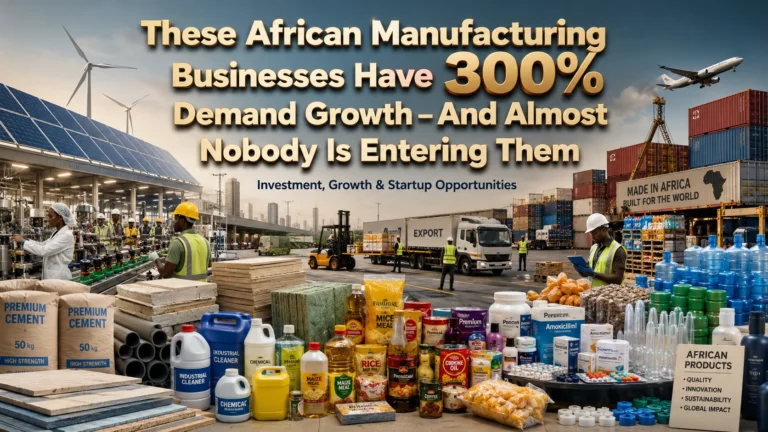
20 Profitable Manufacturing Business Ideas in Africa

These African Manufacturing Business Has 300% Demand Growth – And Almost Nobody Is Entering It

These African Manufacturing Business Has 300% Demand Growth – And Almost Nobody Is Entering It Read More »

Manufacturing Business Ideas in Africa The African frontier has become more than a frontier market; it is one of the most strategically interesting places to manufacture on the planet. The continent boasts a wellspring of aspiring entrepreneurs with a combined GDP surpassing $3 trillion, a young and rapidly urbanising population of over 1.4 billion, and a historic change in its economic structure to reduce reliance on raw commodity exports. The business ideas that are discussed in this article are not just theoretical business opportunities. They are built on real market opportunities, consumer demand, and production economics that are scalable — that first-generation founders and MSME investors can now leverage with an investment of USD $100,000 to USD $200,000. The African Continental Free Trade Area (AfCFTA), which is already in operation for 54 member countries, has altered the investment equation altogether. No longer do manufacturers have to focus on just one country. This little Rwanda plant can legally export to Kenya, Uganda and Tanzania, and the DRC. Nigeria can access Senegal, Ghana and Côte d’Ivoire through a food-processing unit. This transborder flow and the long-neglected manufacturing industry in the continent has built a unique business environment in which supply remains far behind demand. The article offers an academic analysis of 20 practical manufacturing business ideas that align to this investment level, including market logic, business operational insights, export potential, policy support, and lessons learned from entrepreneurs who have succeeded on the ground. Why Africa Is the Right Manufacturing Destination Right Now The manufacturing sector is still less than 15% of GDP in most African economies, while in most East Asian economies, it accounts for more than 25% of GDP. This structural void is not a vulnerability, it’s a chance. Demand for basic manufactured goods (packaged food, construction materials, hygiene products and energy products, animal feed) is outpacing domestic supply chains. Import costs and availability are still high, and imports are becoming less popular for African governments that want to establish local manufacturing capability. In the meantime, the input costs are relatively low. Labour in EA and WA is cheap and has an improving skill level. There are more than ample supplies of raw materials in the form of agricultural produce, mineral, timber and natural fibre throughout the continent. Although still in its infancy, the energy sector has made tremendous strides with the implementation of solar and off-grid electrification programmes. In combination, these factors make a manufacturing environment that is competitive on the margin—even in more crowded Asian markets—when planned appropriately. AfCFTA and Government Policy: Structural Tailwinds for New Manufacturers The African Continental Free Trade Area is the most significant policy development for manufacturing in Africa over the past 40 years. AfCFTA provides for a single market of goods, the scale of which is unprecedented, as the participating nations have agreed to phase out 90% of tariffs on goods over time. This is what it means for a manufacturer to have the ability to create production capacity for Africa from scratch, rather than simply one country. In addition to AfCFTA, there are multiple incentives at the country level. African Development Bank (AfDB) is proactively supporting industrial SMEs through facilities such as the Africa SME Programme and the Affirmative Finance Action for Women in Africa (AFAWA). Kenya Industrial Estates (KIE) in Kenya provides small-scale manufacturers with factory shells, preferential financing and business development assistance. The government of Ethiopia has created special industrial park zones in which it has offered light industrial manufacturers a package of incentives for land use. The Industrial Development (Income Tax Relief) Act of Nigeria provides for pioneer industries tax holiday. The Special Economic Zones (SEZs) are available to provide infrastructure, tax reliefs and streamlined licensing for Rwanda. The African Union’s Industrialisation Strategy in Agenda 2063 prioritises manufacturing as a sector in the continent’s development agenda and is providing funding and technical assistance for just these sorts of projects. 20 Manufacturing Business Ideas for Africa (USD $100K–$200K) The selection of the following ideas has been made based on the market demand data, availability of raw materials, feasibility of production at small-scale and calculable profitability in a two-to-three-year period. They are all good examples of areas in which there is a high level of import reliance in Africa and where production is lacking or is very limited. 1. Processed Cassava Products (Starch, Flour, Chips) Cassava is the most widely grown food crop in Africa – but Africa imports billions of dollars’ worth of cassava starch and cassava flour derivatives that it could produce itself. A small-scale cassava processing plant (drying, milling and packaging) can be built for $150,000 to $180,000 to be utilized by food manufacturers, textile starch producers and export buyers all at once. There is growing demand from food companies, bakeries and industrial users, with Nigeria, Ghana and DRC being the biggest producers of cassava. The main competitive edge for a new player is the ability to add value to the cassava crop, which is not just raw cassava but clean cassava, packaged cassava, specification grade starch, and/or high quality HQCF (High Quality Cassava Flour). 2. Vegetable Oil Refinery (Small-Scale Edible Oil) Urbanisation is driving up Africa’s consumption of edible oils at a significant clip, but the domestic edible oil refining capacity is severely constrained. Raw quantities of palm oil, groundnut oil, sesame oil and sunflower oil are produced on a large scale throughout the continent but are not generally refined to retainable standards in the region. A small-scale expeller and refinery unit can be set up at a cost of $160,000-$200,000 and can supply refined, bleached and deodorised edible oil for retail packing and institutional food services. As by-products from refinery activities, soap manufacturing is an adjacent revenue stream that can be used to enhance margin usage. Refined edible oil has very high demand-supply mismatch in the West African markets, especially in Nigeria, Ghana and Cameroon. Access Complete Business Plan: Edible Oils, Non-Edible Oils, Fats & Vegetable Oils Projects 3. Solar Panel Assembly Unit Access to energy

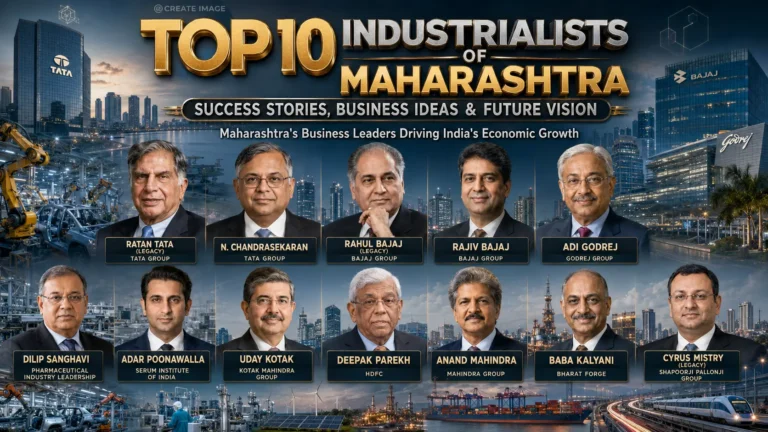
Top 10 Industrialists of Maharashtra: Success Stories

Top 10 Industrialists of Maharashtra: Success Stories, Business Ideas, and Future Vision

Top 10 Industrialists of Maharashtra: Success Stories, Business Ideas, and Future Vision Read More »

Industrialists of Maharashtra Maharashtra’s Industrial Identity as India’s Economic Capital Maharashtra is the financial capital of India, has the most important seaport (JNPT) and the most diversified industrial base, all of which influence business ideas in the area. Maharashtra generates the highest share of industrial gross value added in India (around Rs.) at 16% of total gross value added in the country. It is the biggest state economy in India with 42.67 trillion. The state’s industrial landscape includes the presence of the auto industry (Pune, Nashik, Aurangabad), pharmaceutical industry, IT industry (Pune), financial industry (Mumbai), petrochemical industry (Raigad) and food processing industry. The industrial ethos is tied to the industrial families, some of whom came up with industries that became the national and international leaders in their respective fields, such as the Godrejs in consumer durables, the Bajajs in two-wheelers, and financial services, the Tamils from Mumbai in Tata and the Ambanis in textiles in the early days. New era industrialists in Electric Vehicles, Fintech and Deep-tech are shaping the next generation of the industrial narrative in Maharashtra from the engineering hub of Pune to the capital markets of Mumbai. IBEF Maharashtra Report offers information on the state of investment in the sector. View Full Project Details: Best Business Opportunities in Maharashtra Why Maharashtra Dominates India’s Industrial Economy Maharashtra has three structural strengths that strengthen and support the dominance of the industrial sector. First, the access to capital: Mumbai is home base of BSE, NSE and the leading banks, insurance companies and mutual funds in India, providing unparalleled access to equity and debt capital for industrial expansion in Maharashtra. Secondly, the connectivity of the ports: Jawaharlal Nehru Port (JNPT) is the largest port in India with more than 50% of the country’s traffic through containers, and is the main export hub for manufacturers in Maharashtra and Central India. Third, human capital: hundreds of thousands of engineering, management and finance graduates are produced by Mumbai, Pune and Nagpur every year, which goes to feed manufacturing and technology businesses. The Pune-Mumbai industrial corridor is one of the most productive manufacturing corridors in India where Bajaj Auto, Tata Motors, Volkswagen, Mercedes-Benz, Force Motors, Thermax, and hundreds of tiers-1 and tier-2 auto component makers are spread out. Nashik’s contribution is wine production (which is an unusual success story in the Indian industrial sector), engineering and auto components. Aurangabad is regarded as one of the fastest growing auto manufacturing cities of India. Government Policies Supporting Maharashtra’s Industries More than 280 industrial areas are managed by Maharashtra Industrial Development Corporation (MIDC). Capital subsidy, power tariff benefit and stamp duty benefit are provided for fresh investments in manufacturing under Package Scheme of Incentives (PSI) in Maharashtra. The state EV Policy 2021 aims to achieve 10% EV penetration by 2025 and offers more incentives to purchase and manufacture EVs. The state of Maharashtra has seen investments in the semiconductor design, EV manufacturing and Data centre sectors under Make in India. The Ministry of MSME actively promotes the MSME clusters of Maharashtra in Auto-component, Pharmaceutical, Textile and Food processing Technology. Top 10 Industrialists of Maharashtra: Profiles and Future Vision 1. Ratan Tata (Legacy) / N. Chandrasekaran – Tata Group (Mumbai HQ) The Tata Group is the most trusted and internationally known conglomerate in India with its headquarters in Mumbai, Maharashtra. N. Chandrasekaran (since 2017) has spearheaded the group’s transition to digital services, EV, semiconductors, and clean energy, while retaining its leadership in steel, auto, IT, consumer goods, and hospitality. Long term capital investment, ethical governance, and community development is the Tata model, which has led to the formation of brands (Tata Salt, Tanishq, Titan, TCS, Jaguar Land Rover) which consumers believe in unconditionally. The future plans involve in the development of India’s first indigenous semiconductor chip and creating India’s most valuable EV brand through the Tata Motors. 2. Rahul Bajaj (Legacy) / Rajiv Bajaj – Bajaj Group The Bajaj Group is based in Pune, in Maharashtra and established two of the most prominent enterprise clusters in India: Bajaj Auto (two wheeled vehicles) and Bajaj Finserv (financial services). Rajiv Bajaj’s bold product strategy move of exiting scooters and concentrating on motorcycles and thus creating India’s first true performance-oriented mass motorcycle is one of the boldest product strategy moves in India. His father Rahul Bajaj made the name Bajaj synonymous with the aspirations of the common people in the country over decades. The future plans involve further expansion of Bajaj’s Chetak EV brand and increased digital lending market share for Bajaj Finserv. Explore This Book: Just For Starters: How To Become A Successful Businessman? 3. Adi Godrej – Godrej Group Adi Godrej is the Chairman of Godrej Group, one of the oldest and the most diversified industrial families in India. Godrej’s business portfolio includes aerospace components, real estate, agri-inputs, FMCG (Good Knight, Hit, Cinthol) and consumer durables (refrigerators, washing machines). Their Vikhroli township on Mumbai is a landmark of the industrial heritage of Maharashtra, which is an entire industrial and residential township. The Godrej way to build trust in the trustworthiness of the product and the long-term investments of brands has established the brand as a household name in the Indian consumers’ minds and has been passed on through four generations. 4. Dilip Sanghavi / Pharma MNC Leaders – Pune Pharma Belt Pune and Nashik is one of the most prominent pharmaceutical manufacturing hubs in India, where the companies manufacture APIs, formulations, and clinical research services for the global markets. The world’s largest vaccine maker in terms of volume is the Cyrus Poonawalla group’s Serum Institute of India (Pune) which is now headed by Adar Poonawalla. Adar Poonalla is looking forward to Serum’s future growth as they extend their vaccine pipeline to additional disease segments, and from vaccines, into biologics globally. 5. Adar Poonawalla – Serum Institute of India (Pune) Adar Poonawalla is the CEO of the world’s largest vaccine maker by volume, Serum Institute of India. During the pandemic, Maharashtra’s pharmaceutical industry capability was put to the test as

Seaweed and Marine Algae Products Export Business

How to Start a Seaweed and Marine Algae Products Export Business in India

How to Start a Seaweed and Marine Algae Products Export Business in India Read More »

Seaweed and Marine Algae Products Export Business The seaweed and marine algae products manufacturing for export is one of the promising and fastest-growing business ideas in the blue economy in India. The global seaweed market is over 16 billion dollars annually and is expanding at a rate of 10% to 12% per year, due to the increasing trend in the world towards natural, plant-based, and sustainable products. Seaweed farming and processing is a high priority marine export category promoted by MPEDA and there are significant natural resources of seaweeds in India available along the coast, especially in Tamil Nadu, Gujarat and Andaman and Nicobar Islands. Seaweed and marine algae products represent a business opportunity for entrepreneurs who have access to coastal land, interest in aquaculture or a chemistry processing unit, and are interested in supporting sustainable, healthy, and sustainable business development and future growth. Why Seaweed Products Export Is a Growing Blue Economy Opportunity The potential benefits of seaweed are its exceptional chemical diversity, with carrageenan, agar, alginates, fucoidan, laminarin and various bioactive compounds being used as food additives, excipients for pharmaceuticals, cosmetic actives, agricultural bio stimulants and sustainable packaging materials. This chemical variety provides several opportunities for market penetration and investment and margin characteristics. Seaweed has a strong competitive edge for India because of coastal biodiversity, tropical water temperature, availability of sunlight and its traditional harvesting knowledge among the seaweed harvesting communities in Tamil Nadu and Gujarat. The use of seaweed aquaculture (cultivation of species such as Kapahulu’s alvarezii (cottonii) and Gracilaria (used for agar) production can supplement the natural harvest in terms of scale and consistency. MPEDA and Government Support The Marine Products Export Development Authority (MPEDA) is actively encouraging the cultivation and processing of seaweed products with financial assistance for seaweed cultivation infrastructure, processing equipment, quality certification, and developing market. MPEDA’s seaweed development programme offers subsidies for systems of raft and ropes, for drying facilities and for extraction machines. Seaweed farming infrastructure such as rope, raft cultivation system and seaweed processing equipment are given capital subsidy in the Department of Fisheries PMMSY. The support given to PMMSY is also generous, especially for the cultivation of seaweeds which aligns to the coastal livelihood development and blue economy goals. Central Institute of Fisheries Technology (CIFT), ICAR, offers technical support and technology transfer for the processing of seaweed such as carrageenan extraction, agar production and manufacture of seaweed biostimulant technologies to help entrepreneurs with proven technologies for setting up new enterprises. Exports of seaweed and marine algae products are covered under DGFT RoDTEP Scheme. MPEDA RCMC must be claiming these benefits. Seaweed products are one of the most promising marine export products for MSME entrepreneurs, due to their relatively low investment requirements and the increasing global demand. Read the Complete Book Here: Handbook on Fisheries and Aquaculture Technology Business Ideas in Seaweed and Marine Algae Products 1. Dried Seaweed and Raw Seaweed Export The exported seaweeds are mainly sun-dried Kappaphycus alvarezii (cottonii) from Tamil Nadu coastal farms for processing in food grade carrageenan by the carrageenan extraction companies in Philippines, China and Europe. This is the most readily available seaweed export venture which has minimal processing facilities. Cost investment range between ₹10 lakh to ₹30 lakh for seaweed drying platforms, packaging and basic quality testing. The farmers and SHG of Tamil Nadu involved in seaweed farming under the support of MPEDA and PMMSY provide raw seaweed which is processed and packaged by the traders/exporters. The export price of dried cottonii seaweed is from ₹25 to ₹50 per kg, depending on the quality and the amount of carrageenan present. 2. Carrageenan Extraction and Export A widely used food additive in this country, carrageenan is a natural hydrocolloid obtained from red seaweed, which is used in dairy products, processed meats, infant formula, and cosmetics. The Kappaphycus seaweed cultivation in India is the source of raw material used in the production of carrageenan. The investment amount in an extraction vessel, filtration unit, drying and milling is in the range of ₹1crore to ₹4crore in a carrageenan extraction unit. Premium food industry buyers must use carrageenan that is food grade and certified by JECFA as well as Kosher and Halal. Carrageenan is sold internationally as a stabiliser and gelling agent for dairy manufacturers and processed food producers in the EU, US, Japan and Southeast Asia. 3. Agar Production from Gracilaria Seaweed Agar is a gelling agent from red seaweeds (Gracilaria and Gelidium) that is widely used in microbiology laboratory media, food production and in the manufacture of pharmaceutical capsules. In India natural Gracilaria resources are found in Tamilnadu and Gujarat. The cost of investment for a production unit of the bacteriological agar and food grade agar lies between ₹80 lakh and ₹2.5 crore. The bacteriological agar used in laboratories is one of the most expensive seaweed derivatives in international markets where its prices range from Rs. 2000 to 5000 per kg. Its export markets include some of the global research institutions, food manufacturers, diagnostic laboratories and pharmaceutical companies. To gain access to the pharmaceutical market, the USP and BP agar specifications must be adhered to. Get Detailed Project Report (DPR): Agar Agar (Bacteriological Grade) Manufacturing Industry 4. Seaweed Biostimulant for Agriculture With the growing popularity of organic farming and sustainable agriculture, the use of seaweed based agricultural biostimulants is accelerating in the form of liquid seaweed extracts, seaweed powder and seaweed meal. They are used to enhance crop productivity, tolerance to stress and soil quality when applied to a crop or soil. Mechanical or chemical extraction of fresh or dried seaweed can be used to establish a seaweed biostimulant production unit with an investment of ₹20 lakh to ₹60 lakh. Premium market for organic agriculture opens by compliance with EU Organic Regulation and US organic certification (USDA NOP). The countries with the highest adoption of biostimulants in their export markets are organic farming communities in EU, US, Japan, and Australia. Import-Export Opportunity Analysis The export of seaweed products is steadily increasing in India.

MSME manufacturing business ideas under 75 lakhs in India

38 MSME Manufacturing Business Ideas Up to Rs 75 Lakhs: New and Upcoming Opportunities

38 MSME Manufacturing Business Ideas Up to Rs 75 Lakhs: New and Upcoming Opportunities Read More »

Introduction: Why Manufacturing Still Wins India’s MSME manufacturing sector is at a turning point. There has been a perfect alignment of policy tailwinds, expansion of domestic demand and structural changes in global supply chains, that is unusual. These 38 MSME manufacturing business ideas are a working blueprint, not a motivational talk for the first time entrepreneur and investor who is ready to study the opportunity thoroughly. The investment range covered here is deliberately chosen such that, investment up to ₹75 lakhs. It falls short of the micro enterprise, but it’s not too much for bank loans, government grants or reasonable personal investment. As per Ministry of MSME, the MSME sector is already contributing to over 29% of GDP and employing more than 1.11 crores of people in India. However, thousands of product categories are still not tapped, particularly in speciality manufacturing, agro-processing and industrial components. Those who see these gaps now are the ones who create sustainable and profitable ventures in the future. Why This Is the Right Moment to Enter MSME Manufacturing There are multiple structural forces at play. Global buyers are making supply chains more diversified by no longer relying on only one country. Although wages have been increasing in India, it has been found that the wages are still low as compared to the East Asian countries, in many verticals of the manufacturing industry. The buying habits of the domestic market are changing to more branded, packaged and processed products that MSMEs can compete at relatively low investment. Moreover, DPIIT data has always reflected that manufacturing investment in Tier-2 and Tier-3 cities yields higher ROCE as compared to investments in metros due to lower cost of land, labour and logistics. The Industrial corridors in Rajasthan, Uttar Pradesh, Madhya Pradesh, Odisha and Telangana are maturing with ‘plug and play’ factory sheds, reliable power and road connectivity. With the addition of government procurement through the GeM portal, one has a new channel of demand for new producers who are not present 10 years ago. The profit logic is also attractive. Companies of this size and brands with established products don’t compete in smaller product categories that are specialised. This presents huge white space for MSME manufacturers who have a strong understanding of their product category, maintain quality and establish connection with the B2B buyers or distributors before scaling. Government Support: Schemes Every Aspiring Manufacturer Must Know PMEGP – Prime Minister’s Employment Generation Programme PMEGP is still the most streamlined and direct entry stage for new MSME manufacturers. It provides project cost subsidy ranging from 25–35% up to ₹50 lakhs for manufacturing units and has lower subsidy rate for urban entrepreneurs and higher subsidy rate for SC/ST, women and ex-servicemen. Processing of applications is done at KVIC, KVIBs and District Industry Centres. The rest of the money comes from the bank and the entrepreneur’s own margin may be as little as 5–10% of project cost. CGTMSE – Collateral-Free Lending for MSMEs The Credit Guarantee Fund Trust for Micro and Small Enterprises will facilitate collateral-free credit facilities for eligible MSME manufacturers up to ₹2 crore. This is game-changer for asset-light businesses or entrepreneurs who don’t have mortgageable assets. Currently, most banks actively encourage CGTMSE-backed viable manufacturing projects. Technology Upgradation Fund and PLI Ancillary Benefits Technology Upgradation Fund Scheme (TUFS) offers subsidy on term loans for machinery to enable the new units to acquire modern machines at lower effective cost. In parallel, various schemes such as Production Linked Incentive (PLI) are driving demand from the supply chain that MSME sub-suppliers and ancillaries can directly tap. Udyam Registration and GeM Marketplace All MSME manufacturers should Udyam Registration before starting their business. It enables access to priority sector lending, reduced collateral and access to government procurement through the Government e-Marketplace (GeM). GeM has proved to be one of the most formidable demand channels for small manufacturers, giving them direct access with the institutional buyers in the central and state government departments. 38 New and Upcoming MSME Manufacturing Business Ideas Under ₹75 Lakhs 1. Compostable and Plant-Based Packaging The plastic restriction policy in India has ushered in a compulsory demand shift towards alternative options of packaging made from plants. Areca leaf plates, sugarcane bagasse containers, cornstarch films, and cassava-based bags are being provided by manufacturers to food chains, quick-service restaurant chains, airlines, and event managers. The purchase of thermoforming or hydraulic press setups with agricultural by-products can cost between ₹45 lakhs. The raw materials are mainly agricultural wastes and the margin is over 30%, due to the low acquisition cost. 2. Millet and Ancient Grain Food Processing Millets have come of age as a category of commercial crops. The Ragi pasta, jowar flour mixes, bajra health bars and foxtail millet porridge products are now available on major e-commerce platforms at a considerable premium over the grain-based products. A small food processing unit can be established with grading, roasting and packaging facility for as low as ₹30 lakhs. For this category, there is also the possibility of extra funding through the PMFME scheme and extra marketing assistance. 3. EV Wire Harness and Cable Assembly The need for components is higher than what can be delivered by the big Tier 1 manufacturers by the time India’s e-vehicle population grows. There are several high demand sub-assembly products such as wire harnesses, battery management system connectors, and cable assemblies for two- and three-wheel EV types. A precision wire harness unit with testing facility will cost you ₹40–70 lakhs and you can get a deal from the EV OEMs (originating equipment makers) in Pune, Chennai, Bengaluru, and the NCR belt. 4. Cold-Pressed and Wood-Pressed Oils The consumer willingness to pay 50-80% more for cold-pressed oils as compared to refined oils is the sign of a gradual change in their attitude towards health, which is now mainstream and not emerging. Cold pressed oils like groundnut, sesame, coconut and mustard are doing well in organic outlets, modern trade and D2C outlets. The cost of a traditional wood-press or steel-press unit with

Have a business idea? Let's make it happen together-contact us now!


Contact Form Demo

This will close in 0 seconds

Translate »