10 Profitable Food Processing Business Ideas
The food processing business is one of the fastest-growing and most lucrative industries in India and around the world. With the rising population, increasing urbanization, and changing lifestyles, the demand for ready-to-eat, hygienically packaged, and long-shelf-life food products has skyrocketed. This growing demand creates a vast range of opportunities for entrepreneurs who want to enter the food processing business. With the right business plan, appropriate infrastructure, and a solid marketing strategy, you can turn a small idea into a thriving enterprise.
India is particularly well-suited for such ventures, as it is one of the world’s largest producers of agricultural commodities, including milk, fruits, vegetables, cereals, and pulses. Government initiatives such as subsidies, financial assistance, and infrastructure development under schemes like PMFME and Mega Food Parks have made the sector even more accessible.
Let us now explore some of the most 10 profitable food processing business ideas that you can start with varying levels of investment and expertise. These ideas are carefully selected based on current market trends, demand, and profit potential.
Contents
- 1. Why the Food Processing Business is a Game-Changer
- 1.1. 1. Pickle Manufacturing Business
- 1.2. 2. Frozen Food Production
- 1.3. 3. Spice Powder Manufacturing
- 1.4. 4. Fruit Juice and Beverage Unit
- 1.5. 5. Bakery and Confectionery Products
- 1.6. 6. Dairy Processing Business
- 1.7. 7. Cereal and Pulse Processing
- 1.8. 8. Ready-to-Eat Snack Manufacturing
- 1.9. 9. Papad and Instant Mix Manufacturing
- 1.10. 10. Herbal and Organic Food Processing
- 1.11. Key Steps to Start a Profitable Food Processing Business
- 1.12. Food Processing Business – Government Support and Incentives
- 1.13. Final Thoughts
- 2. Frequently Asked Questions (FAQs)
- 2.1. FAQ 1: What are the most profitable food processing business ideas?
- 2.2. FAQ 2: What is the minimum investment required for a food processing business?
- 2.3. FAQ 3: What licenses are required for a food processing business?
- 2.4. FAQ 4: How profitable is the food processing business?
- 2.5. FAQ 5: What are the fastest-growing food processing sectors in India?
- 2.6. FAQ 6: What is the market outlook for the food processing industry?
- 2.7. FAQ 7: Can I start a food processing business from home?
- 2.8. FAQ 8: What equipment is required for a food processing business?
- 2.9. FAQ 9: How can I market my food products effectively?
- 2.10. FAQ 10: What government support is available for food processing businesses?
- 2.11. FAQ 11: What are the challenges in the food processing business?
- 2.12. FAQ 12: What are the export opportunities for food products?
- 2.13. FAQ 13: How do I get FSSAI certification?
- 2.14. FAQ 14: What are the emerging trends in food processing?
- 2.15. FAQ 15: Why should I invest in a food processing business?
- 2.16. Ready to Start Your Food Processing Business?
Why the Food Processing Business is a Game-Changer
The food processing business converts raw agricultural produce into consumable or storable products, increasing their value, usability, and shelf life. It reduces post-harvest waste, enhances food safety, and allows better resource utilization. From traditional snacks to organic health foods, the scope is vast. It also contributes significantly to employment generation and rural development. As consumer preference shifts toward convenience, hygiene, and health, this sector becomes even more attractive for entrepreneurs.
1. Pickle Manufacturing Business
Pickles are one of the oldest preserved food items in Indian culture. Every region in India has its own variety, flavor, and method of preparation. Starting a pickle manufacturing unit requires low investment but promises high returns if done correctly.
Advantages:
- Low cost of raw materials
- Simple manufacturing process
- Long shelf life and consistent demand
Growth Tips:
- Use traditional recipes with modern packaging
- Offer different varieties like mango, lime, chili, mixed vegetables, and even fruit-based pickles
- Ensure hygiene and secure FSSAI certification for wider reach
2. Frozen Food Production
In today’s busy world, frozen foods like ready-to-cook parathas, vegetables, cut fruits, non-veg snacks, and frozen desserts are becoming daily essentials. Starting a frozen food unit can be a high-investment but high-reward venture.
Setup Requirements:
- Cold storage facility
- Blast freezers
- Clean production environment
- Trained staff
Marketing Strategy:
- Target retail chains, online grocery platforms, and hotels
- Highlight convenience, taste, and hygiene in your branding
This segment of the food processing business is witnessing exponential growth and has immense export potential as well.
3. Spice Powder Manufacturing
India has always been known as the land of spices. Whether it’s turmeric, red chili, coriander, cumin, or complex spice blends like garam masala, there is a huge market for both domestic and international consumption.
Required Equipment:
- Drying chambers
- Pulverizers or grinders
- Weighing and sealing machines
Business Tips:
- Source spices directly from farmers for quality control
- Offer organic or preservative-free options
- Develop a unique brand identity
The spice sector is highly scalable and can be expanded to exports with the right certifications and standards.
4. Fruit Juice and Beverage Unit
With the rising focus on health and immunity, natural juices, smoothies, and detox drinks have become very popular. Starting a juice processing unit can be a profitable food processing business idea with medium investment.
Popular Products:
- Orange juice, mango juice, mixed fruit juice
- Sugarcane juice, coconut water, lemon drinks
- Ayurvedic or herbal beverages
What You Need:
- Fruit washers and crushers
- Pasteurizers
- Sterile filling and capping machines
- Attractive, leak-proof packaging
Tie-ups with schools, hospitals, and fitness centers can give a big boost to your sales.
5. Bakery and Confectionery Products
Baked goods are always in demand—be it bread, cakes, cookies, or pastries. This segment allows for a lot of creativity and branding. You can start from home or open a commercial unit as you grow.
Investment Scale:
- Low to medium
- Basic ovens, mixers, and packaging machines
Niche Options:
- Gluten-free or vegan bakery
- Custom cakes and gift hampers
- Regional specialties like plum cake or rusk
Bakery businesses offer daily revenue opportunities and build loyal customer bases quickly.
6. Dairy Processing Business
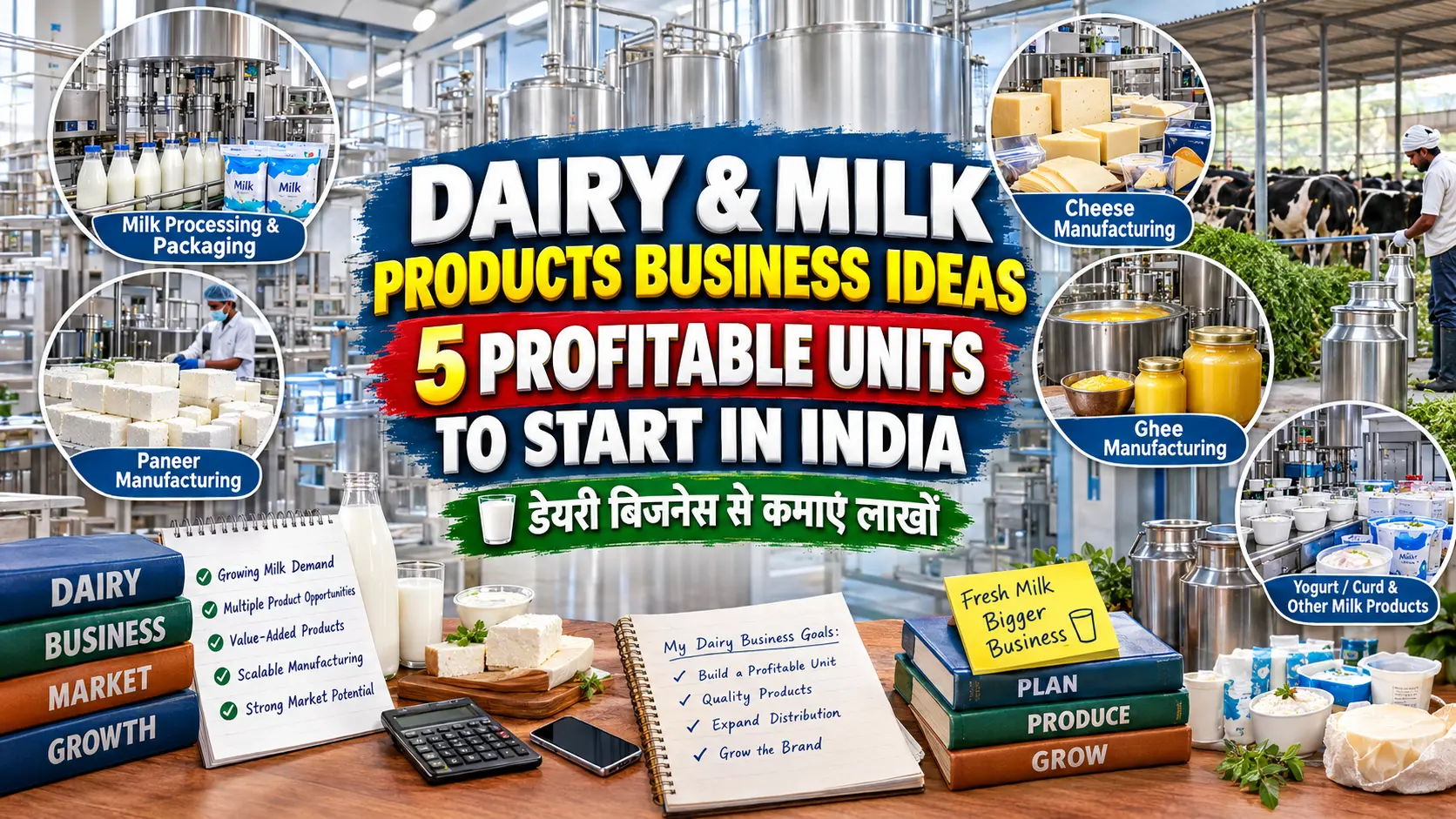
Dairy products like milk, curd, paneer, ghee, cheese, and flavored milk have a stable market. This food processing business requires infrastructure and quality control but offers daily sales.
Key Setup Needs:
- Milk chillers and pasteurizers
- Paneer and ghee making equipment
- Hygienic storage and cold chain
Business Scope:
- Tie up with local dairy farmers for raw milk
- Offer subscription-based delivery to households
- Supply to sweet shops and food retailers
7. Cereal and Pulse Processing
Cereals and pulses are daily-use staples. Their processing includes cleaning, grading, polishing, and packaging. This can be a good option for rural or semi-urban areas.
Machinery Needed:
- Cleaning machines
- Graders and dehuskers
- Packing units
Target Market:
- Households, wholesalers, grocery stores
- Online B2C sales with attractive branding
It is a low-risk business with continuous demand, making it ideal for consistent revenue generation.
8. Ready-to-Eat Snack Manufacturing
People love snacks! Whether it’s spicy namkeen, banana chips, khakhra, or roasted nuts, the snacking industry continues to grow. It is a top-performing segment in the food processing business.
Why It Works:
- High shelf life
- Small unit setup possible
- High margins due to branding
Success Tips:
- Focus on regional flavors
- Offer healthier versions (baked, roasted)
- Package well for gifting and online sales
9. Papad and Instant Mix Manufacturing
Indian homes still rely on quick mixes like idli-dosa batter, gulab jamun mix, and papads. These are easy to produce, have long shelf lives, and appeal to working professionals and students.
Setup Requirements:
- Basic mixing and drying equipment
- Hand or semi-auto rolling machines
- Sealing and labeling systems
Marketing Channels:
- Kirana stores, supermarkets, and online portals
- Export opportunities, especially for traditional Indian items
10. Herbal and Organic Food Processing
If you want to enter a niche market, go for organic and herbal products. These include cold-pressed oils, organic pulses, herbal teas, millet snacks, and more.
Required Certification:
- USDA Organic
- FSSAI
- APEDA (for export)
Growth Potential:
- Millennials and health-conscious people are your main customers
- Partner with Ayurveda and wellness brands
- Sell online and in organic food stores
The demand for sustainable, healthy, and chemical-free food is only growing, making this a promising avenue.
Key Steps to Start a Profitable Food Processing Business
To succeed in any food processing business, follow these critical steps:
Research and Planning
Study the local market, identify gaps, and define your target customers. Choose a product that has stable demand and scope for differentiation.
Legal Registration
Obtain all mandatory registrations:
- FSSAI License
- GST Registration
- Udyog Aadhaar (for MSME)
- Local trade license
Infrastructure and Equipment
Set up a facility that complies with hygiene and safety standards. Purchase machinery suited to your budget and scale.
Branding and Marketing
Create a strong brand identity with professional packaging, digital presence, and storytelling. Use platforms like Instagram, Facebook, Amazon, and Flipkart to reach a wider audience.
Distribution and Scaling
Tie up with local retailers, wholesalers, and distributors. Use online marketplaces, export networks, and subscription models to scale faster.
Food Processing Business – Government Support and Incentives
To promote the food processing business, the Indian government offers:
- PMFME Scheme: Offers 35% subsidy for individual micro-entrepreneurs.
- Mega Food Park Scheme: Provides infrastructure and common facilities.
- NSDC & Skill India: Training and certification support.
- Credit Guarantee Scheme: Easy loans without collateral for MSMEs.
You can take advantage of these schemes to reduce startup costs and accelerate growth.
Final Thoughts
The food processing business offers a unique blend of creativity, consistency, and scalability. Whether you’re passionate about health foods, regional snacks, dairy products, or baking, there is a business idea that fits your skills and budget. The key to success lies in understanding your target market, ensuring quality, maintaining hygiene, and leveraging digital platforms for sales.
With consumer demand at an all-time high and government support in place, now is the best time to turn your dream of owning a food processing business into reality. Start small, scale smartly, and focus on long-term brand building for sustainable success.
Frequently Asked Questions (FAQs)
FAQ 1: What are the most profitable food processing business ideas?
The most profitable food processing business ideas with strong demand and growth potential include:
| Business Idea | Investment (₹) | Profit Margin |
|---|---|---|
| Pickle Manufacturing | 5-20 lakhs | 25-35% |
| Frozen Food Production | 25-50 lakhs | 20-30% |
| Spice Powder Manufacturing | 10-30 lakhs | 25-40% |
| Fruit Juice & Beverage Unit | 15-40 lakhs | 20-30% |
| Bakery & Confectionery | 10-30 lakhs | 30-40% |
| Dairy Processing | 20-50 lakhs | 20-30% |
| Cereal & Pulse Processing | 15-35 lakhs | 15-25% |
| Ready-to-Eat Snacks | 10-25 lakhs | 25-35% |
| Papad & Instant Mix | 5-15 lakhs | 25-35% |
| Herbal & Organic Foods | 15-40 lakhs | 25-40% |
These businesses offer excellent returns with growing consumer demand for processed and convenience foods.
FAQ 2: What is the minimum investment required for a food processing business?
The investment required for a food processing business varies by product and scale:
| Scale | Estimated Investment |
|---|---|
| Small-Scale (Home-Based) | ₹2 – 10 lakhs |
| Medium-Scale (Semi-Automated) | ₹10 – 40 lakhs |
| Large-Scale (Fully Automated) | ₹50 lakhs and above |
Key Cost Components:
Machinery and equipment
Raw materials (initial stock)
Licensing and certifications (FSSAI, GST, MSME)
Packaging and branding
Working capital
Government schemes like PMFME offer up to 35% subsidy for micro-entrepreneurs, significantly reducing initial costs.
FAQ 3: What licenses are required for a food processing business?
To operate a food processing business legally in India, you need:
| License/Certification | Purpose |
|---|---|
| FSSAI License | Food safety compliance |
| GST Registration | Tax compliance |
| MSME/Udyam Registration | Access to subsidies and benefits |
| Factory License | Compliance with Factories Act |
| Pollution Control Clearance | Environmental compliance |
| Trade License | Local municipal permit |
| BIS Certification | For specific products |
| APEDA Registration | For export operations |
| ISO/HACCP Certification | Quality assurance (recommended) |
Proper documentation builds trust among buyers and ensures regulatory compliance.
FAQ 4: How profitable is the food processing business?
The food processing business offers attractive profitability:
| Financial Metric | Value |
|---|---|
| Profit Margins | 20% – 40% |
| Break-even Period | 12 – 24 months |
| ROI Timeline | 2 – 3 years |
Key Profitability Drivers:
Growing demand for convenience and packaged foods
Value addition to raw agricultural produce
Government subsidies and support
Export opportunities
Brand building and premium pricing
With proper planning and quality control, this business delivers excellent returns.
FAQ 5: What are the fastest-growing food processing sectors in India?
The fastest-growing sectors in the food processing business include:
| Sector | Growth Drivers |
|---|---|
| Frozen Foods | Changing lifestyles, convenience demand |
| Ready-to-Eat Snacks | Urbanization, busy lifestyles |
| Health & Organic Foods | Health awareness, wellness trends |
| Beverages & Juices | Health consciousness, fitness trends |
| Dairy Processing | Stable demand, value-added products |
| Bakery & Confectionery | Growing café culture, gifting trends |
| Herbal & Ayurvedic Foods | Traditional wellness appeal |
These sectors offer excellent opportunities for new entrepreneurs.
FAQ 6: What is the market outlook for the food processing industry?
The food processing business in India has a strong market outlook:
| Metric | Value |
|---|---|
| Market Size (2025) | ₹40,000+ Crore |
| Growth Rate | 10-12% CAGR |
| Key Drivers | Urbanization, changing lifestyles, government support |
| Export Potential | Growing demand in Middle East, Europe, USA |
With increasing disposable income and changing consumer preferences, the food processing sector offers immense growth potential.
FAQ 7: Can I start a food processing business from home?
Yes, many food processing business ideas can be started from home:
| Suitable Home-Based Ideas | Investment (₹) |
|---|---|
| Pickle Manufacturing | 2-5 lakhs |
| Papad & Instant Mix | 2-5 lakhs |
| Spice Powder Packaging | 3-8 lakhs |
| Bakery Products | 3-10 lakhs |
| Snack Manufacturing | 3-10 lakhs |
Requirements:
Separate kitchen/workspace
Proper hygiene and sanitation
Local permissions (home business license)
FSSAI registration
Start small, build a customer base, and scale gradually.
FAQ 8: What equipment is required for a food processing business?
Equipment depends on the product, but common machinery includes:
| Business | Machinery Required |
|---|---|
| Pickle Manufacturing | Cutters, mixers, filling machines |
| Spice Powder | Grinders, pulverizers, sealing machines |
| Frozen Foods | Blast freezers, packaging lines |
| Bakery | Ovens, dough mixers, proofers |
| Dairy Processing | Pasteurizers, chillers, packaging |
| Fruit Juice | Washers, crushers, pasteurizers |
| Snacks | Fryers, extruders, seasoning drums |
Semi-automatic machines are suitable for small-scale operations.
FAQ 9: How can I market my food products effectively?
Effective marketing strategies for a food processing business include:
| Channel | Strategy |
|---|---|
| Retail Stores | Supply to supermarkets, kirana stores |
| Online Marketplaces | Sell through Amazon, Flipkart |
| B2B Portals | List on IndiaMART, TradeIndia |
| Social Media | Instagram, Facebook for brand building |
| Direct Sales | Subscribe and delivery models |
| Export Channels | APEDA registration for international buyers |
| Trade Shows | Participate in food expos and fairs |
A strong brand identity with professional packaging builds trust with consumers.
FAQ 10: What government support is available for food processing businesses?
The Indian government offers several schemes for the food processing business:
| Scheme | Benefit |
|---|---|
| PMFME Scheme | 35% subsidy for micro-entrepreneurs |
| Mega Food Park Scheme | Infrastructure and common facilities |
| MSME/Udyam Registration | Access to subsidies and benefits |
| NSDC & Skill India | Training and certification support |
| Credit Guarantee Scheme | Easy loans without collateral |
| APEDA Support | Export assistance |
Applying for these schemes can significantly reduce initial costs and accelerate growth.
FAQ 11: What are the challenges in the food processing business?
| Challenge | Solution |
|---|---|
| Raw Material Price Fluctuations | Bulk contracts, diversified suppliers |
| Shelf Life Issues | Proper packaging, preservatives |
| Competition | Focus on quality, branding, innovation |
| Regulatory Compliance | Stay updated on norms, hire consultants |
| Supply Chain Management | Build reliable logistics partnerships |
| Quality Consistency | Standardized processes, quality control |
Proper planning, quality assurance, and continuous innovation can mitigate these challenges.
FAQ 12: What are the export opportunities for food products?
India has significant export potential for processed foods:
| Product | Target Markets |
|---|---|
| Spices | USA, Europe, Middle East |
| Pickles & Chutneys | UK, USA, UAE |
| Ready-to-Eat Snacks | Europe, USA, Southeast Asia |
| Frozen Foods | USA, Europe, Middle East |
| Organic Products | Europe, USA, Japan |
| Bakery Products | Middle East, Southeast Asia |
Requirements for Export:
Import Export Code (IEC) from DGFT
APEDA registration
ISO/HACCP certification
Compliance with international quality standards
FAQ 13: How do I get FSSAI certification?
Steps to get FSSAI certification for your food processing business:
| Step | Action |
|---|---|
| 1. Application | Apply online through FSSAI portal |
| 2. Document Submission | Upload required documents |
| 3. Inspection | FSSAI officer inspects your facility |
| 4. Certification | License issued upon compliance |
Required Documents:
Identity proof
Business registration
Facility layout
Food safety management plan
FSSAI certification is mandatory for all food businesses.
FAQ 14: What are the emerging trends in food processing?
| Trend | Description |
|---|---|
| Healthy & Organic | Chemical-free, natural products |
| Plant-Based Foods | Vegan and vegetarian alternatives |
| Ready-to-Eat Meals | Convenience food segment |
| Sustainable Packaging | Eco-friendly materials |
| Functional Foods | Health-benefit products |
| Digital Marketing | Online sales and branding |
| Millets & Ancient Grains | Traditional superfoods |
Staying ahead of these trends gives your business a competitive edge.
FAQ 15: Why should I invest in a food processing business?
| Reason | Benefit |
|---|---|
| Growing Demand | Rising population and urbanization |
| Government Support | Subsidies, infrastructure, training |
| Value Addition | Transform raw produce into profitable products |
| High Profit Margins | 20-40% gross margins |
| Scalable Operations | Can start small and expand |
| Export Potential | Access to global markets |
| Essential Products | Food is always in demand |
| Job Creation | Contribute to local employment |
With proper planning, quality control, and strategic marketing, a food processing business can become a highly profitable and sustainable venture.
Ready to Start Your Food Processing Business?
Visit the page Select and Choose the Right Business Startup for You for sorting out the questions arising in your mind before starting any business and know which start-up you can plan.
We, at NPCS, endeavor to make business selection a simple and convenient step for any entrepreneur/startup. Our expert team, by capitalizing on its dexterity and decade’s long experience in the field, has created a list of profitable ventures for entrepreneurs who wish to diversify or venture. The list so mentioned is updated regularly to give you a regular dose of new emerging opportunities.