
Particle Board Manufacturing Business
India’s engineered wood industry is growing well and particle board production is one of the most promising areas of the building materials ecosystem. Rapid urbanization, rise in the demand for modular furniture and growth in real estate construction are driving the consumption of particle boards in the country.
Particle boards are very commonly used in modern interior because they are cheap and easy to process, used for mass furniture production. As consumer tastes lean towards modular kitchens, wardrobes and ready-to-assemble furniture, the manufacturers have turned to the engineered wood panel in place of the traditional solid timber.
Another important development that helps shape the industry is the more stringent quality regulations that have been introduced by the Bureau of Indian Standards. These regulations mandate particle board manufacturers to seek BIS compliance licenses. There are many small and antiquated mills that are unable to meet these standards and are gradually being removed from the market. The current transition cycle creates a new requirement gap which modern production facilities can address.
For entrepreneurs and MSMEs intending to move to manufacturing business, there is an enormous opportunity to invest in particle board production between 2026 and 2031.
Read More: Products From Waste (Industrial & Agro Waste) 2nd Edition
Market Size and Growth of Particle Board Industry
India’s particle board market has witnessed steady growth in the last decade. The industry reports show that the market value will reach between USD 720 million and USD 780 million during the 2024-25 period while the market will expand to USD 1.16 billion by 2030.
Several factors are contributing to this growth, such as the growth of furniture manufacturing, more and more housing construction, and the growing demand for organized solutions for the interior.
Some of the key market indicators are:
- The furniture and cabinetry sector is responsible for over 60% of particle board consumption.
- The overall market is expected to grow at CAGR of around 10% between 2025 and 2030.
- Urban housing projects and commercial office spaces are the large consumers of engineered wood panels.
These numbers demonstrate the strong potential of growth in the industry going forward in the next several years.
Why Is Demand for Particle Boards Growing
The growing demand for particle boards is closely related to the changes in the furniture and construction industries. Modern furniture manufacturers prefer particle boards due to the consistency of the product and the suitability of the boards for mass production.
There are several major trends driving this demand.
Growth of Modular Furniture
Modern homes have increasingly switched to modular kitchen, wardrobe and storage systems. Particle boards are very popular for these applications due to their light weight, low cost and ease of laminating. Global furniture brands like IKEA make use of particle boards widely in the design of ready-to-assemble furniture.
Growth of Real Estate Development
Large infrastructure projects like Delhi-Mumbai Industrial Corridor and new smart cities like Dholera Smart City are boosting construction all over India. Residential and commercial buildings use interior furniture, partition, cabinets and decorative panels all of which make heavy use of particle boards.
Growth of Office Spaces and Co-Working Spaces
The emergence of flexible working spaces has led to a growing demand for standard office furniture. Companies like WeWork, Awfis are growing rapidly in the big Indian cities and this brings in a steady demand for office interiors and modular furniture components.
Read More: Particle Board – Manufacturing Plant, Detailed Project Report, Profile, Business Plan, Industry Trends, Market Research, Survey, Manufacturing Process, Machinery, Raw Materials, Feasibility Study, Investment Opportunities, Cost and Revenue, Plant Layout
Demand – Supply Gap in Indian Market
Despite the growing demand, the particle board manufacturing capacity of India is limited. The organized sector is dominated by a handful of large manufacturers, but many smaller mills have been forced to shut down because of more stringent standards of compliance.
Some of the top companies that work in this sector include:
- Century Plyboards (India) Ltd.
- Action TESA
- Greenply Industries Ltd.
- Associate Decor Ltd.
- Shirdi Industries
Even with these manufacturers, the amount of particle boards supplied has not been able to catch up with the ever growing demand. Imports are resorted to fill the gap still and the cost of imports has been on the rise in recent years.
Another important issue is geographic concentration. Most of the manufacturing plants are found in western and southern India, mostly in the state of Gujarat, Maharashtra and Tamil Nadu. However, there is a fast-growing demand in the north and east which rely on long distance transportation of particle boards from existing manufacturing hubs.
This kind of geographic imbalance leaves big opportunities for the setting-up of new factories in areas such as Uttar Pradesh, Rajasthan, Madhya Pradesh and Bihar.
Read More: Rice Husk, Rice Hull, Rice Husk Ash (Agricultural Waste) based Projects, (Precipitated Silica, Activated Carbon, Cement, Electricity, Ethanol, Hardboard, Oxalic Acid, Paper, Particle Board, Rice Husk Briquettes, Rice Husk Pellet, Silicon, Sodium Silicate)
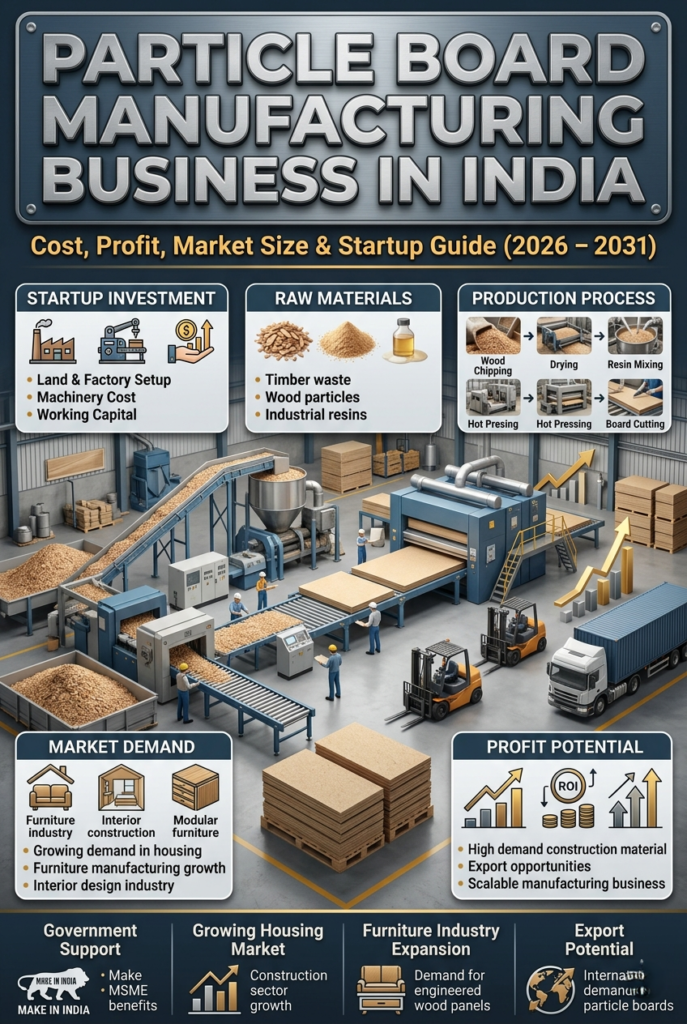
Raw Materials used in Making Particle Board
The manufacturing of particle boards involves the compression of wood particles using adhesives and high temperature and pressure. Traditionally, the feedstock for this process was wood-based materials.
Common raw materials used in the production include:
- Wood chips and sawdust from sawmills
- Shavings of wood from furniture factories
- Sugar can bagasse from sugar mills
- Agricultural residues such as rice husk and wheat straw
Bagasse has emerged as a key material because it exists in abundant supply throughout India and delivers sustainable environmental advantages. By turning agricultural waste into industrial products, manufacturers can save money while adopting environmentally friendly production practices.
Read More: Startup Selector
Investment Needed to Establish a Particle Board Plant
The setting up of a particle board manufacturing facility requires a huge investment in machinery and infrastructure. However, the industry does provide great long-term returns when the planning of projects is done efficiently.
For MSME entrepreneurs, the investment in a small to medium scale plant ranges between a mere Rs. 15 crores to Rs. 40 crores depending upon the production capacity and the level of automation.
The major components of the investment are:
- Equipment needed to produce a chip, such as chip preparation and drying machines
- Multi-daylight press or continuous press system
- Glue kitchen and resin application units
- Sanding, finishing and calibration machines
- Optional lines of lamination for decorative boards
Plants that have the pre-laminated or moisture-resistant board production often get better margins than commodity grade particle boards.
Read More: Transforming Rice Husk into Profitable Particle Boards
Export Opportunities for Indian Manufacturers
Although domestic demand remains as the major driving force of the industry, exports are also promising opportunities. Indian particle boards are already being exported to countries in South Asia and Middle East.
Export markets generally have higher price realisations, particularly for boards that have international emission and quality certification. Manufacturers who meet both BIS standards and international certification standards gain entry to top-tier markets across Europe and North America.
This export potential can have a great impact on the financial viability of new manufacturing projects.
Why the Next Five Years are Critical for Investment
The coming years are a unique opportunity for new players coming into the particle board manufacturing sector. Demand is growing in furniture manufacturing, real estate development and commercial interior projects. At the same time, tightening quality standards are taking the outdated capacity out of the market.
Entrepreneurs who invest in modern technology, efficient raw material sourcing and BIS compliant manufacturing processes, will be well positioned to capture a share of this growing market.
Read More: Rice Husk to Revenue: Profitable Agricultural Waste Business Ideas in India
Conclusion
The period of rapid growth is entered in the particle board industry in India. With the market expected to exceed USD 1 billion in the next few years, the demand for engineered wood panels will continue to increase in the residential, commercial and institutional sectors.
Regulatory changes, increasing imports and geographic supply gaps are providing favourable conditions for new manufacturing ventures. For MSME entrepreneurs and industrial investors who are looking for a scalable business opportunity, particle board manufacturing is a good and future-oriented investment.
Frequently Asked Questions or FAQ
What is the size of particle board market in India?
The market was valued at around USD 720 – 780 million in 2024 – 25 and is estimated to reach around USD 1.16 billion by 2030.
How much investment will be required for establishing a particle board manufacturing plant?
An MSME scale plant of 100-200 cubic metres per day capacity typically requires an investment of between 15 crores of rupees and 40 crores of rupees.
What are the raw materials used in the manufacturing of particle board?
Particle boards are derived from the wood particles like saw dust and wood chips and agricultural wastes like sugarcane bagasse and rice husk.
Is particle board making profitable?
Yes, well-managed plants can have good operating margins with a typical pay-back period of four to six years.
Which regions in India is providing the best opportunity for new plants?
Northern and eastern states like Uttar Pradesh, Rajasthan, Madhya Pradesh and Bihar have increasing demand and comparatively less number of manufacturing units.