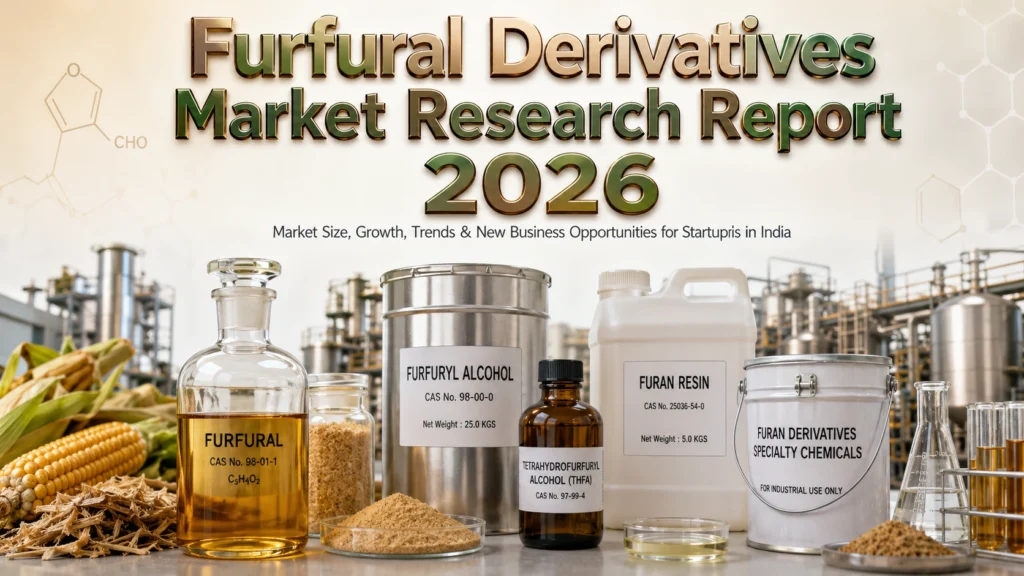

Furfural Derivatives Market in India
In the specialty chemicals field, furfural derivatives have quietly emerged as one of the more intriguing sectors. They are at a crossroads that other chemical categories do not share, as they are created from agricultural waste such as corn cobs, sugarcane bagasse and rice husks but are utilised in a wide range of industries, including foundries, pharmaceuticals, agrochemicals and next-generation bioplastics. That’s a bit difficult to ignore in a nation of hundreds of millions of tonnes of crop residue – like India.
This report explains the current state of the global and Indian furfural derivatives market, insights on market drivers, challenges and opportunities for new players, and why it is worth the attention of MSMEs and first-generation entrepreneurs looking into a manufacturing business.
What Are Furfural Derivatives? (Meaning, Types and Production)
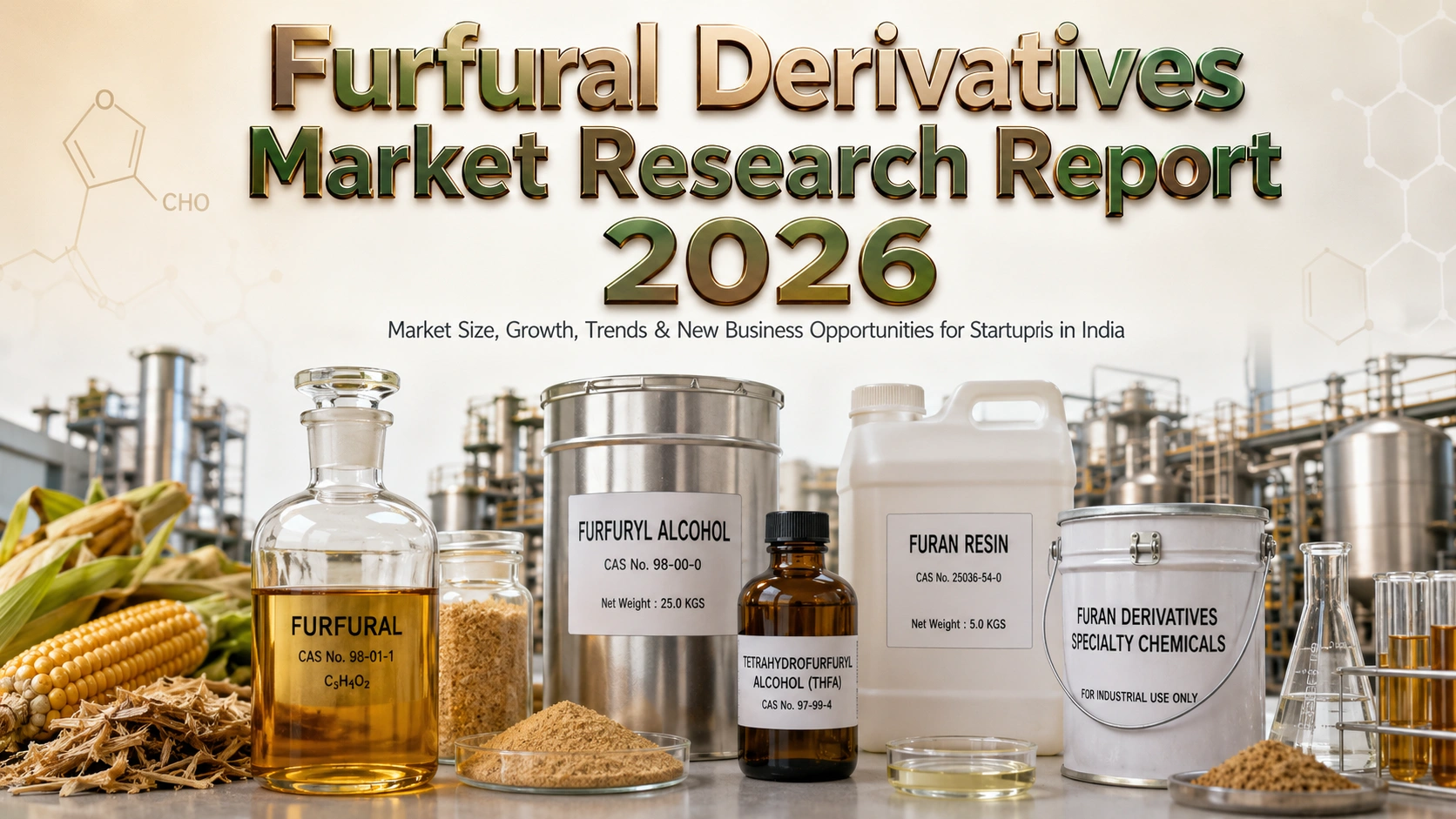
Furfural (C5H4O2) is an organic aldehyde that is produced by the acid hydrolysis of pentosans, which are one of the hemicellulose components of lignocellulosic biomass. Furfural is not a petroleum-derived industrial organic chemical; it is only produced from plant residues like corncobs, sugarcane bagasse, rice husk, oat hulls and cottonseed hull.
After its generation, furfural itself is used as a platform chemical that is subsequently transformed into a series of higher value derivatives such as:
- Furfuryl alcohol – the biggest volume derivative, primarily employed in the production of foundry resins, corrosion-resistant coatings and thermosetting binders
- Tetrahydrofuran (THF) is produced and widely used in industry as a solvent and one of the precursors of polymers such as spandex.
- Furan resins – used in sand-casting and mould-making in metal foundries
- Tetrahydrofurfuryl alcohol (THFA) – for agrochemical formulations, cleaners, and as a green solvent.
- Furoic acid and furan based fine chemicals are utilized in pharmaceuticals, flavouring chemicals, specialty intermediates etc.
- Bio-based PEF plastics – 2,5-Furandicarboxylic acid (FDCA) is an emerging BBL, a renewable alternative to PET.
Since the raw material is farm waste and not crude oil, furfural derivatives are firmly in the “green chemistry” and circular economy dialogue which is becoming more relevant with regulators and buyers demanding lower carbon industrial inputs.
View Full Project Details: Furfural Manufacturing & Project Report
Furfural Derivatives Market Size 2026 and Growth Forecast (CAGR)
The estimates of the furfural derivatives market vary significantly from research agency to research agency, partly due to the varying definitions of what is counted as furfural derivatives (some consider only furfuryl alcohol and THF to be furfural derivatives, while others extend the definition to the much wider furan-chemical family). Overall, the estimates converge on a similar growth trajectory, though not on exact figures.
According to recent industry estimates, the global furfural derivatives market is valued in a broad range of roughly USD 13–15.4 billion for 2025–26, with most forecasts projecting expansion to somewhere between USD 22 billion and USD 28 billion by the early 2030s, at compound annual growth rates generally clustering between 6% and 8.3%. One recent 2026 study by Persistence Market Research places the market at approximately USD 15.4 billion in 2026, climbing to USD 25.7 billion by 2033 — a CAGR of 7.6%.
A separate, narrower estimate focused specifically on furfural itself (the parent compound, excluding derivatives) puts that market closer to USD 700–770 million in 2025-26, underlining how much value gets added once furfural is converted downstream into furfuryl alcohol, THF, and specialty derivatives.
Figures: Assume the numbers provided above are fairly approximate and should be used to gain a sense of scale and trajectory—not as exact numbers that you could present in a fundraising deck without following up with a cross-check on the scope definition from the published market study. If you need investor-grade numbers, NPCS can prepare a custom TEFS, with figures that are scoped very close to your product line and capacity.
Regional Breakdown
Asia Pacific leads the furfural derivatives market by a huge margin with estimated market share of 42-67% of the global market share which is primarily due to China’s production base and the availability of agricultural biomass in the region. Chinese Batch Process is estimated to account for a majority of global furfural production capacity, at a staggering 80% production rate, as it is the most cost-effective method of production (CVP), Grand View Research’s furfural market analysis showed and China is expected to produce an overwhelming 89% of the world’s furfural in 2025.
In contrast, in the EU and North America, furfural and furfural derivatives are net imports and the local production capacity has been decreasing over decades, due to the high production costs compared to Asia. Thus, Western markets are not only the largest markets for the supply of bio-based chemicals through mechanisms such as the EU’s Carbon Border Adjustment Mechanism, but also are structurally dependent on imports — and India’s manufacturers are well poised to fill this gap in the Western markets.
Furfural Derivatives Market in India: Import Dependence and the Manufacturing Opportunity
The part of the story that is important to Indian entrepreneurs is that although India has some of the largest stocks of furfural feedstock in the world, the country is a net importer of furfural, largely from China and to a minor degree from Germany and other producers.
More than 500 million tonnes of agricultural residue is produced in India on a yearly basis. Rice husk, sugarcane bagasse, corn cobs and wheat straw are produced in vast quantities in various agricultural states of Punjab, Haryana, Uttar Pradesh, Maharashtra, Odisha etc. A significant amount of this residue goes into burning in the field (which is a key source of seasonal air pollution in North India) or is used as a low value fuel in boilers where it could be transformed into a chemical intermediate valued roughly at ₹80 per kg to ₹500 per kg depending on the derivative and its purity level.
Bagasse, in particular, is concentrated in Uttar Pradesh and Maharashtra which have dense clusters of sugar mills, which already produce bagasse as a byproduct of sugar and ethanol production; thus feedstock logistics for a furfural unit in close proximity to these sugar mills is much simpler than if a business were to establish a new sugar-based agriculture supply chain from scratch.
India’s specialty chemicals industry as a whole is valued at more than USD 220 billion and growing at 9–12% annually — a growth trajectory tracked by the Department of Chemicals and Petrochemicals under the Ministry of Chemicals and Fertilizers — and furfural derivatives fit squarely inside that growth story as an underpenetrated, import-substitution opportunity rather than a saturated one.
Policy Tailwinds
There are a number of developments that relate to this opportunity from the government level:
1. Global Biofuels Alliance (GBA): Launched by India in 2023 on the sidelines of the G20 Summit, GBA is a multi-stakeholder platform bringing together governments, international bodies, and industry to accelerate biofuel and bio-chemical deployment, including furfural-adjacent biorefinery co-products.
2. The National Policy on Biofuels (2003) India’s National Policy on Biofuels, administered under the Ministry of Petroleum & Natural Gas, already identifies agricultural residues — rice straw, corn cobs, bagasse, and sawdust — as approved feedstocks, directly overlapping with furfural raw materials.
3. State-level incentive for agro-processing units: Some of the states treat biochemical plants that use rice husk or bagasse as agro-processing industries and provide capital subsidies (usually in the range of 15–25%), waivers on duty, and relaxed environmental clearance procedures compared with other chemical manufacturing units.
4. MSME scheme eligibility: Furfural and furfuryl alcohol production units, if framed within the MSME investment limit, can avail credit linked capital subsidy scheme, technology upgradation support and cluster development assistance through the MSME scheme through Ministry of MSME and DCMSME network.
5. Make in India push: Broader manufacturing incentives under the Make in India initiative support domestic value-addition in specialty chemicals and biorefinery-linked sectors, reinforcing the case for import-substituting furfural capacity.
Read the Complete Book Here: Manufacture of Value Added Products from Rice Husk (Hull) and Rice Husk Ash (RHA)
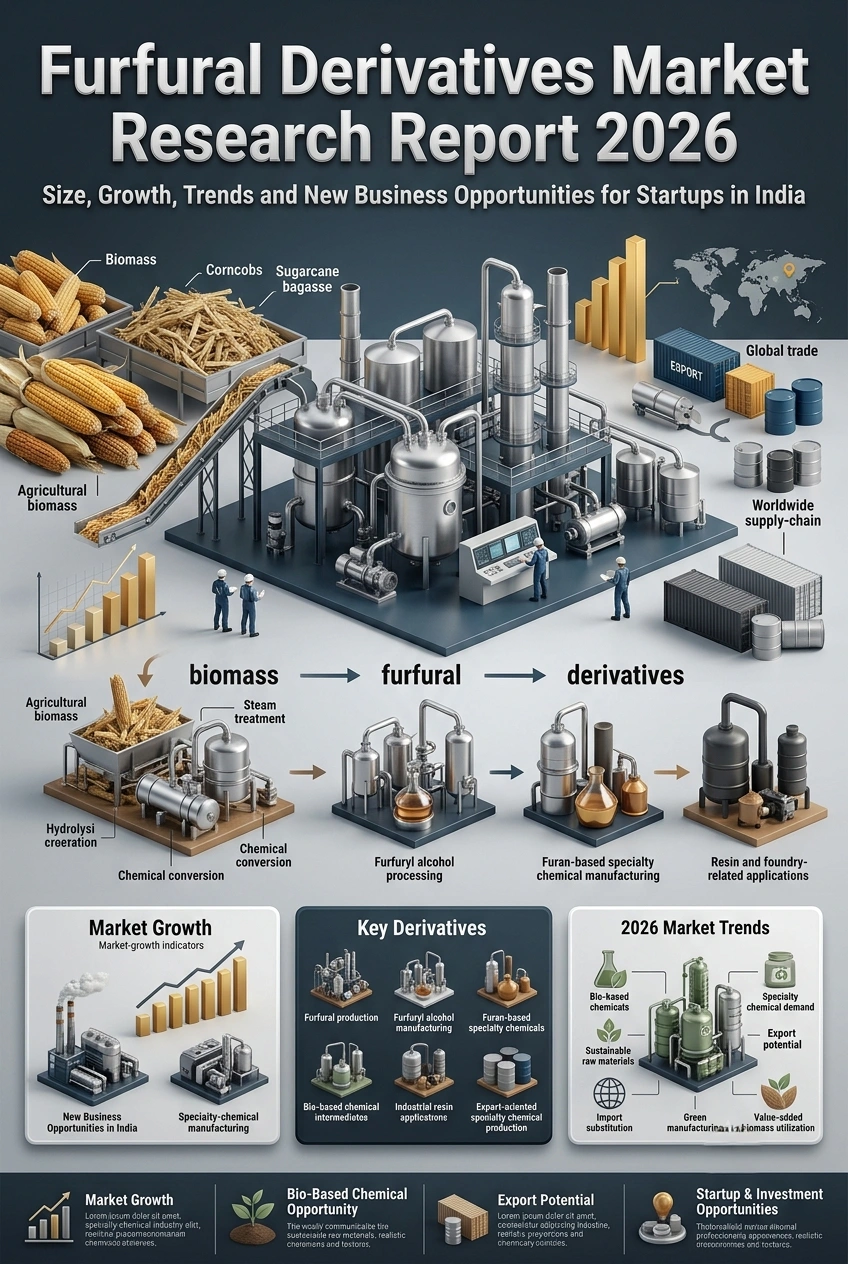
India Furfural Demand-Supply Gap: The Import Substitution Opportunity
The best way to visualize the opportunity is to compare the demand in India with their existing domestic manufacturing. Unlike bulk commodities like urea or fertiliser, there is no central government source of exact, single-source data on tonnage for this industry and the figures presented below have been compiled and triangulated from industry, trade and project-consultancy sources. Avoid using them as an indicator of the size of the gap which is in reality, merely a directional indicator, and not an audited gap figure; a custom NPCS demand study can provide these gap numbers for a particular project, which are current and verifiable.
| Parameter | Furfural (parent chemical) | Furfuryl Alcohol | Furfural Derivatives (overall) |
| Indicative India demand | Growing steadily, tracking foundry, pharma, and agrochemical intermediate demand | Largest single demand pocket, driven by automotive/engineering foundry resin consumption | Rising in line with India’s 9–12% specialty chemicals sector growth |
| Current domestic production base | Limited — largely concentrated in one new large biorefinery (Assam) plus a handful of smaller/merchant-scale units | Very limited standalone capacity; mostly downstream conversion by importers/traders | Thin — India remains a structural net importer across the derivative family |
| Supply gap | Significant; bulk of requirement met via imports | Significant; foundries largely depend on imported or import-linked material | Wide and largely unaddressed by domestic manufacturing |
| Primary import sources | China, Germany | China, and imported furfural converted domestically or abroad | China (dominant), with smaller volumes from Europe |
| Nature of the opportunity | Import substitution + export potential given feedstock cost advantage | High-value downstream conversion opportunity for entrepreneurs already producing/sourcing furfural | End-to-end integrated biorefinery model (furfural → furfuryl alcohol → THF/THFA) |
Reading the gap: India sits on one of the world’s largest volumes of furfural feedstock (rice husk, bagasse, corncob) yet operates only a small fraction of installed furfural/furfuryl alcohol capacity relative to its biomass base — most of the gap is currently closed through imports rather than domestic production. That mismatch between raw material abundance and manufacturing capacity is precisely what makes this an import-substitution opportunity rather than a market entrants would need to fight incumbents for.
Major Indian Furfural & Furfuryl Alcohol Manufacturers (Capacity Snapshot)
| Company | Location / State | Feedstock Base | Estimated Capacity | Notes |
| Assam Bio-Ethanol Pvt. Ltd. (ABEPL) — JV of Numaligarh Refinery Ltd. (NRL), Chempolis & Fortum | Numaligarh, Assam | Bamboo (2G biorefinery) | ~19,000 TPA furfural (within a larger ~49,000 TPA bioethanol biorefinery) | India’s largest dedicated furfural capacity to date; mechanical completion reported in September 2025 |
| KRBL Limited | Uttar Pradesh (rice-milling base) | Rice husk | Captive/byproduct scale (not publicly disclosed) | World’s largest rice miller; furfural is a byproduct diversification from its rice-processing operations |
| Arcoy Biorefinery Pvt. Ltd. | Ahmedabad, Gujarat | Agro-residue based | Not publicly disclosed | Export-oriented; active in Africa, Southeast Asia, and Middle East markets |
| Laxmi Furals Pvt. Ltd. | India (regional) | Agro-residue based | Not publicly disclosed | Cited among established domestic furfural producers |
| A. B. Enterprises | India | Trading/merchant supply | N/A (distributor) | Ranked among top India-linked suppliers by industry directories |
| Emerging MSME-scale units (Odisha, UP, Maharashtra, Bihar) | Various | Rice husk / bagasse / corncob | Typically 500–2,000 TPA (MSME-format plants) | The segment where most new entrant activity and NPCS project consultancy demand is currently concentrated |
Major International Furfural & Furfuryl Alcohol Players (Capacity Snapshot)
| Company | Country | Feedstock Base | Estimated Capacity | Notes |
| Central Romana Corporation (with TransFurans Chemicals & International Furan Chemicals) | Dominican Republic (conversion in Belgium/Netherlands) | Sugarcane bagasse | 50,000+ TPA — widely cited as the world’s single largest furfural facility | Furfural is converted to furfuryl alcohol at TransFurans Chemicals (Belgium); marketed globally via IFC |
| Illovo Sugar Africa (Pty) Ltd. | South Africa | Sugarcane bagasse | 50,000+ TPA | One of only two non-Chinese producers operating at large integrated scale, alongside Central Romana |
| Hongye Holding Group Corporation Ltd. | China (Henan) | Corncob | Large-scale, part of China’s dominant national capacity base | Operates in 40+ countries; among China’s leading integrated furfural/furfuryl alcohol producers |
| Tieling North Furfural (Group) Co., Ltd. | China (Liaoning) | Corncob | Large-scale (China cluster) | Specialised furfural and furfuryl alcohol producer |
| Pennakem LLC | United States (Tennessee) | Imported furfural feedstock | Mid-scale, specialty/derivative focus | USDA-certified biobased product line (Viridisol); full-service R&D and pilot facilities |
| Silvateam S.p.A. | Italy | Agro-residue based | Mid-scale, specialty derivatives | Established European specialty chemicals producer |
| Lenzing AG | Austria | Wood-based biorefinery co-product | Furfural/acetic acid as co-products of fibre production | Furfural produced as a byproduct stream of its cellulosic fibre biorefinery |
Context on scale: Global installed furfural production capacity has been estimated at roughly 800,000–900,000+ tonnes per year, with China alone accounting for the large majority of that base — commonly cited in the 70–89% range of global output, depending on the study and year. Against that backdrop, India’s current dedicated capacity (led by the ~19,000 TPA Assam biorefinery, plus scattered smaller units) represents a small fraction of what its feedstock base could technically support — underscoring both the scale of the import-substitution opportunity and the scale of investment still needed to close it.
Market Segmentation
By Product Type
- Furfuryl alcohol (largest segment by volume — foundry resins, corrosion-resistant materials)
- Tetrahydrofuran (THF) — solvent and polymer precursor
- Furan resins
- Furoic acid
- Other derivatives (THFA, FDCA, furfurylamine)
By Raw Material
- Corncob (currently the dominant feedstock globally, prized for high pentosan concentration and conversion efficiency)
- Sugarcane bagasse (fastest-growing feedstock segment, especially relevant to India)
- Rice husk
- Oat hulls, sunflower hulls, and other agro-residues
By Application
- Foundry and metal casting resins
- Solvents (industrial and green solvent applications)
- Agrochemicals and pesticide formulations
- Pharmaceuticals and drug synthesis intermediates
- Food and flavouring agents
- Plastics and polymer precursors (notably FDCA-based bio-PEF, an emerging high-margin category)
By End-Use Industry
- Chemicals and specialty chemicals manufacturing
- Automotive and foundry
- Pharmaceuticals
- Agriculture
- Food and beverages
- Petroleum refining (furfural is used as a selective solvent in lubricant oil refining)
Key Growth Drivers
1. Shifting to bio-based and renewable chemicals around the world. With a 100% biomass starting material, the structural advantage of furfural is challenging for synthetic alternatives to catch up with as industries and regulators transition away from petroleum derived intermediates.
2. Regulatory push in Europe and North America. Structural opportunities, including the EU Carbon Border Adjustment Mechanism (CBAM) which will go into effect in 2026, will provide an incentive for buyers to seek bio-based chemical inputs in their products, thus favouring producers who are able to provide them with bio-based products that are traceable and compliant with CBAM requirements.
3. Demand for foundry and resin. The automotive and heavy engineering segment where sand-casting and mould-making are critical processes continue to grow in India and furfuryl alcohol is at the heart of the industry.
4. Emerging bioplastics category (FDCA/PEF). New furfural-based bio-PEF plastic production capacity is on the horizon in various parts of the world, and other furfural plastics are finding markets in the resin and solvent sectors in new applications.
5. Agricultural waste-to-value economics. In India, more than 500 million tonnes of crop residue is produced every year, but only a small portion of it is being utilized, and the rest is being burned, which means that the underlying raw material cost base for a furfural unit is much lower than that of most competing specialty chemicals most of which are dependent on imported or petroleum-based feedstock.
6. Import substitution economics. Currently, India imports most of the furfural demand, therefore, an existing local competitor will not be replaced, so the immediate chance is that the imports can be replaced with the already available (local) material, which can be produced in India but has high logistics costs.
Challenges and Restraints
Constraints are an integral part of any opportunity assessment:
- Feedstock seasonality. Availability of sugarcane bagasse and rice husk is dependent on crop and crushing seasons which necessitates using multiple feedstocks or sufficient storage to sustain continuous production.
- The cost of hydrolysis and distillation equipment. The acid hydrolysis reactors, steam distillation and purification columns necessary for producing furfural are not a low-capital investment venture as compared to less complicated agro-processing firms.
- Corrosion management. The acid-based process is corrosive to the conventional process equipment and therefore necessitates acid resistant metallurgy or linings, increasing capital and maintenance costs.
- The impact of Chinese production prices on prices. The ability of China to supply the world at an affordable price and in volume is made possible by the Chinese Batch Process technology, a factor that Indian producers must address during the initial stages of cost modelling.
- Technical skill requirement. The process control required for acid hydrolysis and multi stage distillation is more specific than other agro-processing businesses and will require the technology partner to be selected and the process know-how needs to be transferred as part of the project planning.
- Quality and standards compliance. Purity and testing parameters are normally required for industrial and export grade furfural; entrepreneurs should consider Bureau of Indian Standards (BIS) requirements at the early stage of project planning especially in the derivative streams of pharmaceuticals and food.
Competitive Landscape
The global players in the furfural derivatives market are Hongye Chemical, Central Romana, Illovo Sugar, Lenzing, Penn A Kem, Avantium, Ashland, BASF, Corbion, and Mitsubishi Chemical, with the Chinese manufacturers making up the bulk of the furfural derivatives volume. Within this space, established chemical players are making an effort to get a slice of the new bioplastic’s opportunity, such as Avantium’s commercial-scale FDCA plant, which is scheduled to be available in 2026.
What makes it a competitive affair for an Indian entrant is more about gaining the business of the domestic competitor who are seeking to buy substitutes for imports, and also the export business of the region, where their logistics and proximity to feedstocks give them a real cost advantage over these global giants.
Related Article: Furfuryl Alcohol Production Plant in India: Cost, Process, Profit Margin & Investment Guide
Furfural Manufacturing Business Ideas: New Opportunities for Startups and MSMEs
This is where the story of the furfural derivatives turns into an actionable one for an Indian entrepreneur. There are a number of entry points to consider:
1. Single unit for producing furfural from corncob / bagasse. A single dominant local feedstock to produce furfural, ideal for the entrepreneurs in the vicinity of sugar mill clusters (UP, Maharashtra) or corn growing belts (Bihar, Madhya Pradesh and Karnataka).
2. Production of furfuryl alcohol coupled with a furfural plant. Since furfuryl alcohol has higher value addition and it is a product of the foundry resin market, an integrated facility of furfural-to-furfuryl-alcohol is better for the project economics than selling furfural as an intermediate only.
3. Small-scale/MSME entry format. Industry cost estimates for a small-scale furfuryl alcohol unit in India range roughly between ₹1.5 crore and ₹3.5 crore for initial investment, depending on capacity and level of automation — a range that fits comfortably within MSME investment thresholds and associated subsidy eligibility under DCMSME’s credit-linked capital subsidy schemes. Reported profit margins for existing manufacturers typically fall between 28% and 38%, depending on feedstock efficiency and plant utilisation. First-generation founders structuring this as a new venture may also find it worth registering under Startup India for access to tax benefits, funding support, and easier compliance during the early years.
4. Biorefinery co-product model. For entrepreneurs already operating or planning ethanol, sugar, or rice-milling operations, adding a furfural line as a co-product stream converts an existing waste-disposal cost (bagasse or husk) into a second revenue line — an approach several agro-processing businesses are already exploring under India’s expanding biofuel and biorefinery policy push.
5. Downstream specialty derivatives. Once basic furfural/furfuryl alcohol production is established, expansion into THF, THFA, or agrochemical-grade furan derivatives offers a natural second-phase investment for entrepreneurs looking to move up the value chain.
Assumption flag: The investment and margin figures above are indicative industry ranges drawn from published sources and existing plant benchmarks; actual project cost will depend on your chosen capacity, feedstock, automation level, and location. NPCS prepares detailed, bankable Project Reports with location-specific cost breakdowns, machinery lists, and financial projections (IRR, payback period, break-even) tailored to your exact parameters.
Find the most profitable startup for your investment range
How NPCS Supports Entrepreneurs Entering This Space
For any entrepreneur evaluating a furfural or furfural derivatives manufacturing venture, the starting point is a properly structured Detailed Project Report (DPR) — one that goes beyond generic market commentary and gets into plant capacity, machinery selection, raw material sourcing logistics, manpower planning, project cost, and financial viability specific to the chosen location and scale.
About NPCS (Niir Project Consultancy Services)
NPCS is a New Delhi-based industrial consultancy, established in 1994, and an ISO 9001:2015 certified organisation with over 30 years of experience in techno-economic and project consultancy. Over three decades, NPCS has delivered more than 150,000 project reports and profiles across 85 countries, covering virtually every manufacturing and process industry, including specialty chemicals, agro-based biochemicals, and biorefinery projects.
NPCS operates across three integrated platforms:
- niir.org — the primary repository of industry-specific Detailed Project Reports, business plans, and techno-economic feasibility studies
- entrepreneurindia.co — market research, project profiles, and manufacturing business opportunity content aimed at entrepreneurs and MSMEs
- npcsblog.com — industry insight, trend analysis, and manufacturing sector commentary
NPCS’s core deliverables relevant to a furfural derivatives venture include:
- Detailed Project Reports (DPRs) with plant capacity, machinery specifications, and layout
- Techno-economic feasibility studies
- Financial modelling — project cost, profitability analysis, ROI, and break-even calculations
- Raw material and market assessment specific to Indian states and export markets
- Support documentation for MSME loan applications, subsidy schemes, and bank funding requirements
Entrepreneurs evaluating this sector can access relevant furfural and furfuryl alcohol manufacturing profiles directly on niir.org and entrepreneurindia.co, or request a custom feasibility study scoped to a specific capacity and location.
Government and Institutional Reference Links
For entrepreneurs conducting further due diligence, the following official Indian government resources provide relevant policy, scheme, and regulatory context for a furfural derivatives or agro-biochemical manufacturing venture:
- Ministry of Micro, Small and Medium Enterprises (MSME)
- Development Commissioner, MSME (DCMSME)
- Ministry of New and Renewable Energy
- Ministry of Petroleum and Natural Gas
- Press Information Bureau (PIB), Government of India
- Startup India, Department for Promotion of Industry and Internal Trade
- Invest India (National Investment Promotion and Facilitation Agency)
- Bureau of Indian Standards (BIS)
Entrepreneurs are advised to verify the latest scheme guidelines, subsidy percentages, and eligibility norms directly on these portals, as policy provisions and thresholds are periodically revised.
Conclusion
Furfural derivatives sit in a genuinely favourable position for Indian manufacturing: strong and steady global demand growth, a raw material base India already produces in enormous surplus, an import-substitution gap waiting to be closed, and a policy environment that is actively tilting toward bio-based chemicals and biorefinery co-products. The technical and capital entry barriers are real, but they are the kind that a well-structured project — backed by an accurate feasibility study and financial model — is built to address.
For entrepreneurs and MSMEs evaluating where to place their next manufacturing investment, furfural and furfural derivatives production represents one of the more underexplored, resource-backed opportunities in India’s specialty chemicals space today.