
PET bottle recycling business
The PET Recycling Opportunity Transformed by EPR
Although most commonly recycled plastic in India, polyethylene terephthalate (PET) – clear plastic made for water, soft drink, cooking oil and food packaging – also poses one of the biggest plastic waste concerns for the country. Annually, India generates about 3.5 million tonnes of plastic waste, most of it-60-70%-being collected through an informal network of rag pickers, Kabadiwala networks and small recyclers, and the other 30-40% ending up in landfills, scattered in dumpsites, and often through incinerators.
The implementation of EPR – Extended Producer Responsibility – on all plastic packaging producers in the 2022 Plastic Waste Management Amendment Rules has shifted the economics of PET recycling. Now it comes down to the brand owners to prove they collected and recycled the same amount of plastic they added to the market. This has changed the price of recycled PET from a commodity to an EPR compliance tool, with a lower price limit — thus enhancing the investment argument for formal PET recycling. The current trend of entrepreneurs entering this sector has both genuine demand for the product and value of the raw material driven by the regulations.
Related Article: Packaged Drinking Water with PET Bottles
The PET Recycling Value Chain
PET recycling is a chain starting from collection and sorting by colour (clear, green, blue), followed by baling, washing (hot wash lines remove labels, adhesives and contaminants), flaking (shredding into clean PET flakes) and ending with the conversion of PET flakes into end products. The cost of the investment increases significantly at each step downstream — a “baler” costs Rs. 5 lakhs, a hot-wash line Rs. A fibre spinning line Rs. 50 – 150 lakhs. But so do the margins, 3–8 crore. Entrepreneurs may join anywhere and can sell semi-processed material to the downstream processors or can go forward to get more realisation.
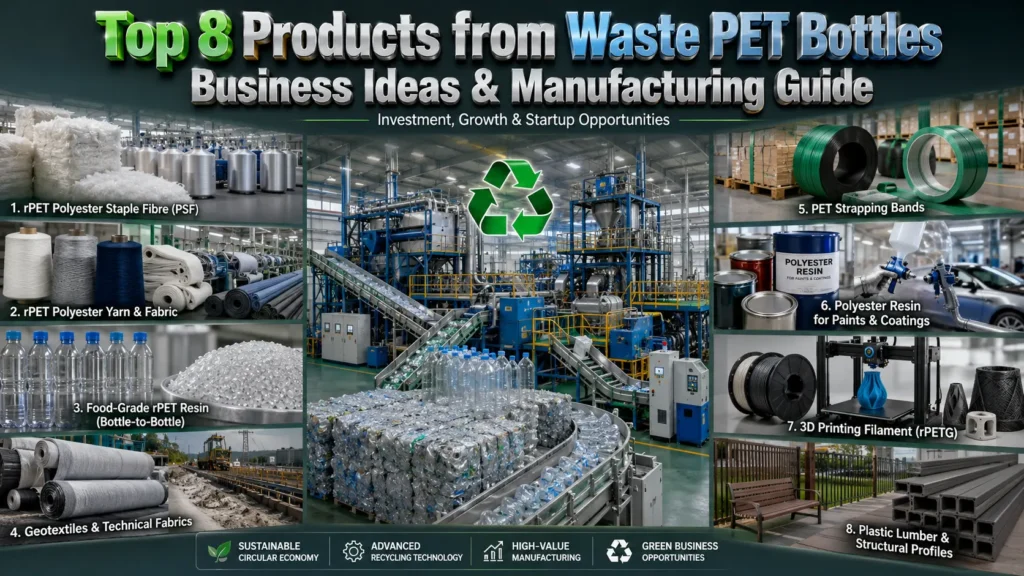
Top 8 Products from Waste PET Bottles
1. rPET Polyester Staple Fibre (PSF)
The most significant end product from PET bottle recycling worldwide is recycled PET polyester staple fibre. After being washed and dried, PET flakes are melted, extruded through spinnerets, drawn, crimped and cut into short fibers (32-64 mm) that are used as pillows, quilts, sleeping bags, stuffed toys and automotive seat cushions. As European and US brands make their recycled fibre content commitments, the demand for exported materials continues to rise.As Europe and the US brands make commitments to recycled fibre content, the demand for exported materials continues to rise. The cost of 10 TPD rPSF plant is Rs. The stake he has in 2–5 crore and the money he generates is Rs. 60,000–90,000 per tonne of output.
Explore This Book: The Complete Technology Book on Expanded Plastics, Polyurethane, Polyamide and Polyester Fibres
2. rPET Polyester Yarn and Fabric
The high-quality PET flakes are melted and extruded to continuous filament polyester yarn. These high-quality yarns have a range of uses that include fabrics for Apparel, such as active wear, outerwear and linings, Home & Lifestyle, Home & Technical products. As, many globally recognised fashion brands set recycled targets for Polyester, to some extent that you’re more likely to find some of the leading companies making commitments, you could even be looking at, like adidas, H&M, Patagonia and IKEA setting some standards.
Indian rPET yarn manufacturers who cater to these brands have established their export business. When making a rPET yarn spinning Plant, the following is required: This makes it a cheaper product than the other 3–8 crore which produces yarn at Rs. 80,000–1,20,000 per tonne.
3. Food-Grade rPET Resin (Bottle-to-Bottle)
The most profitable PET recycling process is the bottle-to-bottle process, where rPET (recycled PET resin) is used to make food-grade resins for new beverage bottles. To get the required high intrinsic viscosity for bottle resin, this will need Solid State Polymerisation (SSP) equipment. There is a considerable investment (Rs. The price of food-grade rPET resin is Rs. 10–25 crore. The price of 80,000 to 1,10,000 per tonne is almost comparable to virgin PET resin price, and raw material (PET flakes) price is much lower. Domestic food-grade rPET is a preferred option as beverage brands under EPR pressure look to fill supply chain.
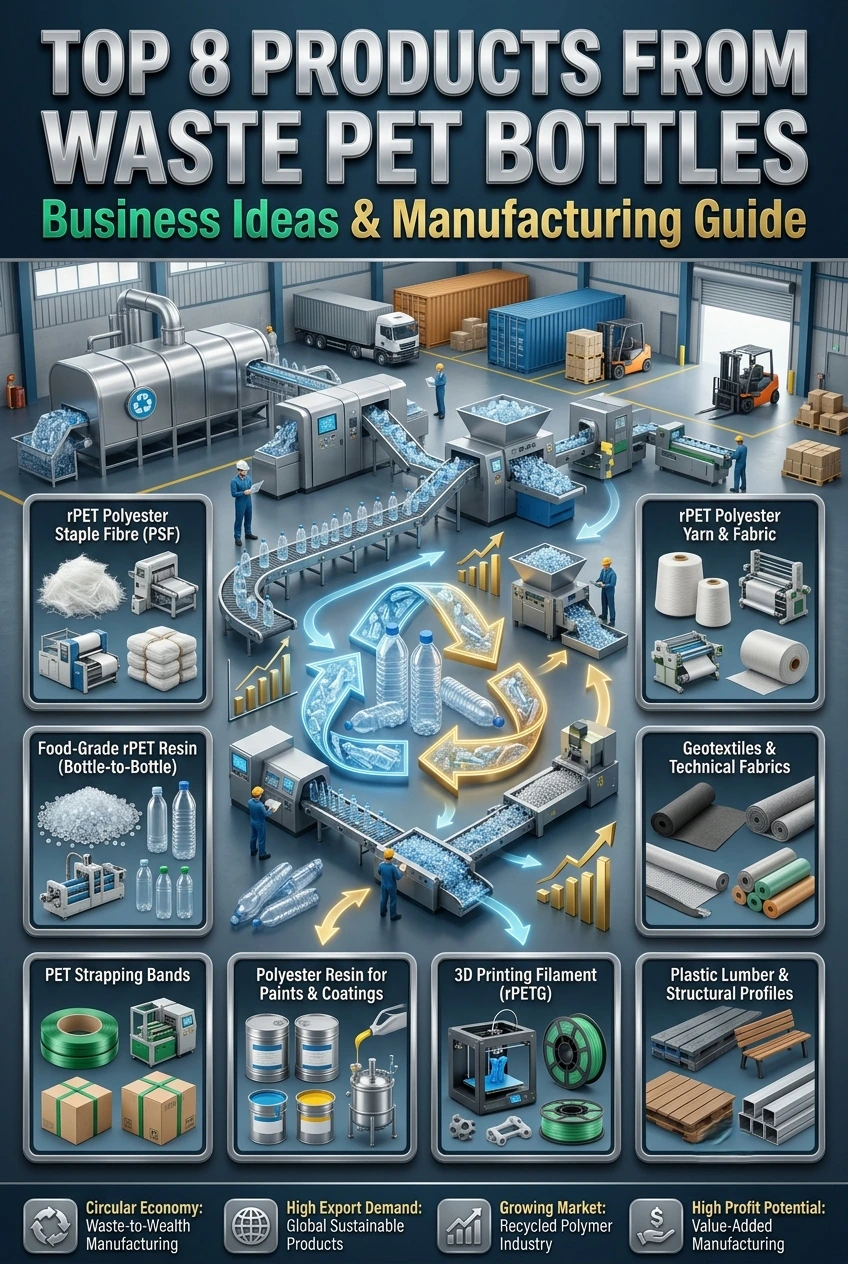
4. Geotextiles and Technical Fabrics
Needle-punched geotextile fabrics used in road constructions, slope stabilisation and soil erosion control are made of rPET fibres. The rPET geotextiles have similar performance to virgin polyester but with a price reduction of 20-30%, which is appealing to infrastructure contractors. Specifying geotextile use is increasing the demand, especially from NHAI and state highway departments. The cost of rPET needle-punch geotextile line is Rs. The value is in the range of 1.5–3 crore and directly serves infrastructure supply chains.
5. PET Strapping Bands
rPET flakes can be used directly in packaging and logistics industry for PET strapping. The use of PET strapping has been largely superseded by the use of steel strapping because it is lighter, it is rust-proof and it does not break on impact. The price of a PET strapping extrusion line is Rs. The cost of 30–80 lakh and produces strapping at Rs. $60,000-$80,000 per tonne — for large domestic packaging and logistics industry.
Get Detailed Project Report (DPR): Plastics, Polymers & Resins Manufacturing Projects
6. Polyester Resin for Paints and Coatings
By performing glycolysis on PET waste, bis-hydroxyethyl terephthalate (BHET) and mixed glycol terephthalate oligomers can be used as polyol for polyurethane foams, alkyd resins and polyester resins in paints and coatings. This is a chemical recycling step which needs more advanced chemistry (Rs.). High value-added chemical intermediates having better margin profiles than mechanical recyclables can be generated (1–3 crore).
7. 3D Printing Filament (rPETG)
These PET flakes can be extruded and spooled into filament for desktop FDM printers, which are usually made in a high clarity varnish. The niche, high value application fetches Rs. 3,000–6,000 per kg of filament versus Rs. A value multiplier of 40–75x 60-80 per kg of input PET flakes. Small-scale production (Rs. The 20–50 lakh price segment is aimed at the budding 3D printing enthusiast, product prototyping, and education segment.
8. Plastic Lumber and Structural Profiles
rPET can be extruded with other recycled plastics and mineral fillers to make structural profiles, boards and panels for outdoor furniture, playgrounds and marine use. These plastic lumber products don’t rot, warp or need painting, as treated wood does. The cost of a mixed plastic extrusion and profiling line is Rs. 80–200 lakh, which is used for municipal infrastructure, school playgrounds and outdoor furniture markets.
Investment and Revenue Summary
| Product | Investment (Rs.) | Output Price | Key Market |
| rPSF (Polyester Staple Fibre) | 2–5 crore | Rs. 60,000–90,000/MT | Pillows, Quilts, Automotive |
| rPET Yarn (Apparel Grade) | 3–8 crore | Rs. 80,000–1,20,000/MT | Fashion Brands, Export |
| Food-Grade rPET Resin | 10–25 crore | Rs. 80,000–1,10,000/MT | Beverage Brands, EPR |
| Geotextile Fabric | 1.5–3 crore | Rs. 80–200/m² | Road Construction, NHAI |
| PET Strapping | 30–80 lakh | Rs. 60,000–80,000/MT | Packaging, Logistics |
| Polyester Resin | 1–3 crore | Rs. 60,000–90,000/MT | Paints, Coatings, PU Foam |
| 3D Printing Filament | 20–50 lakh | Rs. 3,000–6,000/kg | 3D Printing, Prototyping |
EPR Credit Revenue: An Additional Income Stream
India has set annual recycled content requirements for plastic producers under the EPR regulations. They can do this by buying the EPR certificates from registered plastic waste processors. Registered plastic waste processors (PET recyclers) both produce and sell EPR certificates as an additional line of business to direct sale of recycled PET products. The price of EPR has been trading at Rs. in PET.
In recent market transactions, the price of gold has ranged between $3,000 and $12,000 per tonne. If the EPR certificate revenue is to be added to the revenue of 10 TPD plant taking approximately 3000 tonnes per year, the additional revenue could be Rs. Increased core product revenues by 90 lakhs to 3.6 crore per year, thus augmenting the returns of the investments.
Discover business ideas that actually make money
Raw Material Supply and Quality Management
The quality of the PET flakes is the MOST IMPORTANT single criterion affecting the quality & marketability of finished goods made from them. Fibre-grade PET flakes will typically have an IV of 0.72–0.80 dl/g, and the flakes will have a residual moisture level of less than 100ppm following drying, with a L colour reading in excess of 80. Levels of contamination less than 50ppm, and uniform sized flakes (4 – 10mm), with well controlled sorted colours (clear, blue, green bottles) can be achieved through using a combination of color sorting, hot caustic washing (to strip the labels, adhesive, etc.). Entrepreneurs must budget for colour sorting equipment, hot-wash lines, and dryers before the fibre spinning or molding equipment.
Frequently Asked Questions (FAQ)
Q1. What is the EPR credit system and how does it benefit PET recyclers?
Under EPR rules, plastic producers must meet annual recycled content targets by purchasing certificates from registered plastic waste processors. PET recyclers registered as processors generate and sell EPR certificates. Certificate prices for PET have been Rs. 3,000–12,000 per tonne, creating additional revenue above direct product sales.
Q2. What quality of PET flakes is required for fibre spinning?
Requirements of fiber grade PET flakes – IV between 0.72 – 0.80 dl/g, Moisture less than 100ppm post-drying, Colour L-Value greater than 80, contamination less than 50ppm, homogeneous size of 4-10mm. Colour sorting and hot washing are inevitable in processing post-consumer bottles to obtain quality flakes.
Q3. How is PET flake pricing determined?
PET flake prices are linked to virgin PET resin prices (tracking crude oil), with post-consumer clear flakes typically at 60–80% of virgin resin prices. Mixed colour and opaque PET flakes trade at 30–50% discounts. Strong EPR demand is pushing PET flake prices upward.
Q4. What is the minimum viable scale for a PET recycling business?
A washing and flaking unit can start viably at 2–3 TPD (Rs. 30–60 lakh) selling flakes to downstream converters. A fibre spinning line needs 5–10 TPD minimum (Rs. 2–5 crore) to be commercially viable. Higher downstream processing requires larger scale but also delivers higher per-tonne margin.
Q5. Are there export incentives for rPET products?
rPET yarn and fabric exports qualify for RoDTEP benefits. The Synthetic and Rayon Textiles Export Promotion Council (SRTEPC) facilitates export market development and buyer connections for Indian rPET yarn and fabric exporters in European and US markets with recycled content commitments.
Q6. What is the technology risk in PET recycling?
Mechanical recycling of PET (hot wash, flaking, spinning) is mature and low-technology-risk. Chemical recycling (glycolysis, methanolysis) is more complex but also well-proven commercially. The primary business risks are raw material price volatility, contamination quality issues, and polyester market price fluctuations — not technology uncertainty.
How NPCS Helps Entrepreneurs Enter This Sector
Niir Project Consultancy Services (NPCS) offers comprehensive & in-depth Market Survey and Detailed Techno-Economic Feasibility Reports (DPRs) for manufacturing of PET plastic recycling and rPET products. Our DPR’s include details on manufacturing technology/process, project description, market survey, availability of raw material, detailed engineering, civil, mechanical and electrical requirement, financial calculation like cost on machineries & tools, project funding with projected cash and balance sheets with the final calculation on the profitability of the Project.
For entrepreneurs looking to enter waste-based manufacturing, NPCS project reports give you the technical and financial foundation to approach banks, investors, and government agencies with confidence. Visit www.niir.org to explore our full library of waste-based project reports.
Key References and Useful Links
- Ministry of MSME — Government of India
- Make in India — Official Portal
- DPIIT — Dept. for Promotion of Industry
- APEDA — Agricultural Export Development
- NPCS — Waste-Based Project Reports
- Ministry of Environment, Forest & Climate
Conclusion: The Business Case for PET Bottle Recycling Manufacturing
India’s PET recycling sector is at a structural inflection point. EPR regulations have created guaranteed demand for recycled PET. Global fashion and FMCG brands have committed to increasing recycled content targets. The supply of PET waste grows with every new bottle sold. Entrepreneurs who today invest in formal PET-recycling activities are thus building their businesses at the interface between regulation and actual market-need, in an arena of an increasingly plentiful and structured supply.
Early movers in waste to manufactured goods businesses will build ties with raw material suppliers and buyer networks; obtain the approvals needed; and these will be tough to recreate for later entrants. The best time to act on these business ideas is before the sector becomes crowded — and for most waste streams profiled here, that window is still open.